




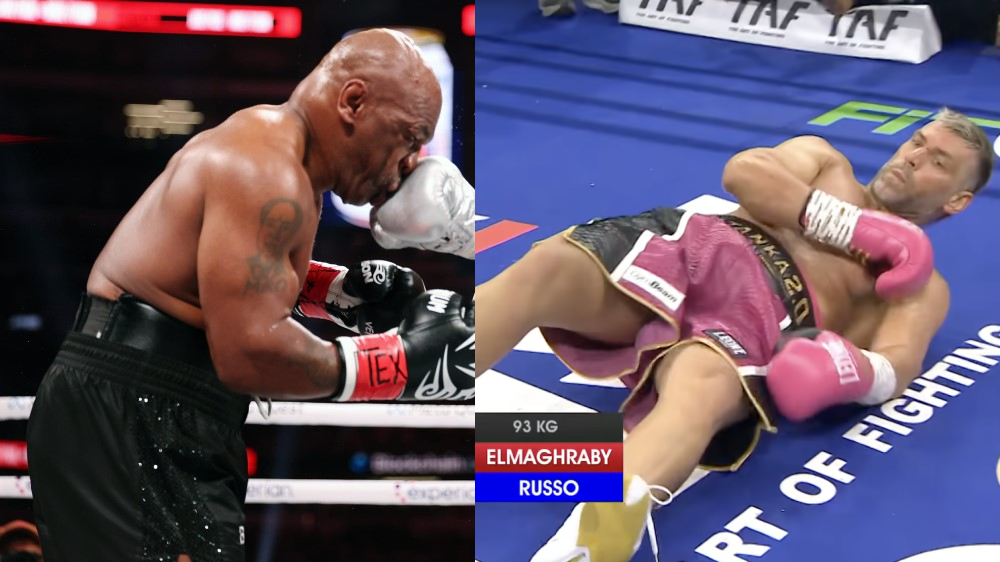
The recent boxing event known as TAF 14, organised by Edoardo Germani at the Allianz Cloud in Milan, featured, as is well known, the return to the ring of an over-40 fighter who had been inactive for a long time and was determined to turn back the clock. Clemente Russo, who suffered a heavy defeat after a performance best forgotten, is certainly not the only example of this kind. From Mike Tyson to Oliver McCall, from Mikkel Kessler to Hasim Rahman, not forgetting Ike Ibeabuchi, a great many boxers have sought one last hurrah in recent years. But what risks lie behind these late-career comebacks?
The Motives Behind Late Comebacks
The reasons behind the high-profile comebacks we have mentioned are fairly easy to understand. A former boxer almost always retains an appetite for the adrenaline rush he once experienced when stepping into the ring. After a prolonged absence from the squared circle, he may find it difficult to resist the desire for one more emotional high. The general public, on the other hand, is naturally nostalgic and struggles to accept that it can no longer enjoy the exploits of its former heroes in real time. These two complementary desires appeal to promoters’ business instincts, and understandably so: they are quick to seize the opportunity to organise events with considerable media appeal.
Of course, not all comebacks are the same. In the cases of Tyson vs Paul and Russo vs Elmaghraby, albeit on very different scales (international in the former case, domestic in the latter), the fights generated curiosity, attention and plenty of publicity. In Hasim Rahman’s case, however, his return in front of barely a dozen spectators, amid general indifference, appears to have been driven more by psychological needs on the part of the former champion.
The Warnings Issued Ahead of Mike Tyson vs Jake Paul
The Mike Tyson vs Jake Paul fight attracted worldwide attention and sparked some interesting debates on the subject. Concerns about the risks the unforgettable Iron Mike might face by taking part in a professional bout at the age of 58, after a rather undisciplined lifestyle, prompted several doctors to look into the matter and share their views publicly. The fight itself ultimately turned out to be more like a gentle sparring session than a battle, but the statements made by specialists ahead of the event remain interesting, as they address general principles that can be applied to any boxer.
Dr Nitin Sethi, a neurologist at NewYork-Presbyterian Hospital’s Weill Cornell Medical Center, expressed his views in an interview with Kieran Mulvaney of BoxingScene:
“What I personally believe is that as you get older, it takes a longer time to recover from a concussive head injury as compared to when you are younger. […] While we all talk about the acute neurological injuries in boxing […] what we forget is that it’s like a pyramid. The vast number of neurological injuries are chronic and hidden. It’s like an iceberg. […] That’s why I think age becomes a big factor, because punches do add up.”
Similar considerations were put in writing by Dr Stephen Hughes, an emergency medicine specialist and Senior Lecturer at the School of Medicine at Anglia Ruskin University. He published an article on the university’s own website highlighting the critical issues associated with competitive boxing beyond a certain age. Here is a brief excerpt:
“In older people, the brain tends to lose volume. This lengthens the bridging veins and makes them more vulnerable to rupture. […] Middle age sees an increase in the likelihood of cardiac events such as arrhythmia (irregular heartbeat), angina (reduced blood flow to heart muscles), and myocardial infarction (heart attack).”
More Than Just Individual Opinions: Scientific Literature Confirms the Risks
The views expressed by Nitin Sethi and Stephen Hughes are not isolated opinions, nor are they simply the product of the authors’ personal concerns or excessive caution. The fact that age and inactivity considerably amplify the risks associated with professional boxing is well established in the scientific literature, and is supported by several research papers published in reputable journals.
A 2024 paper specifically addressing combat sports athletes over the age of 35, published in The Physician and Sportsmedicine, an international sports medicine journal, and co-authored by Italian-Swiss researcher Davide Bianchi, contains the following passage:
“Age-related changes to the neurological, cardiopulmonary, endocrinological, thermoregulatory, osmoregulatory, and musculoskeletal systems increase these athletes’ risks for injury and may prolong their recovery. […] Neurological considerations include increased risk of intracranial lesions, intracranial hemorrhage, and sequelae from traumatic brain injury (TBI), warranting more comprehensive neurological evaluation and neuroimaging.”
The conclusions of this paper, together with those of many other studies on the subject, helped inform a Consensus Statement published in the Clinical Journal of Sport Medicine in 2026 and signed by thirteen authors. The document sets out criteria for identifying combat sports athletes who face a significantly higher risk of injury and mortality. Once again, these include age and prolonged periods of inactivity.
To Ban or Not to Ban? That Is the Question
Given that professional boxing becomes progressively more dangerous as a fighter moves further away from his youth, and that lengthy periods away from competition can further increase the risks, how should regulators deal with a former boxer who wants to return to the ring?
Dr Sethi, already mentioned above, is reluctant to recommend an outright ban. He understands the desire among boxers to continue doing what has been their everyday occupation for so many years: the activity that has allowed them to support themselves and their families while also bringing them recognition and personal fulfilment. Instead, he proposes tightening medical protocols by dramatically increasing the number of cardiovascular and cognitive tests required of boxers over the age of 40, even going so far as to suggest that the relevant commission should visually review footage of their training sessions.
We do not know what the right course of action is. Boxing, like other sports that receive less criticism in terms of public image, exposes its participants to an unavoidable degree of risk. It is not easy to determine where regulations should draw the line in order to strike the best possible balance between preserving the nature and distinctive characteristics of this ancient sport and protecting the health of those who take part in it.
What we are convinced of, however, is that those entrusted with setting the rules of the game also have a moral duty to avoid ambiguity, preferential treatment and contradictions of any kind, and to take responsibility for their decisions. From this standpoint, I can say without hesitation that I do not like the way the Italian Boxing Federation (FPI) has acted, and continues to act. By setting an age limit of 40 for obtaining a professional boxing licence, while at the same time allowing Italian boxers to apply for one abroad and then fight freely at domestic events, the FPI is effectively shifting onto others the responsibility for deciding who should be allowed to fight and who should not — a responsibility that should fall squarely on its own shoulders.