




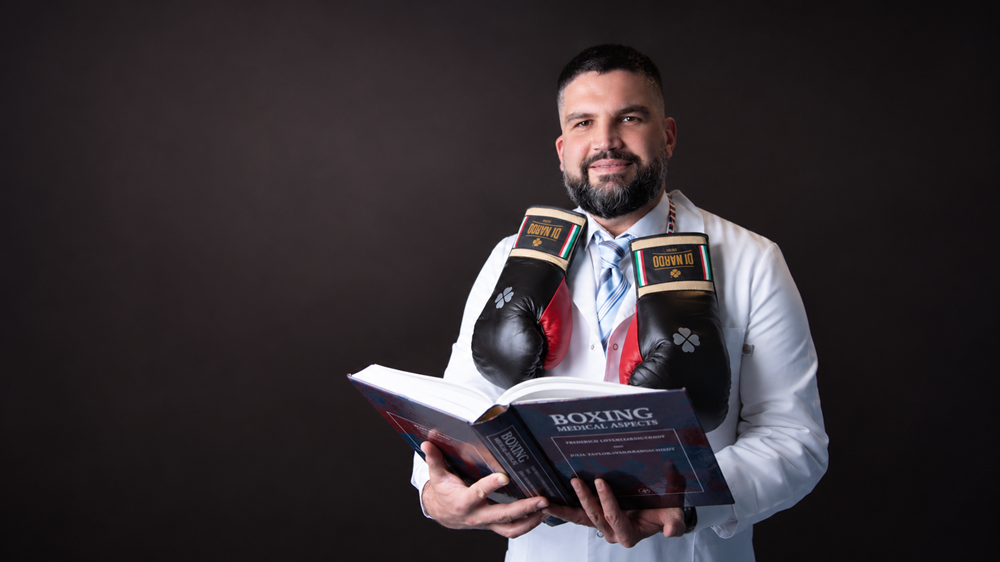
The world of boxing is made up of many different figures, each with their own expertise, professionalism and specific responsibilities. Boxers are naturally the most visible, because their punches, defensive skills, ability to absorb punishment and capacity to manage the pace of a fight determine victories and defeats. However, alongside them are many other key figures who play an equally crucial role in guiding a career towards success.
One particularly fascinating role is that of the manager, the person responsible for looking after a fighter’s interests in order to secure the best opportunities and the highest possible earnings. To learn more about this subject, we contacted Davide Bianchi, who works as a manager for numerous boxers in Italy and abroad, helping guide them towards achieving their goals.
Davide spoke to us about his work, explained how his collaboration with two highly promising Italian prospects, Abbes Mouhiidine and Salvatore Cavallaro, came about, and shared his thoughts on what needs to change to improve the prospects of Italian boxing. Here is our conversation.
In Italy, when people talk about boxing, they talk about promoters, fighters, trainers and sometimes matchmakers, but almost never about managers. What exactly are the responsibilities of a boxing manager, and how did you come to take on this role?
That’s an absolutely relevant and intelligent question, because in Italy we’re used to everyone doing a bit of everything. You have an uncle or a friend acting as your cutman, manager, matchmaker, promoter and so on.
A professional boxing manager, in the American sense of the term, is essentially someone who looks after the boxer’s interests, even when that means going against the promoter’s interests if necessary. He helps develop the fighter’s career, manages sponsorships and public image, offers advice on physical conditioning and technical preparation, and handles external relations.
Therefore, he needs to be someone who travels, speaks foreign languages and has strong international connections.
How did I become one? Through a long apprenticeship, combining some of my professional skills with a great passion for boxing. I spent a lot of money on travel and experiences, working first with ordinary boxers and later with champions. Eventually, after many years, all that experience allowed me to put what I had learned to good use.
Speaking with several prominent figures in Italian boxing through our interviews, we have often recorded thoughts similar to the one you just expressed regarding the anomaly of boxers whose managers are the promoter’s son, nephew, lawyer, and so on, with everything that entails. How do you explain the fact that things work this way in Italy? Is it a cultural thing?
I don’t think it’s cultural. Italy is a wonderful country, but there’s this tradition that’s difficult to eradicate.
For example, that doesn’t happen with Team Magnesi, where Alessandra Branco is the promoter while I am the team’s manager, and we have no family ties whatsoever, as should normally be the case.
Now, I don’t want to get into the details of situations where the manager and promoter belong to the same family, because it’s not my place to comment on those choices. However, I believe that conceptually these are two different roles, even roles that can be fundamentally at odds with each other.
How many boxers are currently under contract with you?
About fifteen.
Let’s turn to one of your most recent professional ventures: managing two emerging talents on the Italian boxing scene at the same time, Abbes Mouhiidine and Salvatore Cavallaro. Both spent many years representing Italy on the national amateur team before turning professional with great ambitions. How did you first get in touch with them, how did your professional relationship develop, and what expectations did you have when you started guiding their careers?
As many people know, I’m a federation doctor for two Olympic teams, including Switzerland’s. I’m Swiss-Italian and I’ve lived in Switzerland for many years. So, when major international tournaments have taken place in recent years, such as the World Championships, Olympic qualifying tournaments and so on, I’ve attended them representing Switzerland.
Naturally, having been born and raised in Italy, I came into contact with several members of the Italian national team, including Abbes, Cavallaro and others.
That’s how the relationship began, over a cup of coffee. From there, we started talking, developed a mutual liking and built mutual trust.
I’ve also been a huge admirer of Abbes for a long time, regardless of my role as his manager. I’ve always believed he has extraordinary technical and athletic potential, enough to compete at a high level in professional boxing.
So, when the opportunity arose, I wanted to offer him a professional career backed by a major sponsor supporting my work. This is a sponsor that allows me to manage the resources as I see fit, without instructions being imposed from above, so I was able to present the young man with an ambitious project.
Salvatore then joined the team as well. Giovanni Cavallaro has been very close to Abbes’s team for many years; they’ve been friends for a long time. So he asked whether I would also be interested in his son, and I said yes. He’s a very talented young man, a World Championships bronze medalist and an excellent amateur boxer, so why not? Let’s give it a try!
That’s how everything started.
After Salvatore Cavallaro won the WBC Mediterranean title, we read your Facebook post in which, besides expressing pride in the achievement, you wrote that it would be your last trip to Sicily, suggesting that your working relationship was coming to an end. Can you explain why you decided to part ways?
Let’s say that when I agreed to manage these two young men, I expected much more, even though we won a Mediterranean title within a year, which is no small achievement.
Salvatore is a wonderful young man, and I want to emphasize that. He’s a genuinely good person, very serious and responsible, but he places his trust in his father.
If you’re managing someone, you should have complete freedom to do your job, and that wasn’t always possible.
His father Giovanni got involved in promoting boxing events, and the two of us probably had different visions, both strategically and technically: me as the manager and him as the promoter.
So, once Salvatore had won the title, I preferred to terminate the contract a few months early and leave him free to pursue other opportunities.
Ultimately, a contract should be a sort of partnership, almost like a marriage. It shouldn’t be an obligation that forces you to remain tied to a particular manager. So, if the two parties have different plans, it’s only right that each should go their own way.
What can you tell us about Abbes Mouhiidine’s professional career so far?
With Abbes, the situation is a little different.
We made a very strong start together. We had two wonderful fights, truly wonderful performances. He was already very high in the rankings for someone who had only recently made his professional debut.
However, because of administrative issues, he was unable to fight for several months. There was a hold-up that had nothing to do with me.
He hasn’t fought since February 15, and we’re now at the end of October. An eternity has passed, and I’ve therefore been unable to carry out my project.
I had hoped to reach the end of the one-year contracts I’d signed with Salvatore and Abbes, or renew them, while celebrating two, three or four titles. Unfortunately, I wasn’t able to do that, through no fault of my own.
So, given the circumstances, I preferred to give both young men their freedom.
If the issues that are keeping Abbes out of the ring were resolved, do you think it would be possible to resume your working relationship with him?
It would be a great pleasure and a great honor for me. He’s a fantastic young man, and I also have an excellent relationship with his trainer, Gennaro Moffa, to whom Abbes is very close, not least because he’s also his uncle.
So, if things get sorted out, and sooner or later they will have to, I would certainly be willing to talk to him.
With Salvatore, I don’t think so, but I say that with the utmost respect and friendship. Quite understandably, he’s very close to his father and relies on him as his promoter.
They want to follow a different path, so I don’t think the conditions for working together are there anymore. As things stand, the necessary conditions simply aren’t in place, and I say that without any criticism or negativity.
Finally, we’d like to ask for your assessment of the prospects for Italian professional boxing. After going through a very difficult period, the sport seems to have shown some signs of revival recently. Are you more optimistic or pessimistic about its future? Where do you see Italian boxing in five or ten years’ time?
I believe in Italian boxing without any doubt, because that’s where I was born and where I’m working.
However, I think that nowadays it’s difficult to promote and support champions without substantial outside sponsorship. So we need to create a system that excites the public and attracts investment.
I was able to offer Cavallaro and Mouhiidine an ambitious project thanks to Justmeben, a British company I had already worked with many years ago. Because they know me, they made significant funds available to me so that I could carry out my work.
It’s a sponsor that supports me in every decision and gives me complete freedom. But if my vision differs from that of the trainer or promoter, and if the boxer chooses to move in a different direction from the one I’ve outlined, the sponsor withdraws its support.
That’s because, quite rightly, they trust my expertise and finance the project on the understanding that it will proceed according to my guidance.