




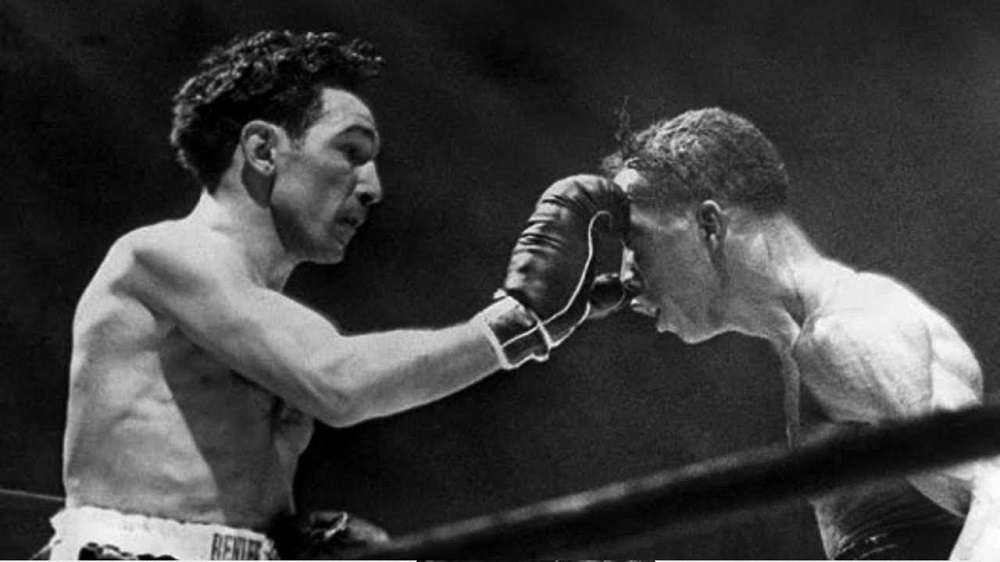
He was elusive, virtually impossible to hit, irreverent in both manner and speech: Willie Pep, born Guglielmo Papaleo, was an extraordinary boxer. In the opinion of many, not only the greatest featherweight of all time, but arguably the greatest boxer ever.
“They call Ray Robinson the best pound-for-pound fighter. I’m the best ounce-for-ounce fighter”: these words perfectly capture Willie Pep.
In 1946, ahead of his fight against Jackie Graves, Willie made a bet with sportswriter Don Riley that he could win a round without throwing a single punch. This is how Riley described that round: “For three minutes Pep moved, taunted, danced around and clinched with Graves – but never threw a punch. It was an extraordinary display of defensive boxing, so skillful, so crafty, so subtle that the 8,000 roaring fans never realized that Pep’s tactics were entirely devoid of offense.” He won that round. Although the story has taken on legendary proportions over the years, individual photographs and short video clips of the round do exist: in every one of them, Pep simply mocks his opponent while dodging every punch thrown his way.
Born on September 19, 1922, in Middletown, a small town in Connecticut with a large population of Italian immigrants, Pep learned to fight at an early age to defend his shoeshine box in the tough neighborhoods of Hartford, the state capital, where he lived with his Sicilian-American family.
Pep was a tiny kid, as he himself enjoyed recalling: “I weighed about 90 pounds soaking wet,” he would say. “I didn’t know anything about boxing. I was just a kid. But I knew enough about how not to get hit.”
In 1937, Pep began his amateur career. These were the years of the Great Depression, and in Connecticut amateur boxers were allowed to fight for money. For the young shoeshine boy, the opportunity to earn a decent living by boxing every Friday night seemed almost too good to be true.
In 1938, in the attic of a feed store, Willie found himself facing a boxer from New York who was dismissed as a no-hoper by someone who had absolutely no idea who that young African American fighter really was. Pep quickly recognized the newcomer’s skill. The boxer had traveled from another state specifically for the money and was fighting under an assumed name. That night, Pep suffered a unanimous decision defeat against a very young Sugar Ray Robinson, putting up a good performance despite giving away almost 26 pounds.
He turned professional in 1940 and quickly attracted widespread attention with a streak of 63 consecutive victories, including his October 1942 win over Chalky Wright for the world featherweight title, at just 20 years of age.
In 1943, he faced lightweight Sammy Angott, and Pep allowed himself to be drawn into what became a barroom brawl, playing into the hands of his opponent, who was taller and considerably heavier. Just ten days later, he was back in the ring, embarking on an astonishing run of 72 victories and one draw.
During World War II, Pep continued his boxing career while serving in the United States Navy, from which he was discharged due to a perforated eardrum. He recorded another 43 victories, but in January 1947 he was involved in a serious plane crash, suffering a broken back and a broken leg. Despite the severity of his injuries, he recovered remarkably quickly and returned to the ring with the same fighting spirit.
His rivalry with Sandy Saddler is legendary. Saddler was a fighter with a sharp, accurate punch and a longer reach. Their first encounter, in 1948, resulted in the second defeat of Pep’s career. Once again, Willie made the mistake of getting drawn into a brawl and was knocked out in the fourth round. The two met again just two months later, and Pep managed to exact his revenge, fracturing Saddler’s jaw and winning on points. However, he risked serious damage to his eyesight because of the severe cuts he sustained.
They met for a third time in 1950 in front of 39,000 spectators. Despite a great fight, Pep was forced to retire due to a badly dislocated shoulder. A year later, they faced each other once again in a fight so brutal, more like an unrestrained beating than a boxing match, that Saddler was suspended indefinitely, while Pep had his boxing license revoked for 17 months. Saddler won, but the verdict remained controversial for a long time.
Over the course of his professional career, Pep fought a total of 241 bouts, losing eleven and drawing one.
Behind the story of a ring virtuoso lay the many twists and turns of an intensely lived life: six wives, a passion for gambling and horse racing, a constant need for money that drove him to fight at an extraordinarily high frequency, and even an arrest for illegal gambling.
He first retired in 1960, but returned to the ring in 1964 for a handful of minor bouts. He finally called it quits in 1966, with these words: “A boxer’s decline? First you lose your footwork. Then you lose your reflexes. Finally, you lose your friends.”
He faced Alzheimer’s disease, which struck him years later, with the same irreverent spirit. When a doctor pointed out to his sixth wife, Barbara, that the blows he had taken in the ring were responsible for his brain damage and illness, Pep replied: “But darling, I’ve never been hit!”
He died on November 23, 2006, at the age of 84. Today, on the twentieth anniversary of his death, we like to remember him in the ring, elusive and cheeky as he always was, both inside and outside it.