




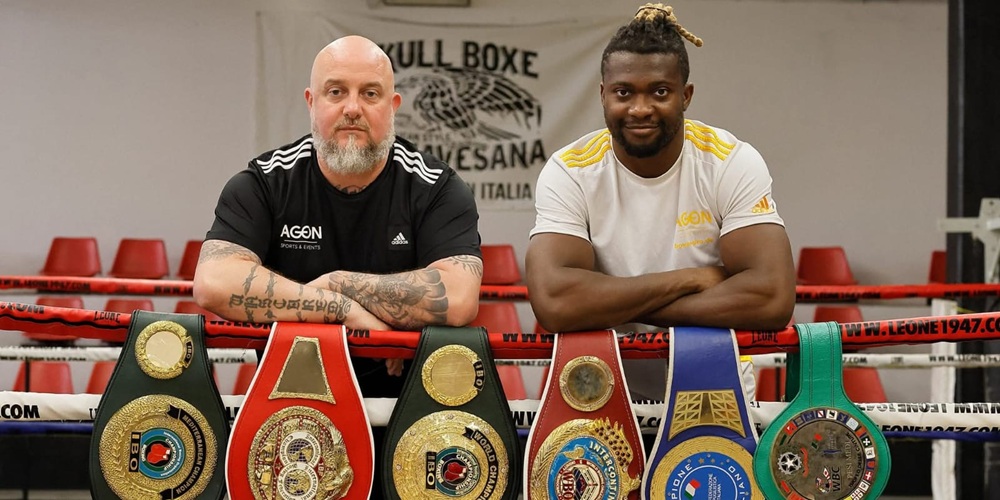
It has been just over three weeks since the Dublin bout for the IBF World Middleweight Title, in which our own Etinosa Oliha, accompanied by his longtime coach Davide Greguoldo, unsuccessfully attempted to defy the bookmakers’ odds against local hero Aaron McKenna.
After allowing the dust to settle, we at Boxe Punch got in touch with coach Greguoldo, who kindly agreed to a long and enjoyable phone conversation. He spoke openly and in considerable detail about the tactical, technical and mental aspects that characterized the unfortunate trip to Ireland.
Here is the full interview, which also touches on Alessio Lorusso, another outstanding boxer coached by Davide, before concluding with a wide-ranging and thought-provoking discussion of the reasons behind the gap between Italian professional boxing and the sport as it is practiced more successfully in other countries around the world.
Let’s immediately address the hot topic that has dominated discussions among Italian boxing fans over the past few weeks: the Dublin fight between Aaron McKenna and Etinosa Oliha, which ended in disappointment for Italian boxing. What do you think went wrong?
We had a fairly unavoidable tactical plan. Going to Ireland to fight an Irishman who, on top of that, is a very good boxer, meant that we necessarily had to fight a high-work-rate fight and try to close the distance.
What I can say is that McKenna did a very good job of exploiting his strengths and forcing us into a difficult kind of fight. He clinched very cleverly at close range to prevent Eti from unloading his punches. Eti certainly became a little frustrated because he is a boxer who is used to dictating the pace. McKenna, however, was very good at completely turning that situation around.
The problem is that if we had gone there and fought cautiously against a boxer with that kind of reach, the fight would still have gone his way.
Perhaps the fact that we were told the day before that there would be an Irish referee in the ring did not help us mentally. We knew that the three judges would be Polish, Irish and Italian, so we were comfortable with that aspect. But the day before the fight, when the gloves were being selected, we found out that the referee was Irish. It probably would not have changed anything because McKenna boxed well, but perhaps that information affected Etinosa slightly on a mental level. From the ring, I could see that he was frequently calling us out when McKenna was the one doing the clinching.
But this is not an excuse. That is not why we lost the fight, absolutely not. In my opinion, the other guy was simply better. You don’t always have to find a particular reason for a defeat. I think McKenna was better than us that night and took the fight where he wanted it to go. He did the right work at long and mid-range, and whenever he had the opportunity, he loaded up on his punches. His footwork also made things difficult for Eti.
Perhaps we were not good enough at changing our tactical plan quickly enough during the fight, although, as I said, we didn’t have many alternatives: we had to fight an attacking fight. I believe Eti put his heart into it. He was always proactive.
On that note, I’d like to ask your opinion about the words of former world champion Patrizio Oliva, who was quite harsh in his criticism of Oliha, accusing him of not having had “the eyes of the tiger” and of being content simply to make it to the final bell. What do you think?
I don’t think that’s the case. Eti tried. Unfortunately, perhaps when he realized that the fight was slipping away from him, he became a little demoralized. But I saw Eti constantly looking for the confrontation. He wasn’t circling the ring trying simply to survive and make it to the end. He was always trying to get closer to his opponent. He tried to fight, but McKenna did his job well.
In my opinion, you also have to acknowledge when the other guy was better.
It had been decades since an Italian had challenged for a world middleweight title with one of the major boxing organizations such as the IBF. Just getting there, with such a major promotion as Zuffa Boxing and such a huge production, was already a privilege. I believe the motivation was absolutely there. It’s not as though you get there and decide to settle for that: at that point, you give it everything you’ve got.
Eti has never had fights where he was content simply to get through them. He was very disappointed that he couldn’t express himself, that he couldn’t do what he wanted to do.
That said, Patrizio was a great champion, so he will certainly have his reasons. But I never read comments on social media because I always say that you have to be there: you have to be on site and see what is happening at that particular moment, understand the situation. Everything looks easy from home, but when you’re actually there, it only takes a little thing for everything to change.
Compared with his early days as a professional, Etinosa has undoubtedly undergone considerable development, but it wasn’t enough to fulfill his dream of becoming world champion. Do you think the young man still has room for improvement? If so, in which areas?
I think he can grow in terms of experience. I believe this fight, despite ending in defeat, will be useful to him. Sometimes a defeat can help you grow more than a victory, even though obviously it’s disappointing that it came when a world title was at stake.
He will certainly continue to improve a great deal from a mental standpoint. I’m sure that if we can improve a few small aspects — from ring management to his ability not to get frustrated and to remain a little more composed and precise in certain situations — he will get another world-title opportunity.
Maybe it will be with another organization, but we’ll certainly get another chance because he is a solid and determined boxer. He’s not someone who goes into survival mode or simply tries to make it to the final bell for the sake of it. He’s always been a proactive boxer, so I believe that by improving a few aspects he will certainly achieve more important things.
This setback means Oliha will have to climb back up the rankings if he wants to return to the top. Have you already thought about your next moves?
Right now he definitely needs to switch off for a while because, in addition to this training camp, he had already gone through two other camps that ultimately didn’t lead to a fight. I think that also contributed to making the situation difficult. He had been inactive for a long time, and perhaps having a tune-up fight in between would have helped him be a little looser on the day of the world-title fight.
Unfortunately, when we went to Texas, we discovered an eye problem and didn’t fight. Then we started preparing to face Shakiel Thompson, but that fight didn’t happen because he was knocked out in England.
So now Eti is a little worn out from all these training camps and needs to take a break. At the same time, we have to avoid staying inactive for too long again.
AGON, his promotion, has already contacted us and plans to have him fight over eight rounds between February and March.
Among the fighters you coach is also the talented Alessio Lorusso, who two months ago put on a tremendous performance, beating former world champion Alexandro Santiago on points. What was the key to the successful tactics that night, and how far do you think Alessio can go?
The whole team did a very good job preparing for the fight, including finding sparring partners with the same characteristics as Santiago. That required a significant investment both from his manager and from Alessio himself.
Unfortunately, in Italy we sometimes have difficulty finding high-level sparring partners. In my opinion, that is one of the reasons why we struggle to close the gap with other countries.
Alessio was very intelligent. We worked extensively on what he needed to do in the ring. Let’s say that Santiago’s characteristics suited Alessio’s style well, because Alessio is someone who times you and is very mobile on his feet. He exploited that characteristic extremely well, and then turned things around by attacking himself.
There was also a great deal of physical preparation, as always, because he is very meticulous in that regard.
Tactically, we knew that Santiago, being a good Mexican fighter, would come forward looking for a confrontation, and Alessio was excellent at neutralizing him with counters and movement. We worked extensively on changing direction. We tried to confuse him, to stop him with a controlling shot as soon as he showed an intention to come forward, and then put combinations together after moving out of the way.
Alessio was brilliant at putting all of this into practice, and I believe this victory has put him in a very favorable position. I think that now, having defended the IBO Intercontinental title twice, he should be given his IBO world-title opportunity.
Then I believe Alessio is easily good enough to fight for a European title, which he has already won, and that he could also compete in a world-title semifinal with another organization.
Right now he can do whatever he wants because he is full of confidence. So I hope that whoever is in a position to make the decisions strikes while the iron is hot.
You developed part of your knowledge by studying the training methods of a top-level coach like Freddie Roach and then refining them through experience. You therefore have a fairly clear idea of how boxing works at the highest international level. In your opinion, what are the most important changes that would be needed in Italy for our fighters to become competitive again on the biggest stages of professional boxing?
This is a somewhat complex issue. Sometimes it seems as though everyone has a solution, but in reality I think it’s very difficult. We have allowed professional boxing to decline in Italy for too long, and now closing the gap with the Americans or the British is an extremely difficult task.
I’ve been fortunate enough to work extensively in the United States. I also did a training camp there with Eti because he had been selected as Badou Jack’s sparring partner when Jack was preparing for his world-title fight against Jean Pascal. We did the entire camp at Mayweather’s gym in Las Vegas.
The biggest problem is that when they start a training camp, they have financial backing that allows them to do everything at the highest level, from selecting sparring partners to training methods. They have substantial budgets provided by their promotion, and that’s something that simply doesn’t happen in Italy.
In Italy, your manager calls you and says, “You’re fighting on such-and-such a date against such-and-such an opponent,” and that’s basically where it ends.
We realized this even while working with AGON Sports. They tell us where and against whom we’re going to fight, and then they ask us, “Where do you want to do the physical preparation?”
“Granada, at 2,300 meters, because we want to train at altitude.”
And they send you there.
“How many sparring partners do you want?”
And so on.
I think our coaches and our boxers are exactly like British and American coaches and boxers. We have nothing to envy them for, especially because we had our own golden era. But ultimately, the biggest gap is financial.
The problem is that we can’t put an athlete in a position to train like a Serie A footballer, as they do.
Here, if you train at your own gym, you don’t have high-level sparring partners, or you have to go out and find them yourself. On top of that, we have boxers in Italy who work and then train.
When you compete against someone who does nothing but box, it’s normal for the other guy to win: there is no real competition because they’re essentially practicing two different sports.
Our great champions of the past, from Stecca to Duran and many others, were professional boxers in the truest sense. Today, a young guy goes to work in a factory, then has to find time to go to the gym, follows a do-it-yourself diet…
Unfortunately, many people are against weight cutting. I would probably tell you that it would be better if it didn’t exist either. But if it’s currently allowed and you can do it, and you want to compete with the very best, you have to adapt. Otherwise you end up fighting guys who step into the ring two weight classes above you.
But to do that properly, you need a qualified nutritionist, and that’s another expense.
Foreign promotions also put us coaches in a position to work as full-time coaches. Quite rightly, if your coach works in a factory and doesn’t finish until seven or eight in the evening, you have to arrange when you can meet at the gym around his shifts, and it becomes complicated.
And these things eventually show up on fight night.
It’s also difficult for someone competing for an important opportunity to deal with the pre-fight period. In just a few days you’re constantly being shuttled between interviews, press conferences, public appearances and appointments, and when you experience that world for the first time, it can be overwhelming.
Even Andra Locatelli, who came to Dublin representing the Italian Boxing Federation (FPI), told me, “I’d never seen anything like this,” referring to the organization.
You had nutritionists preparing your meals at any time of day or night. You called and had a physiotherapist available exclusively for you.
When you arrive there, you feel like a footballer who has always trained on a small pitch in Asti and then suddenly finds himself playing a match at the Bernabéu. It leaves you disoriented.
If you had the opportunity to take part in events like that on a regular basis, you would arrive better prepared for the opportunity of a lifetime.
They’re small things, things you might not think about individually, but when you put them all together at the highest level, they can make a difference.