




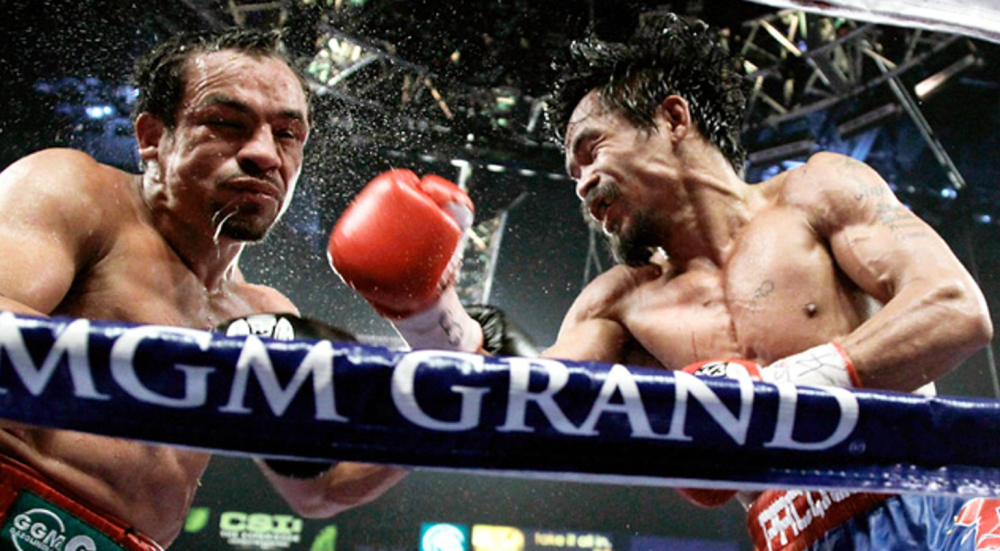
LAS VEGAS — In the end, the long-awaited trilogy delivered yet another controversial verdict. Manny Pacquiao retained his WBO welterweight title. Juan Manuel Marquez, however, left the MGM Grand ring convinced, like many observers, that he had been robbed.
The prelude: a rivalry born from a draw and fuelled by discord
To understand the third chapter, we need to rewind the tape. In May 2004, the two first met at featherweight. Pacquiao knocked Marquez down three times in the opening round alone, but the Mexican got back up each time, shifted gears and battled his way to a draw that many considered generous to the Filipino. To compound an already highly controversial verdict, one judge mistakenly scored the opening round 10-7 in Manny’s favour instead of the 10-6 required for three knockdowns. Without that scoring error, Manny would have won by split decision.
Four years later, in 2008, came the rematch, this time at super featherweight. Pacquiao won by split decision, once again by a narrow margin, despite scoring a knockdown against Marquez in the third round. Two verdicts, no certainty, a thousand controversies.
Marquez entered the third instalment with the feeling that he had never really lost to Pacquiao, and wearing a provocative T-shirt bearing the words: “We Were Robbed” in large letters.
The technical analysis: the same old nemesis
Stylistically, the fight reaffirmed a truth that had been evident for years: Marquez was Pacquiao’s perfect foil. The Mexican was an extraordinary counterpuncher, capable of reading the Filipino’s angles and neutralising him with his impeccable timing, at times making him look like an ordinary fighter. And Manny was anything but ordinary. Phenomenal is the first word that comes to mind: describing his boxing style would require an entire chapter of its own. Yet, despite his qualities, his speed, his blistering pace and his combinations, against the Mexican his aggression often translated into punches hitting thin air, an evident struggle to find his way through the fight tactically, and a palpable sense of caution that curbed his natural exuberance and, consequently, his effectiveness.
Throughout the fight, the two men slipped into their familiar roles: Manny as the aggressor, JuanMa as the counterpuncher, waiting for his opportunities. The script was largely the same, with a brief reversal of roles in the third round, when the Mexican came forward aggressively, only to be punished several times by Manny’s counterpunches, particularly his right hook and straight left.
Having reverted to his original approach, Marquez resumed moving around the ring, neutralising most of Pacquiao’s attacks and showcasing his extraordinary timing. The jab, but above all the straight right hand, began to land with regularity: powerful right hands, not merely scoring punches thrown to build up volume but lacking real effectiveness.
I vividly remember thinking, time and again, that Manny was too square in his stance and consequently kept falling victim to the Mexican’s superior boxing skills. The jab slowed his advance, while the right hand was always there, ready to punish the slightest mistake: an overly predictable attack on the way in or even the slightest hesitation. Even in close-range exchanges, JuanMa’s superior accuracy was evident.
The volume of punches seemed to favour Manny, at least in my eyes, far more than his actual merits warranted. Even when the Filipino’s punches landed, they often appeared to lack power, partly because of his imperfect balance and probably because he needed to readjust his body position to avoid Marquez’s counters. Moreover, his attempts to break through with the straight left were read far too easily by the Mexican, who was adept at slipping underneath the incoming punch and tying Pacquiao up to prevent further attacks.
That is not to say the Filipino didn’t have his moments. Overall, the fight remained finely balanced for long stretches, with rounds that were difficult to score and numerous attacks that were either aborted or simply nullified by the footwork and defensive skills of both men.
What criteria should be used to judge a fight? The more aggressive fighter, the one who throws the greater volume of punches, or the one who appears more effective, landing the more dangerous and harder shots?
Boxing has debated this question for years, and the conventional approach has been to favour the higher punch output, simply because it can be quantified, unlike the power of a punch, which is impossible to measure objectively and inevitably comes down to what we might call subjective impression.
And yet, in this particular fight, over the course of twelve rounds, Marquez gave the impression of being in control of distance and pace, while also landing the more dangerous shots, despite having a lower work rate. At least, that was my reading of it.
The result and the controversy
At the final bell, the scorecards read 114-114 (Robert Hoyle), 115-113 (Dave Moretti) and 116-112 (Glenn Trowbridge), all in favour of Pacquiao: a majority decision victory. The verdict unleashed the fury of some members of the MGM crowd, who showered the ring with cans, bottles and all manner of food.
Marquez didn’t even show up for the post-fight press conference. He left the arena furious, calling it a “second robbery”, and the worse of the two. Pacquiao, for his part, offered a rather laconic statement: “My fans are happy because they know I won fair and square. It wasn’t easy, my opponent is tough, but in the end I still won.”
Now, let’s be absolutely clear: Manny didn’t steal anything. His higher volume of landed punches was an indisputable fact that ultimately worked in his favour, as did his willingness to take the initiative. And opinions on the fight remain divided to this day, with some believing one man won and others favouring the other.
Three fights, three disputed verdicts, no definitive answer. The Pacquiao-Marquez trilogy failed to establish who was the better fighter and, arguably, neither did the fourth instalment, despite Marquez’s spectacular knockout of the Filipino. Because a knockout, however emphatic, ended a fight but not a rivalry. That punch determined who hit the canvas that night, not who was the better fighter. And if three verdicts weren’t enough to settle the debate, neither could a single punch.