




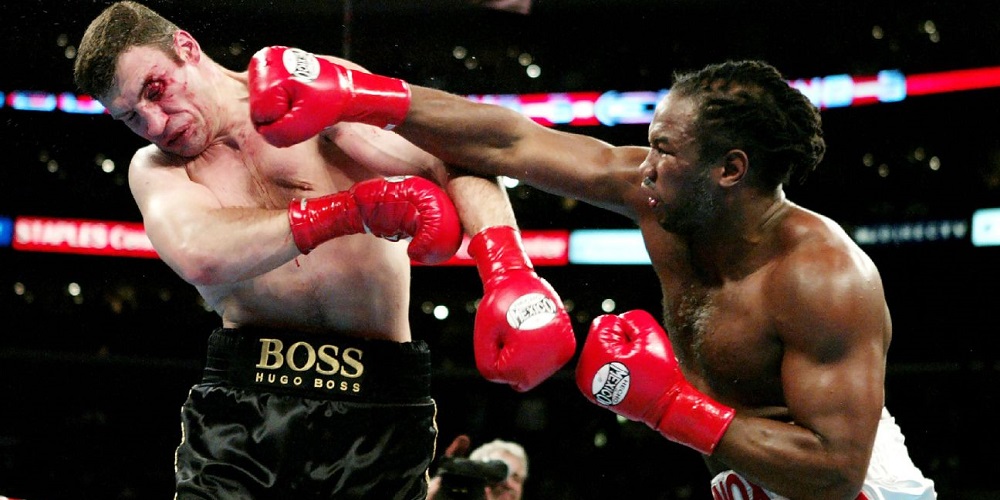
On June 21, 2003, one of the most hotly debated fights in recent boxing history took place: Lennox Lewis and Vitali Klitschko met in a clash of heavyweight titans whose controversial conclusion—a doctor-stoppage TKO due to a cut—continues to fuel heated and seemingly endless debate to this day. Let’s revisit that historic fight and examine the opposing arguments put forward by supporters of each champion.
An Epic Showdown That Came Out of Nowhere
It seemed almost inevitable that Lennox Lewis would sooner or later give rising contender Vitali Klitschko a shot at the world title. The build-up to the fight was, after all, following a familiar blueprint: Vitali was scheduled to appear on the champion’s undercard, a classic promotional tactic designed to whet the public’s appetite for a highly anticipated showdown between the two.
The event, however, took a dramatic turn when Lewis’s scheduled opponent, Canadian Kirk Johnson, withdrew with an injury just three weeks before the fight. The solution came almost instantly: since Klitschko was already training to face the unbeaten Cedric Boswell, why not offer him the chance to step into the ring with Lewis? The challenge was accepted, and the boxing world was sent into a frenzy. On one side stood the established champion, a veteran looking to fire off the last rounds of his career; on the other, the young giant on the rise, whose only defeat had come via injury and who was hungry for glory.
Clash of the Titans
The two fighters started the bout at a furious pace. Both were looking for a big shot that could immediately command their opponent’s respect, and they charged toward center ring, repeatedly colliding as they closed the distance and tied up in the clinch.
Once the initial burst of aggression subsided, the fight turned into a battle of boxing skills—and Klitschko clearly took the upper hand in the opening stages. Lewis appeared caught off guard by his opponent’s hand speed and seemed uncomfortable dealing with a fighter who was both physically imposing and highly unpredictable. Vitali’s left hand, held low when at rest, flashed out at remarkable speed along constantly changing trajectories, while his right hand, thrown with no setup, visibly shook the champion in the second round. Suddenly, an upset no longer seemed out of the question.
But Lennox’s 43 professional fights had prepared him for virtually every scenario. The Briton did not panic in the face of his early difficulties. Sensing the danger, he simply changed tactics, never losing the confident, determined look on his face. From the third round onward, the champion put aside his finesse and turned to brute force. Before long, one of his devastating, full-power right hands grazed Klitschko’s face, opening the first of several cuts that would soon follow.
The opponent’s almost animalistic aggression, the blood beginning to pour, the pressure of a career-defining night: for a few minutes, Vitali appeared to be in serious trouble, backed into a corner by a rapidly deteriorating situation. But Klitschko was a champion—and champions know how to respond.
In the fourth and fifth rounds, the challenger resumed his boxing. Lewis continued to press forward relentlessly, but Klitschko kept him at bay, landing from every angle, moving around the ring and firing again on the move. Punches rained down like lightning in a storm; some crashed into the guard, while others found their mark and prevented the British great from establishing his range.
Klitschko’s strategy seemed to be working, but it was extremely demanding. It required constant movement of his legs and upper body, as well as a work rate that would be almost impossible to sustain over the long haul. Lewis, meanwhile, showed no signs of easing off the pressure and began to make himself dangerous in the clinches as well, using rough, grinding tactics that gradually wore his opponent down.
His jab was another weapon: a sledgehammer. It landed only sporadically, but whenever it did, it literally moved Klitschko backward and left fresh damage on his face.
The sixth round opened with a short-range uppercut from the champion that was a thing of beauty. Lewis timed the punch perfectly as the two fighters were about to come together. Vitali’s head snapped upward amid a stunned roar from the crowd, but the Ukrainian somehow remained on his feet and continued trading without respite.
Lewis’s blows, however, were beginning to take their toll. Klitschko’s face had become a mask of blood and, despite continuing to fight courageously, the Ukrainian was increasingly struggling to see Lewis’s punches coming, leaving him more and more vulnerable to the champion’s dangerous right hand.
The ringside doctor’s examination at the end of the round proved decisive: Vitali had to turn his entire head just to see to his left, and under those circumstances he could not continue. An exhausted Lewis, meanwhile, was carried around the arena in triumph.
The Eternal Debate
Although the fight officially produced a winner, that did little to settle the argument among boxing fans over which man was ultimately the better fighter: Lennox Lewis or Vitali Klitschko.
Klitschko’s supporters continue to emphasize the rather fortuitous circumstances surrounding the injury, point out that Vitali was ahead on the scorecards when the fight was stopped, accuse Lewis of refusing a rematch because he knew he was inferior, and argue that the blood obstructing Klitschko’s vision clearly compromised his performance from the third round onward.
Lewis’s supporters, on the other hand, point out that the champion was almost 38 years old on fight night and had weighed more than ever before—a possible sign that he was already entering the twilight of his career. They emphasize that Vitali suffered multiple deep cuts to his face, requiring no fewer than 60 stitches; they argue that the final round was clearly in Lewis’s favor and that a knockout was only a matter of time. Finally, they praise their man for walking away from the sport after recognizing that his decline had begun, rather than risk losing his title to an inferior opponent.
So where does the truth lie?
It is difficult to say without allowing personal preferences to color the judgment. Both sides undoubtedly have legitimate arguments and can point to concrete evidence in support of their case.
In the absence of a rematch, all we can do is sit back, popcorn in hand, and watch the footage of that historic battle all over again. One thing, at least, is beyond dispute: it was a landmark moment in the modern heavyweight division, and on that point, everyone can agree.