




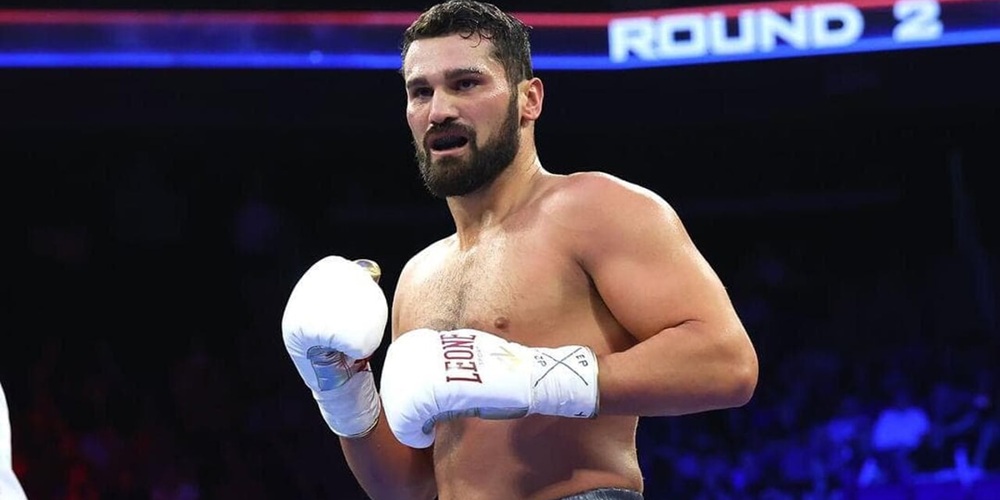
What we witnessed on Saturday night at London’s O2 Arena in Guido Vianello’s fight can be described as a “false start.” In his first bout with Queensberry Promotions, “The Gladiator” delivered a below-par performance, managing only a draw against the far-from-formidable Moses Jolly. Nevertheless, precisely at this difficult moment, while he is being bombarded with criticism from fans, I feel the need to say a few words in defense of our man.
A Lackluster Performance, but with Mitigating Circumstances
Let’s start with a premise that may sound obvious but needs to be stated: Vianello did not have a good fight on Saturday night. Despite holding a significant advantage in terms of technical ability and experience, Guido was unable to prevent his opponent from dragging him into a brawl. He struggled with Jolly’s unorthodox style, took too long to find the right adjustments, and for long stretches of the fight betrayed his insecurity with a tense, worried expression on his face. There are, however, mitigating circumstances that deserve to be taken into account.
Over the years, I have interviewed great champions and top-level trainers, and their words and stories have made me realize on more than one occasion just how disruptive it can be for a fighter to start and stop training camp several times while his opponent keeps changing, forcing the team to reset everything, start over from scratch, and then stop yet again. When you finally step through the ropes and find yourself under the bright lights, you discover that something is missing, that you are struggling to bring out your best qualities.
Vianello was supposed to fight Jarrell Miller, then Martin Bakole, then David Adeleye, and finally found himself facing Jolly—in name and in nature. Certainly not an outstanding fighter, but also an unknown quantity, a mystery, someone difficult to study and figure out in just two weeks. On top of that, compared with most of the footage available of him, he entered the ring carrying a significant increase in muscle mass, to the point of raising eyebrows.
The Pitfalls of the “American Dream”
But let’s take a step back. Before passing sweeping judgments on the Vianello of today, let’s try to remember where he started. I’ll admit it without hesitation: when I heard that Guido was turning professional with Top Rank, I wouldn’t have bet a single euro on him. I had his amateur performances fresh in my mind, and he did not strike me as suited to making the big leap. Some of the shortcomings I had seen at the Olympics and in other major tournaments—from an awkward, inefficient stance to a lack of explosiveness in his punches—made me think that across the Atlantic they would eat him alive from his very first sparring sessions and eventually make him give up.
Many people see only the positive side of the “American dream” and consequently accuse Vianello of being privileged, ignoring the pitfalls and brutal tests that a 24-year-old faces when he is suddenly thrown into American boxing gyms, where “sink or swim” is the standard mantra for everyone. The legendary Paolo Vidoz, who had talent to burn, once put it very clearly to me: “What I remember most about the two years I spent in America are the battles we used to have in the gym. Over there, every training session was a fight, and I had to earn respect with my fists.”
Vianello went from a sheltered environment in which he was pampered and protected straight into the lion’s den. He found himself sparring with a tank like Joe Joyce, who keeps coming forward even if you shoot him; with a killer like Murat Gassiev, whose body shots can fold you in half with pain; and with a champion of Tyson Fury’s caliber, a man capable of driving you crazy just trying to figure out his movements. Vianello walked through the fire and did not quit. He allowed those tests to forge him, learned from them, and used them to give himself a chance in the shark-infested waters of professional boxing.
“He’s Not Top 10 Material”: The Great Misconception of False Expectations
When confronted with the undeniable progress our man has made, some of the surprising performances he has produced against highly ranked opponents, and the level he has managed to reach both in terms of purses and rankings, his harshest critics argue that all of this still falls well short of what was expected of him. He never broke into the top 10, he never earned a world title shot, and therefore, according to them, “he failed.”
But where exactly do these supposedly unfulfilled expectations come from? Who decided that the minimum acceptable goal for Vianello was to compete with the very best in the world? Sure, he has occasionally made ambitious statements, but that is perfectly normal for a professional athlete—there would be something wrong if he didn’t! To get the most out of himself, a boxer has to keep raising the bar, aim for the top and refuse to settle. That is the only way to push beyond your limits, and it does not mean that anything short of ultimate triumph should be regarded as failure.
If we put the talk aside and focus on the facts, we can see that going into each of the four international fights Vianello had before last Saturday, Guido was the betting underdog. Yet he won two of those four, and in my personal opinion he should actually have won three, since I found the split-decision loss to Efe Ajagba rather questionable. So how can anyone say that he failed to live up to expectations?
A Fighter with Strengths and Weaknesses Who Deserves Our Support
Guido Vianello is not an elite fighter. Despite the undeniable improvements he has made over the years, there are still areas of his game that need work. He telegraphs his right uppercut far too much, robbing it of unpredictability and effectiveness; his hooks sometimes travel on overly wide arcs, turning into slapping punches when fatigue sets in; and his inside fighting leaves something to be desired.
But The Gladiator also has some very respectable qualities. His footwork is better than that of many heavyweights ranked above him; his chin is extremely solid—Guido has never been knocked down in his professional career despite facing a fair number of opponents known for having heavy hands; and his conditioning is excellent. Had he had another two rounds to work with, he would have given a very good athlete like Ajagba all kinds of trouble, as the Nigerian finished their fight badly fatigued.
Since none of us has a crystal ball, we do not know how far our fighter will go. At present, he is an upper-mid-tier heavyweight who shines against certain styles and struggles against others, who alternates impressive performances with lackluster ones, but who still has room to improve. What we do know is that Guido does not deserve some of the comments directed at him online over the past few days. He does not deserve to be called “useless” or “mediocre,” let alone be told that he should retire.
Vianello could have stayed in his comfort zone and enjoyed the security of a steady job, especially given that he also came from a financially comfortable family background. Instead, he chose to venture into a minefield because he loves to fight and because he is someone who chases his dreams.
Whether he achieves them or not, he deserves our support.