




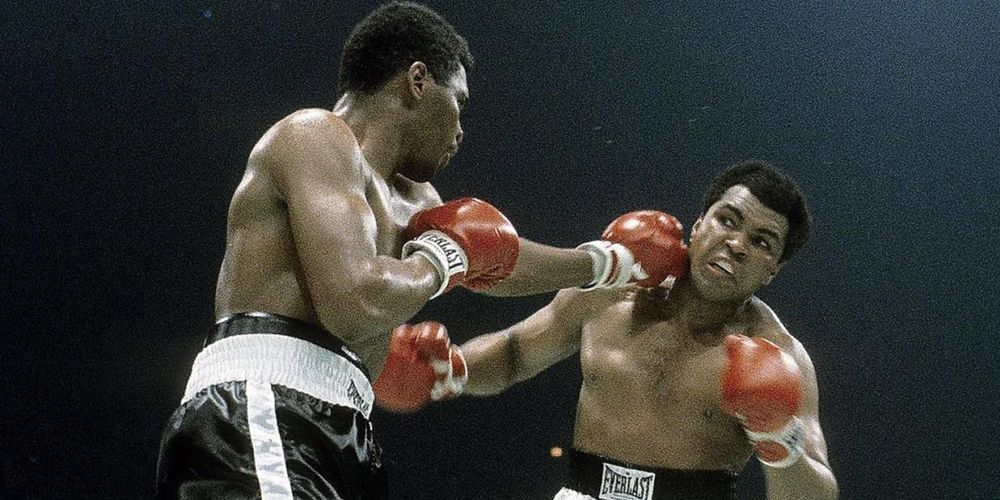
There is nothing more fleeting and dangerous for a boxer than the false myth of invincibility—especially when the boxer himself starts to believe it, even for a brief moment. Because when ego takes over, a fighter becomes helpless, or at least vulnerable, in front of someone more motivated and focused. The history of the noble art, in this regard, is repetitive—but above all, it teaches.
Landover, Maryland. It was April 30, 1976, and the 12,472 spectators gathered at the Capital Centre had come to witness the usual one-man show of the champion, Muhammad Ali, ready to lift the World Heavyweight title once again. What they saw instead was something entirely different: a very heavy man trying to catch a ghost.
That ghost was Jimmy Young, a Philadelphia heavyweight with a misleading record (17-4-2 at the time), but a far from reassuring look, blessed with hand speed and upper-body movement that would trouble many great names in the division.
Backstage before the fight, there was no real tension. Ali was coming off a knockout win over Jean Pierre Coopman, but above all from the legendary Thrilla in Manila against Joe Frazier—a fight that many insiders believed should have been his last, marking a glorious farewell due to the physical toll. “The extent of the damage—to the brain tissue, the kidney tissue; everything that happened in that fight was as close to death as you can get in the ring,” said Ferdie Pacheco, Ali’s longtime physician. But the champion was not ready to stop—and wouldn’t be for quite some time.
Perhaps to celebrate still being alive and winning, perhaps out of boredom or due to his inflated ego, Ali entered the ring at 230 pounds (104 kg), the heaviest weight of his career up to that point.
“Too much cake, too much ice cream,” the champion later admitted. Angelo Dundee, his longtime trainer, tried to warn him with a simple message: “Remember San Diego”—a reference to his loss to Ken Norton in 1973, when Ali had come in unprepared. But Ali simply did not consider Young a threat.
It was said that Jimmy sensed the giant’s mental lightness and the physical heaviness of the aging champion, worn down by many battles. Jimmy, 27, knew he had the opportunity of a lifetime.
When the bell rang, the unthinkable happened. Ali could not land consistently on Young. The Philadelphian, with experience, quick reactions, a bit of spoiling, and a slick ability to lean back and evade, neutralized Ali’s combinations: the champion did not float like he used to, and above all, he did not sting like before.
During the fight, Young challenged the limits of the ring six times by literally slipping through the ropes to avoid Ali’s attacks. In the 12th round, referee Tom Kelly penalized him by ruling it a knockdown and issuing a count. But in reality, that was the only blemish in an otherwise masterful performance by the challenger.
Ali’s frustration was evident. His personal doctor, Ferdie Pacheco, noted that his reflexes were at only “25-30% of normal” and that he seemed to tire far too easily.
As the 15th round ended, the Capital Centre held its breath. Unlike the usual ovation for Ali, this time there were also boos. The decision was unanimous for “The Greatest.” But the scorecards—72-65, 71-64, and 70-68—told of a victory that many observers did not believe was deserved. The Associated Press scored the fight 69-66 for Young, and for many that should have been the only possible verdict.
According to CompuBox statistics, compiled later by reviewing the footage, the numbers were embarrassing for the champion: Young landed 222 punches, Ali only 113—65 jabs to 27, and 187 power punches to 86. Simply put, Ali could not find his range.
The New York Times wrote the next day that boxing is “the most subjective of all sports,” emphasizing how judges saw what they wanted to see, not what actually happened. Ali himself, in a cryptic remark, said: “I was in terrible shape. It was a miracle.”
What Ali called a miracle was a bitter disappointment for Young. The man who had troubled the great champion never got another world title shot.
A few months later, Young further proved his worth by clearly defeating the brutal puncher Ron Lyle for the second time. Then, the following year, it was George Foreman’s turn to be outmaneuvered, frustrated, and even knocked down by the talented Philadelphia fighter—who that night pushed “Big George” into a ten-year retirement.
A meteoric rise toward glory, abruptly halted by yet another controversial decision—the one that saw him lose to Ken Norton in 1977—before beginning his decline.