




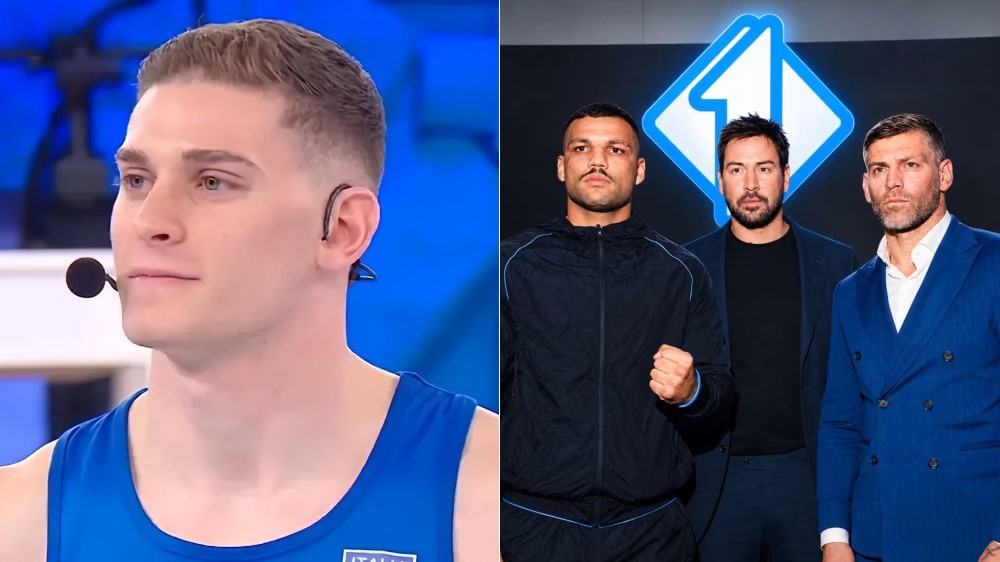
The dazzling spotlights and glamorous atmosphere of the Amici stage on the one hand, the sensational return to the ring of showman and former champion Clemente Russo, complete with a live broadcast on Italia 1, on the other: Italian boxing seems to be embracing a “pop turn” in an effort to broaden its appeal and attract new viewers and stakeholders. Some applaud this direction and are convinced of its potential to save the sport in Italy. We, however, have serious reservations and remain rather sceptical. In this opinion piece, we will try to explain why.
The Surreal Fight Involving Gabriele Guidi Rontani
With his clean-cut looks, blue eyes and sculpted physique, 22-year-old Gabriele Guidi Rontani, a talented boxer with excellent prospects, was the ideal candidate to introduce boxing to the Amici talent show. It is no coincidence that he was the one chosen for the role.
On November 1, Gabriele, who now lives in the Amici house alongside the other contestants, fought his first bout on the Italia 1 stage. We watched it to get an idea of how boxing would be presented to Mediaset’s vast audience.
Guidi Rontani’s opponent was introduced simply as “Francesco”. His surname was never mentioned during the broadcast, but fortunately his coach, Giancarlo Talamoni, was named. This allowed us, by cross-checking a few details and doing some research, to establish the young man’s identity. He was 19-year-old Francesco Etna, whose amateur record stood at 32 wins, 16 losses and one draw ahead of the bout (FPI source). The gap in experience was therefore considerable, as Guidi Rontani had a record of 91 wins, 27 losses and one draw.
The way the first round was broadcast would have made even the most tolerant boxing fan’s skin crawl and prompted them to curse in ancient Aramaic: unbearable background music, constant cuts, infuriating shots of spectators, singers and dancers cheering from the sidelines… Very little of what was actually happening in the ring could be made out, despite the best efforts of the unfortunate Stefano Buttafuoco, who had the unenviable task of providing the commentary.
Fortunately, the production style changed radically over the following two rounds, which were shown in their entirety and without music, although the broadcast still featured frequent shots away from the ring. Guidi Rontani won both rounds clearly and thus retained his place on the show, much to nobody’s surprise.
That day, Amici attracted an average audience of around two and a half million viewers, a considerable figure compared with the number of people who typically follow the Sweet Science in Italy. Yet this audience was served up a sanitised, glossy, dressed-up version of our sport. Some of those who are becoming fans of Guidi Rontani might experience a jarring and disorienting culture shock if they ever set foot in a real boxing gym. This raises an important question: what if we are targeting the wrong audience? And what if exposing a promising young boxer, who will be fighting over the next two years for a place at the Olympic Games, to a world overflowing with distractions is simply not worth the risk?
Russo vs Elmaghraby: A Potential Own Goal
On Saturday, November 21, TAF 14 will take place at the Allianz Cloud in Milan. The event is organised by Edoardo Germani’s The Art of Fighting promotion. The card will feature several interesting matchups with uncertain outcomes, all of which could deliver excitement and entertainment. However, media attention has inevitably focused on the main event, given the sensational return of Clemente Russo to the ring after more than five years of inactivity.
Those who welcome this unusual initiative argue that the visibility generated by the charismatic and flamboyant Clemente will benefit all the other boxers involved in the event and, by extension, Italian boxing as a whole. The sport will finally be showcased on a mainstream television channel, live to boot, in the hope that this will be the first seed to take root and bear abundant fruit in the future.
But what if it turned out to be a spectacular own goal? Let us explain what we mean.
Clemente Russo was a high-level amateur boxer. His achievements speak for themselves, and only someone influenced by personal tastes and prejudices could deny that. However, his performances in the ring declined significantly and visibly during the final years of his career, as the athletic qualities that were crucial and indispensable to the success of his boxing style gradually faded with age. His participation in the 2021 Italian Elite Championships, despite his enormous experience advantage over his opponents, was marked by extremely hard-fought victories. He eventually won the gold medal only thanks to a very favourable decision in the final against young Matteo Girolamo, who subsequently left boxing to pursue wrestling.
Mohamed Elmaghraby, meanwhile, has so far fallen short of the expectations surrounding his professional career. He has won the Italian title, certainly, but his unbeaten record has remained intact only thanks to a serious refereeing mistake that denied his opponent, Stiven Leonetti Dredhaj, a technical knockout victory in March 2025, and an utterly incomprehensible decision that went in his favour at the end of his most recent bout against Vincenzo Lizzi.
When we also consider that Russo has not fought since 2021 and that Elmaghraby will be catapulted into a weight limit 14 kilograms above the one at which he is accustomed to competing, we realise that the risk of witnessing an extremely poor fight in terms of entertainment and remarkably lacking in technical substance is far from negligible.
And if the result really were a depressing spectacle, how would viewers watching on Italia 1 react? How many of them, having tuned in out of curiosity, would come away thinking that boxing is an unattractive sport and that their free time would be better spent watching something more engaging? The hope that an excellent undercard might compensate for a disappointing main event is equally misplaced, because the other fights will be broadcast on Canale 20, possibly even on a delayed basis, and will therefore reach a dramatically smaller audience.
Perhaps We Have Taken the Wrong Path
It is striking that the two announcements – Russo’s return to the ring and the introduction of boxing on Amici – came in September, within a short space of time, following a rather bitter summer for Italian boxing fans. The world-title defeats suffered by Michael Magnesi and Etinosa Oliha, Dario Morello’s European-title defeat and Guido Vianello’s unexpected draw all put the brakes on the careers of our leading fighters, spreading dismay and resignation throughout the boxing community.
What has happened, therefore, takes on the shape of a genuine philosophical metaphor. It is as if Italian boxing, having proved unable to rise again and shine in the “traditional” way, through the sweat, commitment and hard work of its most prominent athletes, were now trying to circumvent the obstacle by diving headfirst into the world of show business, with the blessing and enthusiastic support of the federation’s leadership.
And yet, in September and October, three prominent figures from our boxing gyms achieved significant sporting feats, largely ignored by the media fanfare. We are referring to Jonathan Kogasso, Francesco De Rosa and Angelo Morejon. Under the skilful guidance of their coaches Vincenzo Gigliotti, Emilio Desiderio and Emanuele Orlando, respectively, they secured important victories, demonstrating that they are ready for major challenges and great achievements.
This naturally begs the question: would it not be better to channel all our available resources into supporting those boxers and coaches who, like the ones mentioned above, deserve to be given the ideal conditions to do their jobs to the best of their abilities, rather than having to struggle with financial constraints, obstacles and a lack of adequate resources?
Some will argue that we can do both. But the truth is that, in a context of limited resources, choosing which area to prioritise is unavoidable, as well as absolutely crucial. And when one of the most important, capable and established promoters in Italian boxing today lets his most talented fighter slip through his fingers, only to throw himself headlong into organising a bout of highly questionable sporting value, the suspicion that we are heading in the wrong direction begins to take hold with considerable force.
Of course, we hope we are wrong.