




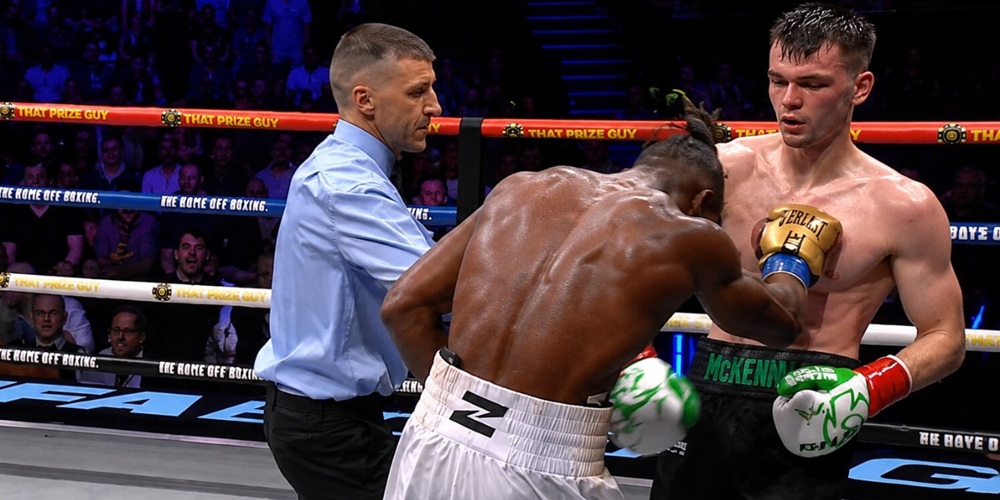
Many Italian boxing fans were left disappointed by the officiating of Mr. Padraig O’Reachtagain during Saturday night’s world title fight between our own Etinosa Oliha and Ireland’s Aaron McKenna, as he adopted a far more lenient approach than the one we are accustomed to seeing on Italian rings.
Indeed, throughout the twelve rounds, McKenna’s conduct consistently remained on the borderline of the rules and occasionally went beyond it: leaning his head forward, using his long arms to tie up his opponent’s arms, and using his shoulders and elbows to push him backwards were just some of the “tricks of the trade” we witnessed. Something similar happened to Michael Magnesi less than two months ago, when he was subjected to comparable treatment by Ryan Garner in Southampton.
There is, however, one point that needs to be clarified. Anyone who regularly follows international boxing, and particularly boxing staged in Britain, Ireland and the United States, knows full well that this kind of officiating is not an exception but the norm. We are therefore not dealing with malicious attempts to favor the home fighter, but with an established practice that enjoys the approval of local audiences, who dislike frequent referee intervention and tend to let the fighters “sort things out themselves”, barring blatant and serious fouls.
In football parlance, people often speak of “English refereeing” to describe the tendency to overlook particularly rough challenges and intervene only in the event of an obvious foul. Well, the definition fits the work of most international boxing referees like a glove, including those officiating at the most prestigious American events. Consider, for example, the career of decorated former world champion Andre Ward, who made guile one of the key ingredients of his many victories, naturally combining it with outstanding technical ability.
Borrowing and adapting a famous quote from Antonio Moccia, Professor Emeritus at the University of Naples Federico II, who was referring at the time to the use of English as the universal language of engineers: “We Italians don’t like it. But it certainly is a thing.”
In other words, regardless of what each of us legitimately considers the ideal refereeing standard, when we go abroad to fight, we absolutely must step into the ring fully aware of what awaits us and ready to adopt the necessary countermeasures if the fight turns into a brawl with the referee’s blessing.
Many elite fighters from countries that were once part of the Soviet Union provide an extraordinary lesson in this regard: Ukrainian, Russian, Kazakh and other boxers. Their boxing tradition has historically emphasized a very clean style: it is rare to see them punch below the belt line, crash into their opponents, mix punches with wrestling holds or hit behind the head. Yet when the best among them face someone who tries to “fight dirty”, they prove perfectly prepared for it.
There is still an old video online in which Gennady Golovkin, the formidable former Kazakh boxer who dominated the middleweight division for many years, “instructs” Cuban light heavyweight Sullivan Barrera on how to handle inside-fighting situations. During the training session, Golovkin explains how to position your head to restrict your opponent’s vision, how to tie up his arms with your elbows, how to create enough space to land your own short punches and much more. In other words, one of the fairest, most sporting and most honorable fighters of the modern era knew every trick in the book typically employed by those who prefer chaotic, scrappy boxing.
For our champions of the past, preparing to deal with the difficult situations discussed in this article was simply part of the job. In the beautiful documentary about Nino Benvenuti’s life broadcast by RAI after the passing of the beloved former Istrian boxer, Patrizio Oliva explained how he had taken inspiration from Benvenuti’s movements to refine his own inside-fighting skills. The elusive “Sparrowhawk”, best known for his footwork, long punches and evasiveness, had therefore spent countless hours in the gym perfecting situations outside his usual style so that he would not be caught unprepared if an opponent forced him into an all-out battle.
Today, many Italian boxers do not seem to possess this additional skill set. When dragged into a dirty, chaotic fight, they appear lost, disoriented and lacking a Plan B to prevent their opponent from imposing his style and rendering them ineffective. And in the end, when our representative returns home empty-handed, we find ourselves complaining and wondering what might have happened with different refereeing, proving the point of Julio Velasco’s famous saying: “The winner celebrates, the loser explains.”