




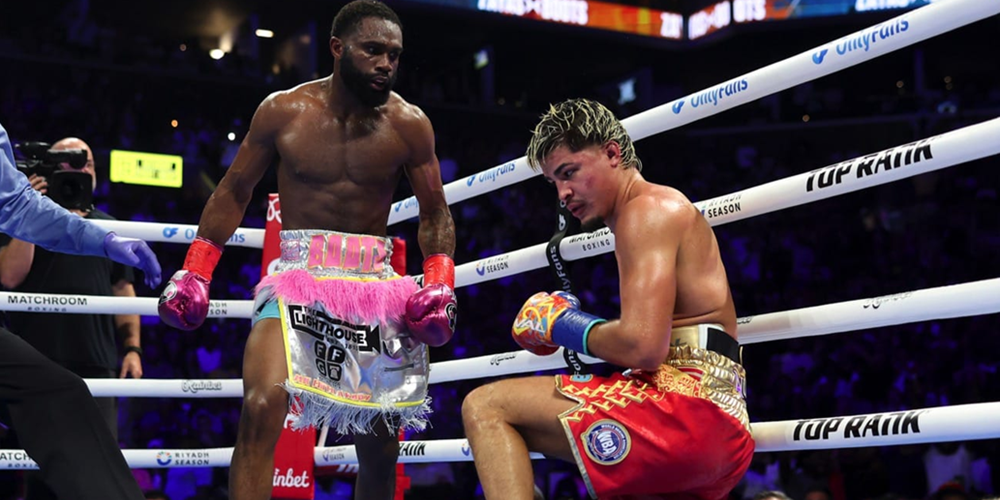
Last Saturday, Vergil Ortiz Jr., Devin Haney, Adrien Broner, among others, pointed the finger at Puerto Rican boxer Xander Zayas, accusing him of quitting in his fight against Jaron Ennis instead of continuing after suffering his third knockdown. It is a false accusation, as the footage clearly suggests and as those who were present at the event have confirmed. More importantly, it reflects an unhealthy mindset shared by far too many fighters and boxing fans, who see boxing not as a sport, but as a fight to the death.
Let us begin with the disputed facts. During the seventh round, after absorbing yet another barrage of punches from his opponent, the 23-year-old Zayas took a knee. His attention was immediately drawn to his corner, and he turned toward them as the referee began the count. Moments later, the referee also looked in that direction before waving off the contest while Zayas nodded.
It therefore seems quite evident—and those who witnessed the scene ringside support this conclusion—that it was the Puerto Rican fighter’s corner that requested the stoppage, while the young boxer merely accepted his team’s decision. Could he have protested and desperately pleaded to continue? Certainly. But it would have changed nothing except the theatrics of the moment.
Calling it quitting, therefore, seems, at the very least, inappropriate. However, that is not the main issue this article seeks to address. In my opinion, even if it were true that Zayas had quit on Saturday night—even if the request to stop the fight had originated from him—it would still be foolish to viciously attack him and brand him a coward.
The San Juan native actually fought with tremendous courage—perhaps even too much. He adopted a far more aggressive strategy than most analysts would have recommended, choosing to trade in the center of the ring with a heavy-handed puncher like Jaron Ennis.
Zayas suffered two heavy knockdowns, in the first and fifth rounds. Both times he got back to his feet, gritted his teeth, and kept trying. Had he remained flat on his back staring at the lights of Barclays Center after the devastating uppercut Ennis landed in the fifth round, no one would have questioned it. Instead, he rose and absorbed so many punches during the remainder of the round that the ringside physician examined him before allowing the next round to begin.
Boxing is a complex sport, filled with countless nuances. Its history includes many fights in which a boxer who appeared exhausted and destined for defeat managed to turn everything around with one perfectly landed punch, earning hero status in the process. But its history also includes, unfortunately, tragedies that could have been avoided had the referee or the fighter’s corner exercised greater caution.
Boxing is a constant balancing act, and it is incredibly difficult to stay on that tightrope without falling to one side or the other: stopping a fighter who is still capable of competing, or allowing one to continue when he has nothing left to give. In the first case, the very essence of the sport is undermined. In the second, a young man is sent to the slaughter simply to satisfy those who will never have to face the consequences.
So how do we preserve that delicate balance? In my view, the first step is to look at boxing as a sport. A brutal sport, at times a bloody one, but still a sport—not a war worth dying for. Once we embrace that perspective, accepting defeat when the opponent has proven superior and when there is no longer a realistic chance of victory without risking irreversible damage to one’s health will no longer be seen as dishonorable, but rather as a sign of intelligence and foresight.
On this subject, I am reminded of something former world champion Maurizio Stecca once told me about his decision to turn his back on Louie Espinoza when his vision had effectively been reduced to one eye and the situation had become hopeless:
“As I heard the referee counting, with my good eye I could see that he was fully charged up and ready to come after me again. During those eight seconds I thought to myself: ‘If I get up and continue, I risk ending my career. If I quit, the fight ends, and then we’ll see whether my career can continue.’ So I got up and turned my back on him. Two years later I became world champion again, so I believe it was the right decision.”
I would like to conclude these reflections by reminding Vergil Ortiz, Devin Haney, and every active fighter who believes it is acceptable to express outrage and contempt toward a fellow boxer after watching him fall, that no one can predict the future. Sometimes the words we utter too lightly have a way of coming back to haunt us.
Some call it karma, others divine justice, while some simply call it coincidence. Whatever the explanation, it is far from uncommon in boxing for those who cruelly mocked a defeated fighter to later become the target of similar ridicule themselves. A perfect example is what Billy Joe Saunders had the audacity to say about fellow Briton Daniel Dubois after Dubois took a knee in the tenth round of his fight against Joe Joyce because of a fractured orbital bone:
“If my two eye sockets were broken, my jaw was broken, my teeth were out, my nose was smashed, my brain was beaten, I was not stopping until I was knocked out or worse. I don’t agree with a man taking the knee and letting the ref count him out.”
As we all know, those foolish words evaporated under the punches of Saul “Canelo” Alvarez. We also know how the careers of the two British fighters unfolded afterward. Dubois went on to become a two-time world champion—a title he still holds today—while Saunders now fights only against excess weight and the unfortunate hares of Lincolnshire, illegally hunted by him and his companions.