




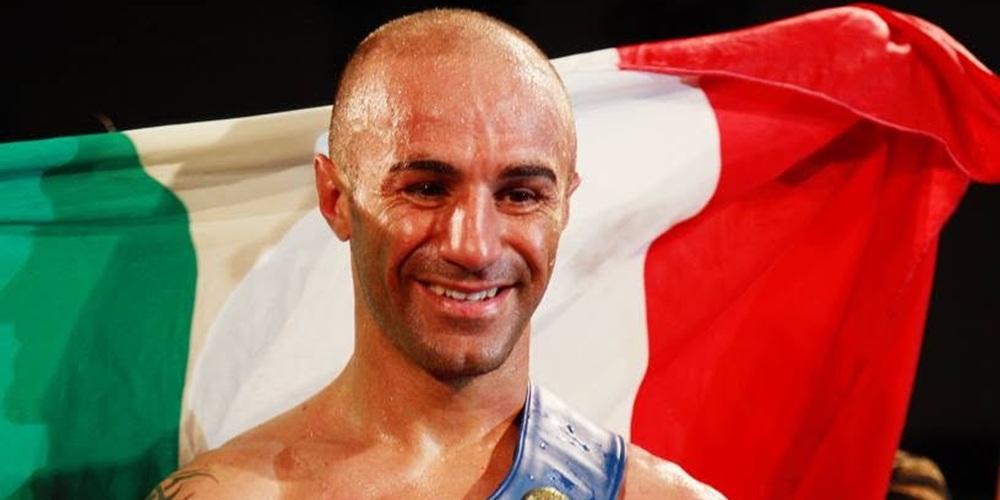
Whenever Sardinian boxer Simone Maludrottu stepped into the ring, boredom was never an option. A relentless pace, furious exchanges, suffocating pressure, and close-range warfare characterized all of his fights, and very few opponents were able to withstand, as the minutes passed, the exhaustion and attrition caused by the explosive aggression of “Boom Boom.”
Although he had already displayed part of his talent during his amateur career, which earned him a place on the Italian National Team and the opportunity to compete in prestigious international tournaments, Maludrottu achieved his greatest feats in the professional ranks—a world that was better suited to showcasing his finest qualities.
Winning one battle after another, Simone climbed every step leading to boxing glory, first becoming Italian champion and then European champion, a title he held for three years, making eight successful defenses without ever being dethroned.
The only thing missing from his résumé was a world title. Unfortunately, his lone opportunity came in hostile territory against a great champion, Japan’s Hozumi Hasegawa, who nevertheless was pushed to the limit by our own Boom Boom.
For our “Great Italian Boxing” series, we contacted Maludrottu, who kindly agreed to answer some questions about his remarkable sporting journey.
How did your passion for boxing begin?
Actually, I started just for fun. When I was 13, I had a friend who boxed, and he talked about it all the time. One evening I told him I wanted to try it too. Since I was a bit lively as a kid, I thought boxing might suit me, so I went to the gym and met coach Egidio Pellegrino.
As soon as he saw me, he asked if I wanted to take it seriously and compete. I told him yes, that my goal was to fight, and from then on I started training. I took boxing very seriously right from the beginning because my coach made it clear that I would have to train every day. Boxing requires sacrifices, discipline, and a lot of determination.
You are mainly famous for your professional achievements, but you also enjoyed considerable success as an amateur. What were your first moments of glory?
About a year and a half after I joined the gym, it was time for my debut. I entered the championships, which at the time were called Primi Pugni and corresponded to the novice category.
I made my debut directly in the regional championships and won them—two fights, two victories. After that, I competed in the interregional championships in Acqui Terme, Piedmont, and won those as well. Then, in the final stage held in Campania, I lost on points in the semifinals to a guy I later got to know very well on the National Team, Salvio Di Grazia. He was very good too. Later on, both of us competed at the Youth World Championships in Cuba, with me at flyweight and him at featherweight.
As an amateur, I had around seventy fights and won almost all of them. I won the Italian championships twice, earned a place on the National Team, and started competing in prestigious international tournaments, including one in Budapest, Hungary, where I won a bronze medal.
There, I won my first fight by knockout. Then I faced a Canadian boxer who had been a world silver medalist, and I lost on points because I lacked experience. Later, as I mentioned, I competed in the Youth World Championships in Havana, Cuba.
Afterward, I joined the army and took part in the Military World Championships in Texas. I traveled to the United States several times. In 1997, I went there for a competition between the Italian Army and the Marines in Jacksonville, North Carolina. I won there with a pretty spectacular knockout.
What made you turn professional at only 22 years old instead of pursuing the Olympic dream?
Three rounds weren’t enough for me. The fights would end and I still felt fresh. I really needed to fight over a longer distance. In fact, in professional boxing I often came on strong from the eighth round onward—that was one of my characteristics.
I was like a diesel engine: I built momentum little by little, and once I found my rhythm, I could perform at my best. So I was naturally more suited to the professional game, and my coach always told me that.
On top of that, I no longer wanted to return to the National Team. I’m very attached to my roots, and being away from home was difficult for me. I spent too much time traveling, and at that time I was already engaged. So I told myself: “I’ll stay here, turn pro, and see where this adventure takes me.”
Your first professional title fight was your victory over Emiliano Salvini for the Italian title in 2003. What did it feel like to become Italian champion?
It was an incredible feeling because my first dream as a professional was to win the Italian title, and I managed to achieve it through a lot of sacrifice.
I remember running every morning and working extremely hard to make weight because, to compete at bantamweight, I always had to lose four or five kilos. I was willing to make many sacrifices because I desperately wanted that title. I had to win it, especially for myself.
Then, after that fight, my manager surprisingly offered me the chance to fight for the European title right away. I won the Italian title in 2003, and the following year I was already fighting for the European championship.
I expected to make at least one defense of the Italian title, but this opportunity came up and I grabbed it immediately, even though I didn’t have much professional experience yet. I trusted my abilities, though, so I said, “I’m in. I feel ready. Let’s do it.” I trained hard, was extremely disciplined and determined, and truly lived like an athlete.
Your European reign was long, glorious, and full of difficult challenges. In your very first title defense, you had to travel to Spain to face Karim Quibir. What stands out from that hard-fought victory in Madrid?
We knew from the start that it would be a tough fight, even though all we really knew about him was his record: 25 fights, 20 wins by knockout.
Apart from that, we accepted the fight almost blindly. We had no footage to study; back then it wasn’t easy to find videos. So we arrived in Madrid knowing only his record, attended the press conference, made weight, and fought the next day.
It was a very intense and very tough fight. I was really tested, but thank God, after eight closely contested rounds, he started fading from the ninth round onward and I took control. The championship rounds made the difference.
Because of my opponent’s quality, that victory made me realize I could compete with anyone in Europe. That day I became aware of my true value because I had surpassed my own limits.
It wasn’t an easy fight: it was my first professional bout abroad, in front of ten thousand hostile spectators, against a very good opponent. Winning made me understand how far I could go.
In the rematch you granted Quibir two years later in Sardinia, you were involved in a truly unusual incident. After knocking him down, you almost threw a kick before stopping yourself at the last second and immediately apologizing. What was going through your mind?
It was pure competitive aggression.
When I fought in Spain, afterward the Spanish fans and even his manager said the fight had been very close and perhaps should have gone in Quibir’s favor. So I carried that chip on my shoulder and wanted to prove that I was the superior boxer.
For a moment I lost my composure, but thankfully I managed to stop myself in time.
Your world title opportunity came in Japan against the outstanding local hero Hozumi Hasegawa. During that fight, a terrible cut suffered by Hasegawa was allowed to continue for most of the bout, and the WBC’s open scoring showed what seemed to be an insurmountable and frankly unfair gap after eight rounds. If you had been given the chance to fight for the biggest prize of your life in Sardinia, do you think things would have been different?
I think so.
I arrived in Japan eight days before the fight and never managed to adapt. I couldn’t sleep at night, and every day there was something to do—press conferences, public workouts, the weigh-in. So it was eight exhausting days leading up to the world title fight.
On top of that, making weight had become extremely difficult for me. Getting down to bantamweight was a real struggle; I simply couldn’t do it comfortably anymore.
So I wasn’t at 100%, but I fought with all my strength and tried until the very end. If the fight had taken place—not necessarily in Sardinia, but even in England on neutral ground—I believe things would have been different.
Today you are still fully involved in boxing as a trainer. Has anything changed in young athletes’ attitudes compared to when you were competing?
Yes, it’s different now.
Today, if you give young boxers even a small scolding, they turn their backs and leave. We used to take our reprimands and stay in the gym—they motivated us to work even harder.
Now I see that young people are distracted by many other things, and it’s very easy to lose them, so you have to be more “gentle,” so to speak.
Times are changing, and the young people who come to the gym no longer want to suffer or make major sacrifices, but boxing demands exactly that.
Because it’s an individual sport, you need a certain mindset and, above all, discipline.