




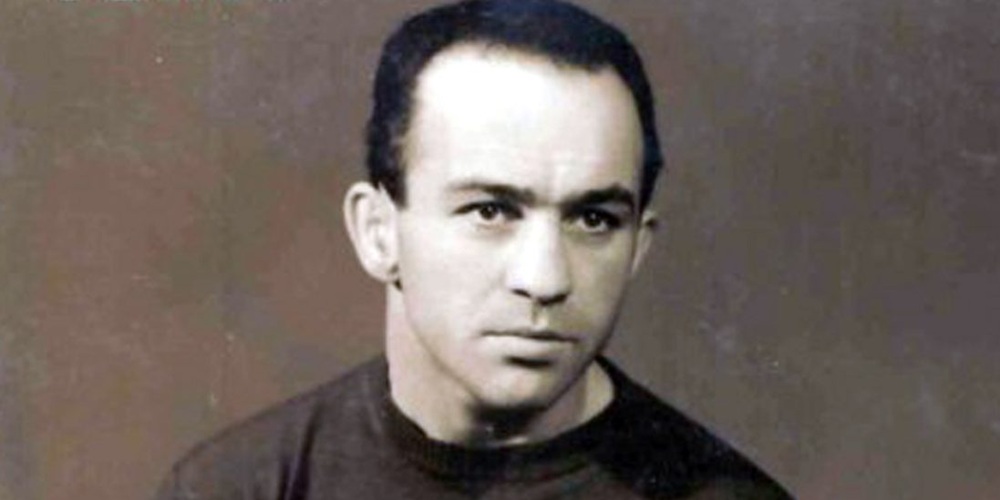
Alone with himself, locked inside a world shaped only by touch and sight, just like the punches he absorbed, slipped, and threw. Yet inside the ring, Mario D’Agata perceived himself differently: “Boxing taught me to be strong, to overcome life’s obstacles and, most importantly, to feel equal to everyone else.”
A Childhood on the Margins
Mario D’Agata was born in Arezzo, Italy, in 1926. He grew up in a large, working-class family. Deaf and mute from birth, he spent his childhood not only deprived of hearing but also socially isolated: he could not attend school and had no opportunity to interact with children his own age.
At the age of seven, he was sent to a school for the deaf, where he earned his elementary school certificate and learned woodworking and ceramic decoration.
Despite these difficulties, Mario gradually learned to interact with the outside world while forming a deep bond with others who, like him, were deaf.
At the age of 18, he attended a boxing match, and his life changed forever. He immediately fell in love with the sport and found in the noble art not only an outlet but, above all, a world where he was equal to everyone else. He could not hear the cheers of the crowd, the encouragement, or the instructions from his corner. Inside the ring, he was even more alone than most fighters—but he possessed undeniable talent. Standing just 157 centimeters (5’2″) tall and weighing 54 kilograms (119 pounds), Mario was undersized, yet he possessed extraordinary determination, toughness, and aggression. These qualities earned him the nickname “Little Marciano,” along with a sense of dignity that would lead him to remarkable achievements despite his disability.
Equal to Everyone Else
D’Agata fought around 100 amateur bouts [other sources even suggest as many as 150, editor’s note], winning approximately seventy of them. He then decided to turn professional, but his application for a boxing license was rejected simply because no deaf boxer had ever requested one before. There were also practical concerns: Mario could not hear the bell and depended on the referee to signal the end of each round.
The Italian Boxing Federation hesitated, but faced with protests from his fellow citizens and a growing public campaign—supported even by political figures such as Amintore Fanfani—it eventually relented. D’Agata officially became a professional boxer.
He made his professional debut in 1950 against Giuseppe Salardi, winning by points. In 1953, thanks to the guidance of trainer Giuliattini and the support of his father-in-law Arrigo, he earned a shot at the Italian bantamweight title against Gianni Zuddas, the silver medalist at the 1948 London Olympics. D’Agata captured the title when Zuddas was disqualified in the ninth round.
He defended the championship twice: first by stopping Luigi Fasulo via technical knockout, then by defeating Gianni Zuddas once again on points.
In May 1954, he faced reigning European champion Robert Cohen of French Algeria in a non-title bout and lost a close decision. It was a defeat Mario could never accept. “Cohen” was the only name he was able to pronounce, and from that moment on the desire for a rematch became an obsession.
He later traveled to Australia, where he scored two major victories over Australian champion Bobby Sinn and American Billy Peacock.
The Serious Accident and Miraculous Recovery
In 1955, a tragic incident nearly ended his career. Mario became caught up in an argument between his father and a family friend with whom they jointly operated a laundry business. During the altercation, he was shot in the chest with a shotgun. His mother saved his life by shielding him with her own body.
Rushed to the hospital in critical condition, many believed his boxing career was over. Remarkably, however, Mario recovered, returned to training almost immediately, and resumed fighting.
Only three months after the shooting, he was back in the ring against Arthur Emboulè. Unsurprisingly, he was far from his best, but still managed to win when his opponent retired in the eighth round. As the months passed, his form steadily improved, earning him a shot at the European title.
On October 29, 1955, in Milan, despite the lingering pain in his chest and the scars left by the shooting, Mario defeated the formidable Andre Valignant to become European bantamweight champion.
Just a few weeks later, on December 10, 1955, he married his longtime partner Luana, who was also deaf and equally determined. Their daughter, Annamaria, would later be born.
Second to None
In June 1956, D’Agata met Robert Cohen once again, this time with the world bantamweight championship at stake. Cohen entered the fight brimming with confidence, convinced he would defeat D’Agata with ease.
Before an astonishing crowd of 38,000 spectators at Rome’s Olympic Stadium—a sea of people Mario could experience only through sight—the two produced a memorable contest. Cohen was technically superior and stylistically more refined, but Mario possessed extraordinary determination. He relentlessly pressed forward, wearing the Frenchman down through constant pressure and prolonged clinches.
In the seventh round, Mario landed a beautiful shot to the liver that dropped Cohen to one knee. Although the Frenchman rose, he was unable to continue. The “little mute,” as everyone called him, had reached the summit of the boxing world, becoming the first deaf athlete in history to win a professional world boxing championship.
The joy, however, proved short-lived.
In April 1957, Mario traveled to Paris to defend his title against another Frenchman, the gifted Alphonse Halimi. The circumstances surrounding his defeat were surreal. D’Agata typically grew stronger as fights progressed, but in the third round a short circuit plunged the arena into darkness. At the same time, a burning piece of debris fell from the large chandelier hanging above the ring, landing on Mario’s shoulder and causing burns.
The darkness unsettled him profoundly, depriving him of the only sense upon which he could rely completely. After an interruption lasting eighteen long minutes, the fight resumed—but Mario was no longer the same fighter. To make matters worse, every time he attempted to work at close range, the referee stepped in and broke the action. He ultimately lost his title on points, and the disappointment only deepened when Halimi refused to grant him a rematch.
Years later, D’Agata bitterly recalled:
“Everyone could see it was a robbery, and the fact that I was never given a rematch proves it.”
Frustrated by the situation, Mario turned his attention back to European competition. On October 27, 1957, he regained the European title—which he himself had previously vacated—by defeating Federico Scarponi.
A year later, he defended the championship against Pietro Rollo in Cagliari. At the Amsicora Stadium, the two men fought an extremely close contest, with the hometown fighter perhaps receiving an overly generous decision.
By the age of 32, Mario had entered the twilight of his career. He fought a few more bouts, but it was clear that he no longer possessed the relentless aggression of his prime.
At 36, he made one final attempt to capture the vacant Italian title against Federico Scarponi, whom he had previously defeated to win the European championship. This time, however, Scarponi—six years younger—won on points.
It was Mario’s final fight.
He retired from boxing and left behind forever the ring that had made him “Second to None,” the very words engraved on the championship belt he had won on that unforgettable night in Rome.
Throughout his entire professional career, not a single opponent ever managed to knock him down.
Mario D’Agata passed away on April 4, 2009, in Florence, where he had lived for many years. He died from an incurable illness at the age of 83.