




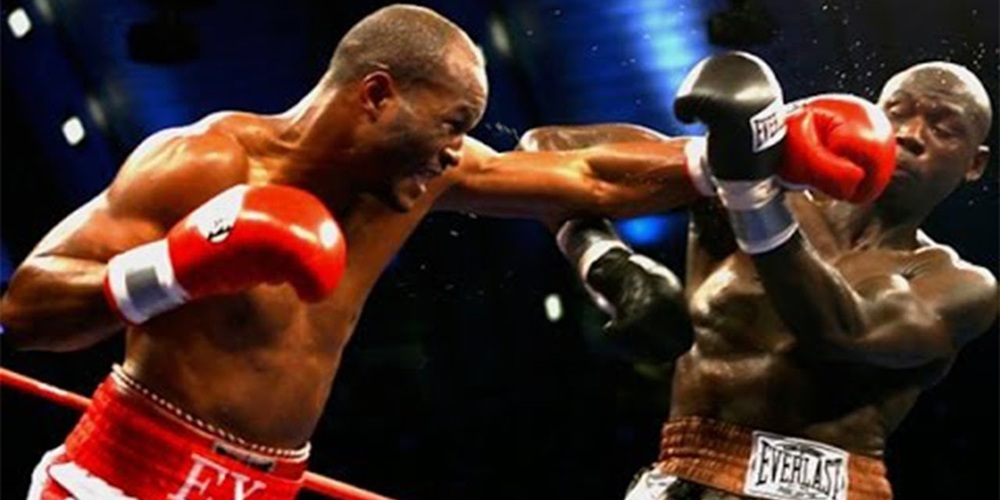
Atlantic City, Boardwalk Hall, June 10, 2006 –
If there is one enemy every boxer must eventually bow to, it is time and its relentless passage. There comes a precise moment in the twilight of a great champion’s career when the body begins to betray the mind. Reflexes slow, punches no longer explode with the same ferocity and intensity. A jab arrives a fraction late, a slip is missed by inches, a right hand sails through empty air.
For Antonio Tarver and Bernard Hopkins, that June night in Atlantic City was not merely an opportunity to claim the IBO light heavyweight title. It was also a challenge against time itself.
Two of the finest pound-for-pound fighters of their era stood across from one another. For Hopkins, the bout was supposed to be a final tango before retirement, a grand farewell. For Tarver, it was a chance to complete the circle after his battles with Glen Johnson and Roy Jones Jr., to clear out the division and cement his name in boxing immortality.
Tarver, 37, entered the fight after a series of high-profile wars with Roy Jones Jr. and Glen Johnson that had established him as “The Magic Man,” the magician capable of switching off the lights of a great champion like Jones.
Hopkins, 41, carried on his shoulders the weight of a decade-long reign at middleweight and the controversial defeats to Jermain Taylor that had ended his dictatorship over the division. The old lion had not looked like himself in those losses: too passive, perhaps too convinced he would prevail over the long haul, or simply too proud to believe that time applied to him as well.
The build-up was enlivened by Tarver’s prediction that he would stop Hopkins within five rounds. In response, Hopkins inserted a clause into the contract requiring Tarver to donate $250,000 if he failed to do so. The money would go to the Make A Way Foundation, the charity Bernard had established to help underprivileged young people find opportunities in life, just as he once had.
A natural southpaw counterpuncher blessed with exceptional reach and surgical timing, Tarver was the rightful favorite, especially considering the age difference. His devastating knockout of Roy Jones Jr.—that unforgettable missile to the chin that remains one of boxing’s iconic moments—had given him the aura of a destroyer of legends.
Across the ring stood Hopkins, a fighter who had turned rough defense, suffocating clinches, and psychological warfare into an art form. Many believed Tarver’s explosive power and timing would prove too much for Bernard “The Executioner” Hopkins’ tactical cunning. Antonio certainly believed so himself, convinced he would turn the ring into a battlefield.
Unfortunately for him, Hopkins transformed it into a chessboard—and he was a grandmaster.
From the opening bell, the fight became a tactical masterclass.
Tarver attempted to establish control with his right jab, the punch he used to dictate rhythm and impose his physical advantages. Instead, he found himself chasing a ghost. Hopkins moved with caution and complete command of the ring: half a step back, a subtle sidestep, a torso feint, his head always just beyond the trajectory of incoming punches.
It was not especially spectacular, but it was a lesson in authority and ring intelligence.
Whenever Tarver loaded up his left hand, Hopkins smothered it before it could develop, tying him up in a clinch or pivoting away and allowing the punch to whistle harmlessly through the air. It was masterful.
As frustration mounted, Tarver began loading up on his shots. That only made his intentions easier to read. Hopkins punished him in classic fashion, firing short, lightning-fast counters before wrapping him up in octopus-like clinches from which Tarver struggled to escape.
Again and again, Bernard beat him to the punch, surprising him with his timing and completely reversing the expected script. He neutralized Tarver’s jab and straight left with astonishing ease: a slip, a clinch to steal time and space, or a simple shoulder roll that redirected the attack.
The championship rounds became a nightmare for Antonio. Fatigued and increasingly helpless, he could find no answer to an opponent who had thoroughly tied him up in knots.
Hopkins, meanwhile, looked entirely at home. At times he moved with the lightness and swagger of his younger days.
When the final bell rang, the unanimous decision victory—three scores of 118-109—simply confirmed a technical domination that bordered on the unbelievable. A 41-year-old man, written off after losing his middleweight crown and supposedly fighting his farewell bout, had moved up in weight and delivered a boxing lesson to the best light heavyweight in the world.
That night, beneath the lights of Atlantic City, Bernard Hopkins won more than a belt—particularly one as secondary as the IBO title.
He achieved sporting immortality.
He rendered a great opponent harmless—one who was younger, bigger, and more powerful—using weapons that time had failed to erode: guile, experience, and above all, his extraordinary mind.