




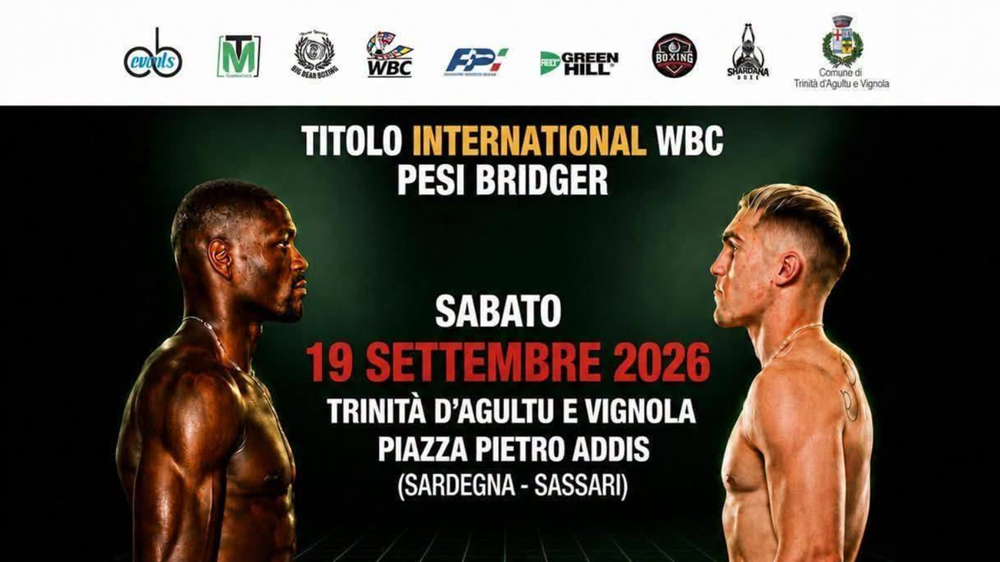
The last seven months in cruiserweight Jonathan Kogasso’s life have been packed with major developments. During this period, “The Mamba” obtained Italian citizenship, captured the European Silver Title by defeating highly rated Ukrainian boxer Ramazan Muslimov, surprisingly parted ways with Edoardo Germani’s TAF after turning down a fight against Clemente Russo, and began working with Alessandra Branco’s Magnesi Boxing Team.
This Saturday will bring yet another crucial moment for him, as the Italian representative, making his first appearance under his new promotional banner, will cross gloves with talented Argentine Kevin Cristopher Ramirez in Piazza Pietro Addis, Trinità d’Agultu e Vignola, Sardinia.
Here is our analysis and prediction for this fascinating bout, which will be contested for the WBC International Bridgerweight Title and broadcast live on Rai Sport.
Jonathan Kogasso and the climb up the mountain called WBC
Some observers, taking a superficial view, might turn up their noses at the belt the two fighters will contest in the ring at Piazza Pietro Addis. The bridgerweight division was only introduced recently and is currently recognized solely by the WBC, which inevitably gives it less prestige than more established weight classes.
However, Jonathan’s intention, as clearly confirmed by his trainer Vincenzo Gigliotti, is to continue his career at cruiserweight. It is therefore no coincidence that the two teams agreed on a weight limit of just 92 kilograms, well below the standard bridgerweight limit of 101.6 kg.
Ramirez currently holds a very high position in the WBC cruiserweight rankings, sitting at No. 12. Defeating him would therefore allow The Mamba, currently ranked No. 26, to make a significant leap up the standings and move closer to the upper reaches of the rankings, where major opportunities traditionally become available.
We can already see the first results of the partnership between Kogasso and Alessandra Branco that was officially announced a month and a half ago. The Rome-based promoter has repeatedly shown that she knows how to maintain productive relations with Mauricio Sulaiman’s sanctioning body. It is no coincidence that her leading fighter, Michael Magnesi, spent a long time near the top of the WBC rankings, earning prestigious opportunities both in Italy and abroad.
Kevin Ramirez: the little man who beats up giants
Ramirez’s professional record is not particularly extensive, but the South American boxer has nevertheless attracted the attention of fans and experts thanks to his excellent run in the Boxing Grand Prix, organized in Saudi Arabia by the WBC in collaboration with Riyadh Season.
At the start of the tournament, each of the four weight divisions featured 32 emerging fighters from all over the world, making the level of competition particularly demanding.
The Argentine competed in the heavyweight division and, despite facing opponents considerably heavier than himself, went all the way and lifted the trophy after producing a masterful performance in the final against powerful Bosnian Ahmed Krnjic, the man who had eliminated Italy’s Davide Brito.
Throughout the prestigious tournament, Ramirez made up for his weight disadvantage by troubling his opponents with a high work rate, fast execution, excellent conditioning and outstanding agility. His punch resistance was also impressive, allowing him to trade openly even with heavy-handed fighters such as Krnjic without paying too high a price.
What will happen? Boxe Punch’s prediction
It might be tempting to assume that Ramirez’s impressive performances against the heavyweights he faced in Riyadh mean that, when matched against opponents closer to his own size, the South American could become an absolute wrecking machine. But that would be a conceptual mistake.
When discussing the heavier weight classes, it is important to recognize that some fighters, paradoxical as it may sound, perform better against large, heavy and relatively static opponents, because they are able to capitalize on qualities that become less effective against fighters who are lighter and more mobile.
Take, for example, Jimmy Young, the celebrated boxer of the 1970s who produced outstanding performances against Golden Age heavyweights such as Earnie Shavers, Ron Lyle, Muhammad Ali, George Foreman and Ken Norton, only to have his career effectively derailed by the “small” Ossie Ocasio.
We cannot know for certain whether Ramirez faces the same kind of risk, but my personal feeling is that the Argentine will not be able to trouble Kogasso with the same weapons that caused so many problems for the slow and cumbersome heavyweights in the Riyadh tournament.
At a disadvantage in both height and reach, Ramirez will be forced to close the distance, exposing himself to The Mamba’s counterpunches. Kogasso may not be a true knockout artist, but he nevertheless possesses more than respectable power, and we have already seen how decisive it can be against opponents who try to pressure him without the necessary caution.
Vincenzo Gigliotti told us that his fighter will adopt a cautious approach during the first half of the bout, using the full width of the ring and denying his opponent the chance to thrive in close-range exchanges before gradually increasing the intensity as the rounds go by.
I therefore expect a balanced first half of the fight, with Ramirez’s greater initiative being offset by Kogasso’s range-controlling punches and elegant counterpunching.
Then, in my view, the Italian representative will step on the accelerator and begin to pull ahead on the scorecards, decisively shifting the momentum of the fight just as he did in his last outing against the dangerous Muslimov.
Given Ramirez’s proven durability, I do not consider a knockout particularly likely. However, I believe the Argentine will struggle to get through The Mamba’s defensive fire, will find it difficult to impose his usual pace on the fight and will gradually fall behind on the scorecards as the minutes pass.
I therefore predict a points victory for Jonathan Kogasso, by margins of approximately four points on the judges’ scorecards.