




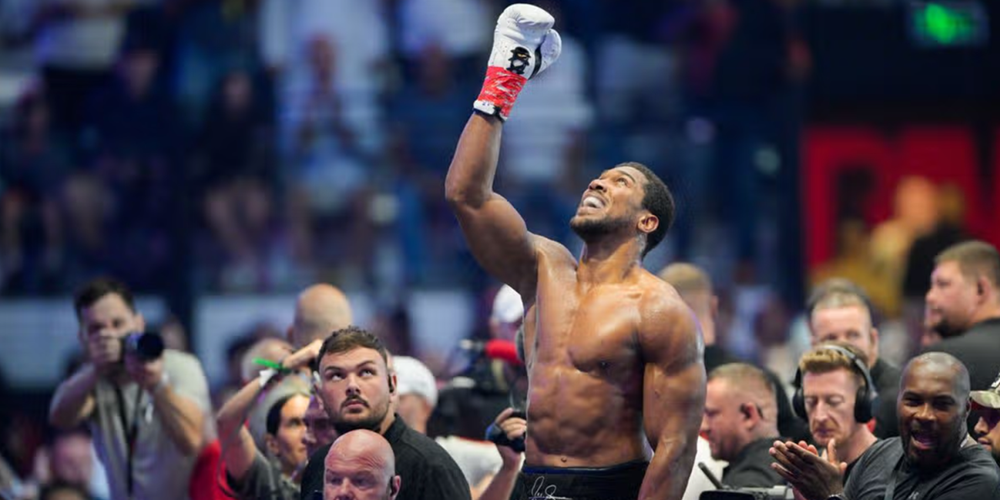
The much-discussed Anthony Joshua vs Tyson Fury showdown came dangerously close to falling apart for good. At the Jeddah Superdome in Saudi Arabia, in what was supposed to be nothing more than a simple tune-up fight, Joshua endured a nightmare opening round, being knocked down twice by Albanian fighter Kristian Prenga and coming close to defeat. The British boxer then turned things around in the second round, which was marked by frankly rather suspicious dynamics and ended with AJ scoring a brutal knockout.
There was barely enough time for fans to settle in and enjoy the spectacle before the pre-fight favorite was already on the canvas. At the first meaningful exchange of the fight, Prenga throwed a wide right hook, following it up with a short uppercut to the chin that caught Joshua off guard and sent him down for the first count of the night.
AJ appeared more embarrassed than stunned: he got back up immediately and showed composure by counting along with the referee, but the episode certainly raised alarm bells mentally while simultaneously giving confidence to his opponent.
Sensing the opportunity of a lifetime, Prenga charged forward, throwing punches wildly and loading up on every shot, fully aware that he was facing a confused and potentially vulnerable opponent. The aggressive approach proved effective: a powerful right hand from the Albanian fighter sent Joshua stumbling backward toward the ropes, and from that moment onward the Briton looked unsteady on his legs and repeatedly resorted to clinching to neutralize his opponent’s aggression.
Late in the round, another right hook to the temple sent the British fighter down once again. He rose with a dazed expression and then struggled desperately to survive until the saving sound of the bell, returning to his corner for the usual instructions.
Almost any other heavyweight in the world, finding himself in Kristian Prenga’s position after such a first round, would have stormed forward at the start of the second round to test whether AJ had truly recovered and attempt to finish the job. Astonishingly, however, the Albanian chose the opposite approach, adopting a cautious, waiting strategy and voluntarily surrendering the center of the ring and the initiative to his opponent.
For much of the second round, Prenga limited himself to circling and covering up, reducing his offensive output to just a handful of hesitant attacks, while Joshua gradually regained confidence, brought his left jab into play, and studied his opponent’s stance in search of the right opening.
With around thirty seconds remaining in the round, AJ pushed Prenga toward the corner with a precise one-two combination before overwhelming him with a three-punch sequence. The final blow, a devastating right hand to the face, sent the Albanian fighter crashing heavily to the canvas.
The feeling that the fight was already over was so strong that Joshua’s corner team began entering the ring to celebrate even before referee Luis Pabon had officially signaled the knockout, only to step back and wait for the completion of the count.
Inevitably, some people online began promoting conspiracy theories about Prenga’s behavior, suggesting that the Albanian had been approached during the minute-long break by an intermediary of Saudi official Turki Alalshikh and somehow persuaded not to derail the hugely lucrative British showdown between AJ and the Gypsy King.
Without evidence, we cannot support such a theory, but neither can we ignore the fact that the defeated fighter committed an inexplicable tactical suicide by suddenly abandoning the explosive aggression that had been bringing him considerable success. If everything happened in good faith, as we hope, Prenga will certainly have major regrets about failing to keep his foot on the gas and wasting a remarkable sporting opportunity.
Regardless of all that, the fight we witnessed further confirms that Anthony Joshua’s career is now approaching its final stages. The former world champion no longer sees punches coming in time, becomes stiff and disorganized whenever he is hit, and loses his balance with alarming ease. Some may argue that his chin was never made of granite, but in all honesty, the fighter who got back up after being “flattened” by a devastating right hand from Wladimir Klitschko and went on to win that fight was unquestionably much tougher and more resilient than the version we see today.
On the other hand, as the Italian saying goes, “if Athens is crying, Sparta is not laughing”: Tyson Fury himself has shown poor physical condition and a significant decline in performance in his recent outings, making the outcome of the showdown uncertain. As we have written several times, it will be a clash between fighters nearing the twilight of their careers, and its result will tell us nothing about what might have happened had the fight taken place at the right time — several years ago.
That train has already left the station, no matter how much promoters, managers, and marketing agencies may try to convince us otherwise.