




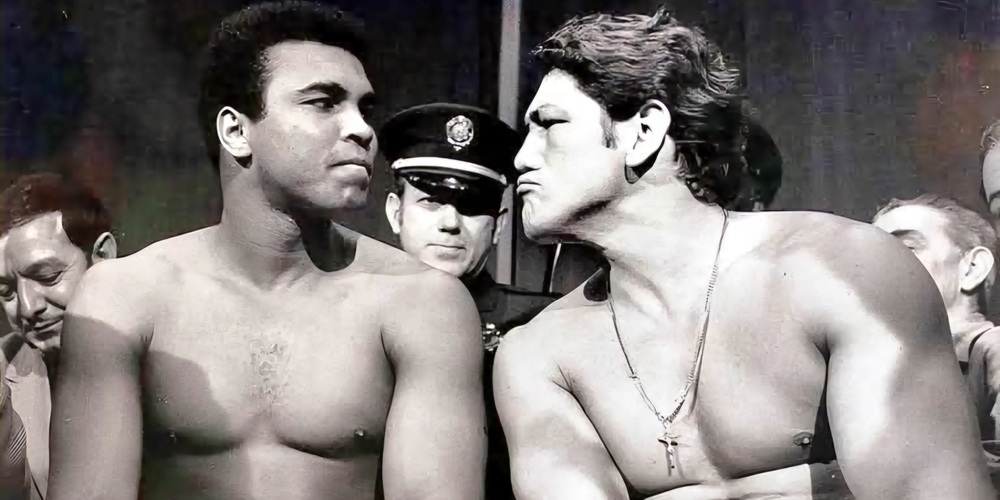
He was excessive, brazen, and rebellious, yet incredibly generous, stubborn, and radiant — one of those people who light up a room the moment they walk in. He loved the good life, women, alcohol, and getting himself into trouble, driven by a carefree and uncontrollable nature exactly like the one he showed inside the ropes. Oscar Natalio “Ringo” Bonavena was probably one of the most famous outsiders in boxing history, capable of capturing the attention of an entire nation and the spotlight of the media of his era, despite never managing to wear a world championship belt.
Oscar seemed born with his destiny already written on his face. When he came into the world on September 2, 1942, in the heart of the working-class Parque Patricios neighborhood in Buenos Aires, his father had no doubts: that baby with the flattened nose and instinctively clenched fists would become a boxer.
Raised in a warm and noisy family of Italian origins, made up of his parents and about ten siblings, amid a constant mix of Calabrian and Ciociarian dialects, Oscar soon began to feel the call of the ring. At the age of seven, his mother, Doña Dominga, gave him a pair of boxing gloves and red shorts bearing the name Joe Louis. And during Carnival, using a burnt cork, she painted his face black so that the transformation would be complete.
Young Oscar grew up strong and sturdy, developing powerful shoulders and arms partly thanks to his hard work as a butcher’s assistant, carrying huge quarters of meat on his back. Although he dreamed of football and wearing the Huracán jersey, a serious physical defect blocked his path: flat feet. He had an unusual posture and awkward gait, but inside the ring these became advantages, making him unpredictable.
Bonavena was a natural left-hander converted to fighting orthodox, gifted with tremendous toughness, an indomitable temperament, and punches as heavy as boulders. His amateur career was dazzling: he suffered only two defeats throughout his entire amateur run, though one of them cost him a spot at the 1960 Rome Olympics where the heavyweight gold would eventually go to Italian boxer Francesco De Piccoli and the light heavyweight title to a young Cassius Clay.
Then, at the 1963 Pan American Games, irritated during a clinch by his opponent Lee Carr, Bonavena bit the man’s nipple and was immediately disqualified, abruptly ending that chapter of his life, betrayed by his fiery nature.
To climb boxing’s highest peaks, Bonavena landed in the United States on September 4, 1965. In Times Square, an elderly woman mistook him for the Beatles’ drummer because of his bowl haircut. That was how the nickname “Ringo” was born — a trademark that would stay with him forever.
As a professional, his record was impressive: 68 fights, 58 victories, 44 by knockout. In the United States his star shone brightly. He defeated men such as George Chuvalo and Billy Daniels, was soundly beaten by Zora Folley, but later avenged that loss.
Back in Argentina, he packed the legendary Luna Park arena for a showdown with national champion Gregorio Peralta. Bonavena won the fight after provoking his rival for weeks, yet after the final bell he invited him to Doña Dominga’s house for fettuccine. Peralta refused, and Oscar never stopped teasing him about it for years.
Later, when Oscar met Peralta again after the latter had faded and fallen on hard times financially, Bonavena knew a defeat would deprive Peralta of a decent purse. So he endured the crowd’s boos and “played around” in the ring, disguising his superiority to secure his rival a draw.
Besides being a solid and feared boxer, Ringo was also an absolute pioneer of modern sports marketing, a born showman who understood the importance of the media before the rise of commercial television. Outside the ring, his life became a chain of excesses: beautiful women, tailored suits, and diamond rings. He reinvented himself as a pop singer by recording the song “Pio Pio Pa,” written by Palito Ortega, which climbed the charts and sold thousands of copies. He appeared on theater stages and became a regular face on talk shows. Yet behind the provocateur’s armor remained the boy from Parque Patricios, deeply attached to Doña Dominga. Every Sunday, Argentine cameras and photographers waited outside his mother’s modest home to capture the image of his luxurious car parked there, where Ringo always returned for the lunch prepared by his mother.
Ironically, his worldwide consecration came through his most legendary defeats. The first great epic was his two-fight saga against undefeated “Smokin’” Joe Frazier. In their first clash at Madison Square Garden in 1966, the American entered the ring with a spotless record of eleven knockout victories, only to find himself facing an immovable mountain. In the second round, the Argentine nearly pulled off the impossible, knocking Frazier down twice. Frazier had to dig into unknown reserves of energy and survived by a miracle, eventually winning on points via a split decision heavily disputed by the crowd. The rematch took place two years and three months later in Philadelphia, this time with the world title on the line. It was another brutal war, ending with a clearer verdict in Frazier’s favor, but Ringo never went down, displaying a granite chin and confirming himself as a dangerous heavyweight for anyone alive.
Having missed his chance at the world title, Bonavena still remained the ideal opponent — credible and entertaining — for Muhammad Ali’s grand comeback after his long forced exile from boxing. On December 7, 1970, the lights of Madison Square Garden shone on fifteen rounds of rare intensity. The build-up was a masterpiece of psychological warfare orchestrated by the Argentine. During press conferences he enraged Ali, publicly calling him a “chicken” for refusing the Vietnam draft while also provoking him on racial and personal grounds. Inside the ring, Ringo backed up his words with action. In the ninth round, a devastating counter left hook buckled Ali’s knees and brought him within inches of a knockout defeat. Bonavena’s resistance only collapsed in the fifteenth and final round, when Ali managed to floor him three times, forcing a technical knockout stoppage. Before that night, Ringo had never been knocked down in his entire career. Argentina welcomed him home like a true popular hero.
By the mid-1970s, Oscar’s sporting decline had begun. Officially he was thirty-three years old, but his body felt twice that age, worn down by a life of excess. He started frequenting seedy bars, sipping whiskey among shady characters, prostitutes, street fights, and police sirens flashing through the night.
Eventually Oscar signed a contract with Joe Conforte, a shady Italian-American owner of the Mustang Ranch, Nevada’s first legal brothel. It marked the beginning of the end. Bonavena’s explosive and arrogant personality quickly poisoned the relationship between the two men. Worse still, Oscar began a secret affair with Conforte’s seventy-year-old wife Sally, who managed the boxer’s contracts. She even gave him a vintage car and made him co-owner of several businesses. Tensions with the mob-connected Conforte became unbearable. The boss ordered Ringo never to show his face again and gave him money for a one-way ticket back to Buenos Aires.
On May 22, 1976, incapable of obeying orders, remarkably gifted at getting into trouble, and perhaps convinced he was untouchable, Bonavena returned one last time to the gates of the Mustang Ranch to “settle” the situation. He was denied entry, and from the ranch tower Willard Ross Brymer, Conforte’s bodyguard, opened fire with a Remington 30-06 rifle. One shot to the chest killed Ringo instantly.
The life of Oscar Natalio “Ringo” Bonavena came to a brutal end at the age of thirty-three outside the gates of a Nevada brothel. A paradoxical finale for one of the most charismatic, unruly, and beloved heavyweights in boxing history.
Before being an athlete, Bonavena was a pop-cultural phenomenon, a born provocateur, and an absolute idol of the Argentine people. Fifty years after that tragic night, we like to remember him this way: smiling, with a whiskey on the rocks in one hand and a cigar in the other — insolent and hedonistic, yet also incredibly sincere and authentic.