




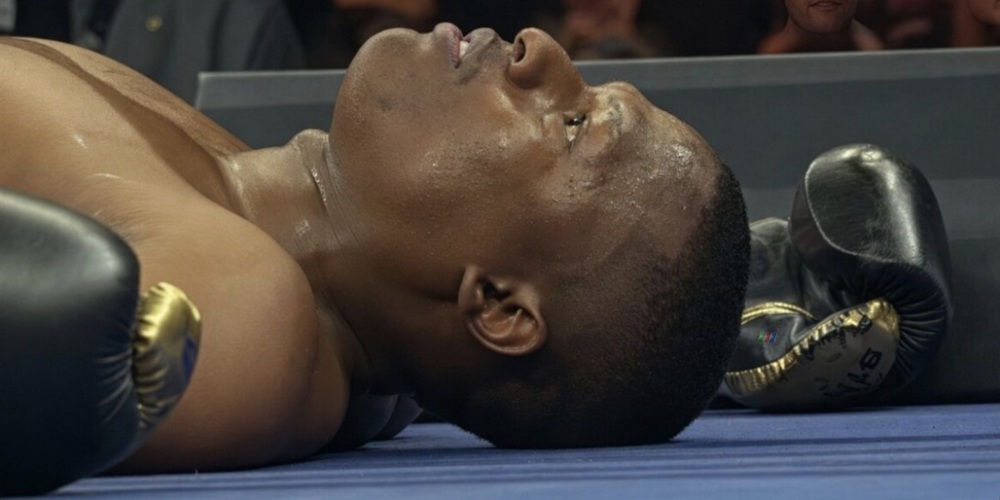
Last Friday night, at the SAP Arena in Mannheim, 26-year-old German heavyweight Viktor Jurk scored an extremely quick knockout over Colombian fighter Edwin Castillo, dropping him for the full count with the very first punch of the fight. We covered the incident through a post on our Facebook page, strongly criticizing the performance of referee Marian Gavrila, which in our view was highly unprofessional. However, the footage of the incident sparked controversy and match-fixing accusations online, which is why I believe it is appropriate to put some reflections on the matter into writing.
A brief recap of the facts
The bell rings. Jurk aggressively moves toward his opponent, who appears to extend his glove for the traditional opening touch. The German ignores it and throws a violent full-force left hand that sends Castillo crashing backward to the canvas. After hitting the floor, the Colombian briefly rolls onto his side, then returns to a supine position and remains motionless, staring blankly, throughout the referee’s count.
The referee continues counting all the way to ten despite Castillo lying there as still as a statue. Then, after waving the fight off with the traditional arm gesture, he turns around and starts walking away. After taking a couple of steps, he stops, turns back, returns to the fallen fighter and bends down to remove the mouthpiece from Castillo’s mouth while finally signaling for medical assistance to enter the ring.
Supporters of the “fixed fight” theory mainly point to three elements to justify their suspicions.
- The first is that, from some camera angles, the punch appears to land on the shoulder rather than the face, which would supposedly make the observed effects implausible.
- The second is that Castillo did not lose consciousness instantly, extending one arm toward the ropes during the fall and briefly rolling onto his side before becoming motionless.
- The third is that the Colombian’s cornermen did not rush into the ring to help him, which would supposedly prove that they themselves were aware of the alleged act.
In my opinion, none of these elements is fully convincing, for the reasons I am about to explain.
Are we sure it only hit the shoulder?
A careful viewing of all the available footage, slowed down appropriately, does not provide certainty that Jurk’s punch failed to connect with Castillo’s face and only hit the shoulder, as some users online have claimed. On the contrary, rewatching the punch from every angle creates the opposite impression. In this freeze-frame, you can see that Jurk’s glove travels above Castillo’s left shoulder and impacts sideways in an area between the throat and the jaw.
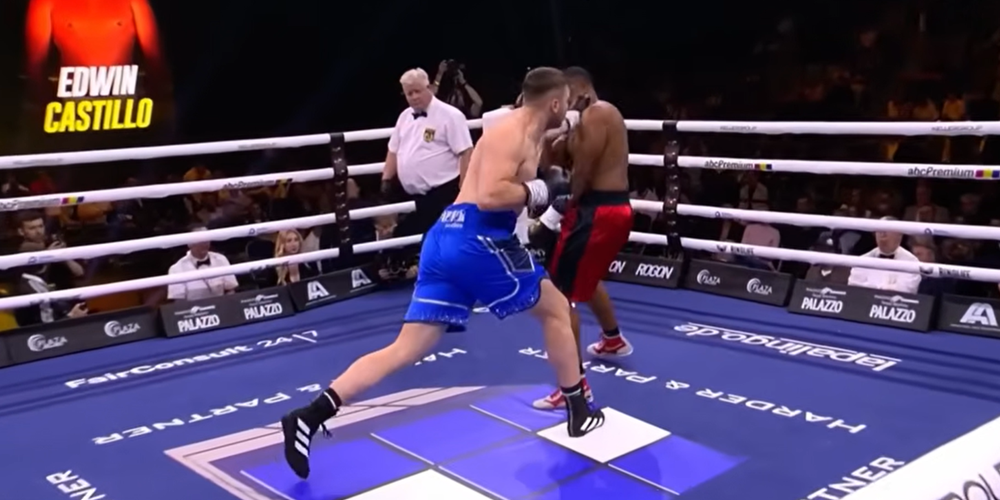
The footage shot from the camera positioned behind Castillo, which we showed yesterday on our Facebook page, makes the “shoulder punch” theory appear even more doubtful and unlikely, especially because it captures the Colombian’s vacant stare during the fall.
The well-known delayed effect of knockout punches
Those who argue that, in the case of a genuine knockout, Castillo should have lost consciousness at the exact moment of impact — or that he would never have instinctively reached toward the ropes while falling — clearly have not watched enough boxing fights to speak authoritatively on the matter.
It is well known that punches to the face affecting the nervous system can manifest their effects with a slight delay after landing. Boxing history is full of examples of fighters collapsing seconds after the punch connected (Trevor Berbick being knocked out by Mike Tyson comes to mind) and situations in which a boxer rendered unconscious by a punch continues to perform instinctive movements (such as Simon Brown after being knocked out by Vincent Pettway).
The affection of cornermen is not guaranteed
The observations of those who insist that Castillo’s seconds would certainly have rushed into the ring immediately if the Colombian’s health had truly been in danger also reveal limited knowledge of certain dynamics within professional boxing, particularly those involving so-called “journeymen.”
These are fighters with no real prospects, “professional losers” interested solely in earning the purses necessary to get through the month. It is not uncommon, especially when they come from distant countries, for them to arrive at the venue without an actual team. I have personally attended boxing events in Italy where a local trainer was asked as a favor to work the corner of a South American, African or Asian fighter.
I do not have enough information to state with certainty that Castillo was in such a situation. However, I certainly would not assume that his relationship with the man wearing the “USA” hoodie on Friday night — who climbed into the ring to check on him only after a considerable delay — was necessarily long-standing or based on deep friendship.
A terrible refereeing performance
Having established that none of the arguments presented by conspiracy theorists allows us to conclude with reasonable certainty that Edwin Castillo staged a fake knockout, the performance of referee Marian Gavrila remains absolutely indefensible.
After seeing the Colombian fighter lying motionless on the canvas with his eyes wide open, Gavrila should have immediately stopped the count and urgently called medical personnel into the ring. Just as quickly, he should have removed Castillo’s mouthpiece to prevent the risk of suffocation.
Instead, his actions appeared marked by complete carelessness. Gavrila kept counting a man incapable of moving; then he turned his back on him as if, once the count ended, the fighter’s condition was no longer his concern; then, thankfully, it finally occurred to him that he should remove the mouthpiece…
In our post on Saturday we wrote that Gavrila should never referee again, and today we repeat it with complete conviction. Professional boxing is a dangerous sport, and in order to minimize risks it is essential that those responsible for enforcing the rules follow proper protocols and possess common sense.