




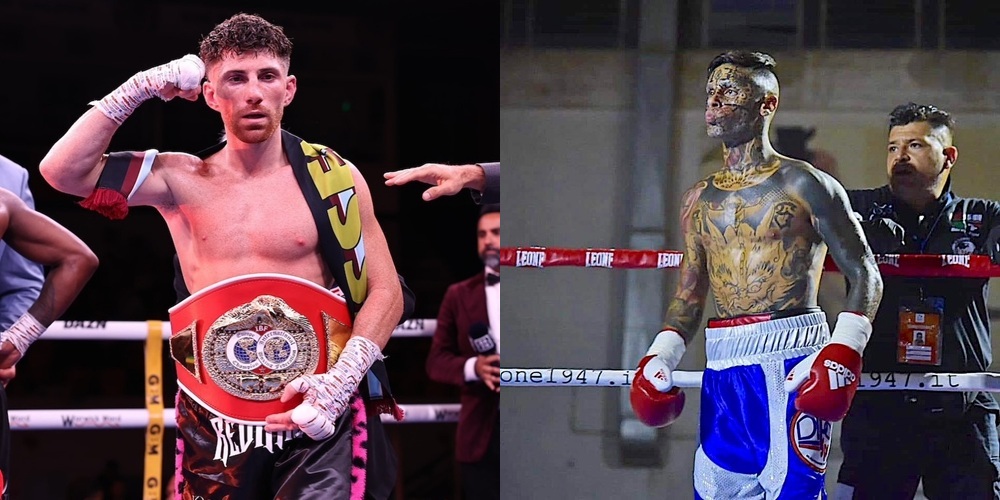
We had included it in our list of “dream Italian derbies,” we got excited when the EBU named the two fighters as co-challengers for the European title, and finally we were disappointed when the fight fell through amid mutual accusations. Francesco De Rosa and Alessio Lorusso, the two best Italian super bantamweights, will not face each other—or at least not anytime soon. In this piece, I will try to reconstruct what happened and offer some reflections on the situation.
A recap of events
As mentioned in the introduction, the two protagonists of this article were supposed to meet for the European title following the relinquishment of the belt by the previous holder, Britain’s Shabaz Masoud.
After an initial private agreement between the parties and its subsequent cancellation, the two teams went to purse bids. The promotional rights were secured by Promo Boxe Italia, led by Mario Loreni—who promotes De Rosa—thanks to a €40,000 offer. Danger Promotion, headed by Simone Verdicchio, bid €38,000, showing real interest in the event but falling just short.
At that point, everything seemed set to move forward smoothly, but Alessio Lorusso decided to take a different path, proposing that Francesco De Rosa also abandon the EBU route. On March 27, Danger Promotion published on social media a screenshot of a private chat (with the other party’s name hidden), showing the following exchange:
- Do you want to do the IBO world semifinal Lorusso vs De Rosa?
- De Rosa is doing the European
- Not interested in a world semifinal?
- No
The post was accompanied by the caption: “Lorusso vs De Rosa: De Rosa refuses. The IBO world semifinal Lorusso vs De Rosa will not happen. De Rosa has refused our offer.”
The subsequent developments were predictable: Lorusso gave up his EBU co-challenger status, opting for the path proposed by the IBO, while De Rosa retained his position and will face France’s Thomas Masson for the European title.
Social media skirmishes: the fighters’ positions
Francesco De Rosa and Alessio Lorusso did not miss the chance to trade barbs on social media over the responsibility for the failed fight. Their respective positions are easy to summarize, as they have been publicly stated.
De Rosa, fully backed by Promo Boxe Italia—which issued a clear statement two days ago—considers the European title a highly prestigious achievement. The Campania-born boxer does not intend to trade that opportunity for a semifinal leading to a title—the IBO belt—which De Rosa has described as “a minor world title.”
Lorusso disputes that view, pointing out that the IBO title has been and still is held by major champions. He also noted that he already won the EBU belt four years ago and stated his intention to pursue higher goals. From his perspective, the global nature of the IBO title surpasses the continental value of the EBU belt.
Right and wrong, facts and opinions
So who is right? Regarding titles and their importance, some considerations can be based on objective facts, while others inevitably fall into the realm of personal opinion.
An undeniable fact is that the IBO title cannot be placed on the same level as the WBC, WBA, IBF, and WBO belts in terms of value. This is evident not only because the IBO is not recognized by the International Boxing Hall of Fame—unlike the four major organizations—but also because of how it is treated in reports by the most authoritative international journalists, who never refer to a fighter holding only the IBO belt as a “world champion.”
De Rosa is therefore correct in calling it a “minor world title,” and Lorusso’s argument that it has been held by big names is not entirely convincing. The IBO has adopted a clever self-promotion strategy, placing its belt on the line in high-profile fights where other major world titles are already at stake. Since its sanctioning fees are significantly lower than those of the major organizations, fighters and promoters are happy to accept it as “an extra belt.”
A quick check shows that while it is true that current IBO champions include elite fighters such as Oleksandr Usyk and Dmitrii Bivol (who also hold top-tier belts), it is also true that across seventeen weight classes the IBO currently has only nine champions, and some of them—such as Albanian cruiserweight Juergen Uldedaj or Irish super featherweight Jono Carroll—are far from the top of the global scene.
So which carries more weight, the EBU title or the IBO title? Here we enter the realm of subjectivity, as there is no official hierarchy of belts. For what my “very personal” opinion is worth, I greatly prefer the history, tradition, and meaning of the EBU belt. If I had to advise a boxer friend on which path to pursue, I would have no doubt in suggesting he aim to become European champion.
Does that mean Alessio Lorusso made the wrong choice? Not necessarily. The Lombardy-based fighter can legitimately have a different view on the prestige of these titles and feel more motivated by the idea of capturing the IBO belt—especially considering he has already held the EBU title in the past.
More questionable, in my view, was the decision by Danger Promotion to make a private conversation public in order to “stir up” Lorusso’s fans against De Rosa, who was unfairly accused of cowardice by those who seem to forget that less than two years ago the Salerno fighter went to the United Kingdom and battered a highly regarded local prospect.
The two athletes will now go their separate ways, and as neutral fans we can only wish them both great success—and perhaps hope their paths will cross in the future, after they have added a few more significant victories to their resumes. Because at Boxe Punch, our desire to see this derby has not faded yet.