




In every historical era—including those that today seem glorious and untouchable—the heavyweights have been heavily criticized by fans and analysts. Nostalgia for past champions has often turned into disdain for contemporary ones, to the point of clouding the judgment of those who let emotions override rational thinking.
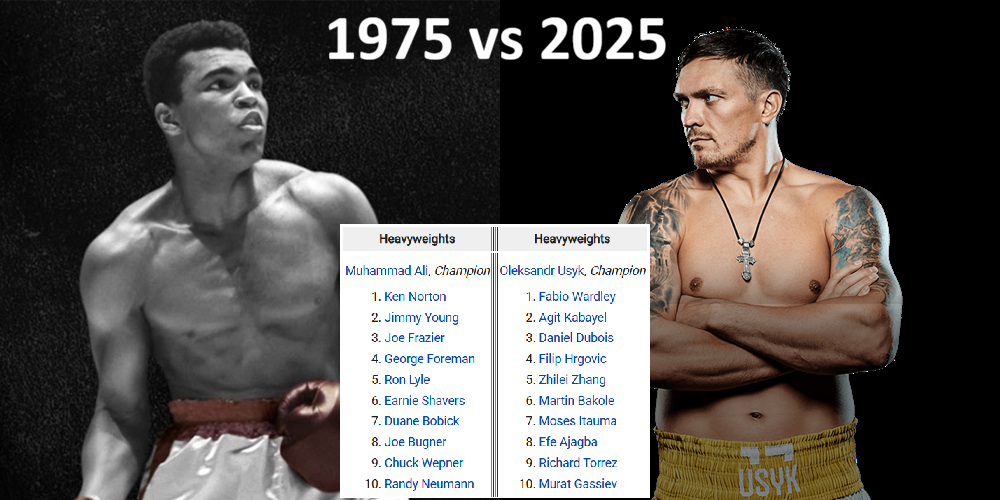
Today I decided to run an experiment. I took The Ring magazine’s end-of-year rankings for 2025, the most recent “annual” list available, and placed them alongside the rankings from the end of 1975 to compare the much-maligned present with the state of the heavyweight division exactly fifty years earlier, in the middle of the mythical 1970s.
I then gave my take on eleven fantasy matchups, asking myself who would win if fighters ranked in the same position in the two lists could face each other in the ring—obviously considering them in the form they had at that specific point in time. Here’s what came out of it!
Position No. 10: Randy Neumann vs Murat Gassiev
Neumann was a rather mediocre fighter. At certain points in his career he may have given his managers some hope, but every time he tried to raise the level of competition he suffered heavy defeats. His place in the 1975 year-end rankings is a mystery, given that the American had just been battered by fellow countryman Duane Bobick and was considering retirement. Although Gassiev is now a much slower and more cumbersome fighter than he was at cruiserweight, the Russian has shown against Pulev that he can still deliver devastating punches. I therefore believe he would win fairly easily. Gassiev by KO.
Position No. 9: Chuck Wepner vs Richard Torrez
Wepner is one of those fighters remembered more for his losses than his wins. He’s known, for example, for the stubborn resistance he showed against Muhammad Ali, which inspired Sylvester Stallone to create the character of Rocky, but also for the beating he took against Sonny Liston, who reduced his face to a bloody mask using only his left hand. Torrez is certainly not a phenomenon, but he is powerful, effective, and relentless with his pressure. Wepner’s heart wouldn’t be enough to hold him off. Torrez by TKO (cut).
Position No. 8: Joe Bugner vs Efe Ajagba
Despite being only 25 years old, Joe Bugner at the end of 1975 was, in my opinion, less effective than he had been a few years earlier. Putting on some extra weight had hurt his mobility, and indeed his second loss to Muhammad Ali was clearer than the first. Nevertheless, the Brit was still a very solid boxer, with a granite chin, an excellent jab, high-level defense, and tactical intelligence. Ajagba has Herculean strength, very long reach, and great power, but he is extremely stiff in the upper body, and predictable in his attacks. Bugner might struggle at times, but he would find a way to neutralize him. Bugner by decision.
Position No. 7: Duane Bobick vs Moses Itauma
This is, in my view, one of the easiest predictions on the list. Bobick was carefully managed in the early part of his professional career and racked up a long winning streak, but when he was forced to face quality opposition he came up short. The American had very poor defense and struggled badly against heavy hitters. Although he still has much to prove, I believe Itauma has all the tools to become the next dominant force in the division. I think he would dispose of Bobick within two rounds, if not in the first. Itauma by KO.
Position No. 6: Earnie Shavers vs Martin Bakole
I have great affection for Shavers: I’ve read his wonderful autobiography, I admire him immensely on a human level, and I get excited rewatching his thrilling fights. However, I think this stylistic matchup would be very problematic for him. Bakole is like a mountain in (slow) motion: he absorbs everything and keeps pressing forward relentlessly. Shavers would certainly shine in the early rounds, and I wouldn’t rule out him landing a decisive punch, but if he failed to do so, he would run out of gas and eventually be overwhelmed, as happened several times in his career. Bakole by KO.
Position No. 5: Ron Lyle vs Zhilei Zhang
Here we have the opposite situation compared to the previous matchup. In this case, the modern fighter—Zhang—would have the best chance early on, while still fresh. One of his ballistic missiles could certainly take Lyle out, but Lyle was tough and durable. I find it more likely that the American would weather the storm and then take advantage of the Chinese fighter’s advancing age to wear him down and force a stoppage in the later rounds. Lyle by KO.
Position No. 4: George Foreman vs Filip Hrgovic
Even trying to imagine alternative scenarios, I can’t see any outcome other than a total massacre in this fight. Although Foreman at the end of 1975 was psychologically fragile, haunted by his recent loss to Ali, “Big George” was still a devastating war machine. Hrgovic, moreover, does not have the right attributes to frustrate Foreman and to make him see the ghosts of a second Rumble in the Jungle, as Jimmy Young did in 1977. The Croatian would take a brutal beating. Foreman by KO.
Position No. 3: Joe Frazier vs Daniel Dubois
At the end of 1975, Joe Frazier was coming off the third and final chapter of his trilogy with Muhammad Ali, the legendary Thrilla in Manila. It was such a violent and grueling war that it pushed both fighters to the limits of human endurance, to the point that neither was ever the same afterward. I believe that a prime Frazier would have neutralized the size difference against Dubois with his agility and would have finished the Brit with his left hook. But by late ’75, the best “Smokin’ Joe” existed only in the memories of fans. Asking him, at that point in time, to face a puncher nearly 15 kilos heavier would have been pure sadism. Dubois by KO.
Position No. 2: Jimmy Young vs Agit Kabayel
We’re talking about two “specialists” who, throughout their careers, maximized their strengths by adopting styles perfectly suited to them—and extremely awkward for their opponents. Young was a master of elusiveness, Kabayel a master of demolition: a fascinating clash of strategies, with the German pressing forward aggressively and the American moving along the ropes, countering. At the end of ’75, Young was at the absolute peak of his career: in the following years he lost a controversial decision against Ali and defeated both Lyle and Foreman. In my opinion, he would manage Kabayel’s relentless but one-dimensional pressure well enough to edge the decision. Young by decision.
Position No. 1: Ken Norton vs Fabio Wardley
Norton was outstanding against mobile and technical opponents, but extremely vulnerable against explosive punchers. His chin was not on par with his other qualities, and his cross-arm defense was ill-suited to heavyweights who attacked him head-on, forcing him into close-range battles. Wardley is undoubtedly far less technically gifted than Norton and would almost certainly fall behind on the scorecards. However, his explosive power could turn the fight around at any moment—an outcome I personally consider likely enough to influence my pick. Wardley by KO.
The Champions: Muhammad Ali vs Oleksandr Usyk
Here the discussion is similar to what was said about Frazier vs Dubois. While I consider Usyk an extraordinary talent and believe he would be highly competitive in any era, I would favor Ali if we were talking about “The Greatest” at his peak. However, like Frazier, Ali came out of the brutal war in the Philippines badly worn, and in the years that followed he delivered several underwhelming performances. Despite being older in terms of age, I believe the Usyk of late 2025 is a more intact and effective fighter than the Ali of late 1975. For that reason, if I had to bet, I would side with the Ukrainian. Usyk by decision.
Final Result
1975: 4 wins
2025: 7 wins
Conclusions
Beyond opinions on the outcomes of individual matchups—which are obviously subjective and open to debate—I can already imagine one of the main criticisms of this article: that I “chose” a year in which the legends of the 1970s had already begun to decline.
This objection misses the point, and not only because my choice was made in good faith, guided solely by the round figure of a fifty-year gap. This article does not prove—nor could it—that the present is better than the past: there are years in which the result of this exercise would have been different, and others in which it would have been the same.
That’s because the level of a given weight class in boxing tends to fluctuate over time. It doesn’t steadily decline for decades as the eternal nostalgics claim, nor does it progress toward perfection as the devotees of modernity argue.
My invitation, therefore, is to become “omnivorous” fans: constantly refreshing our memory by watching the great champions of the past, but without dismissing today’s fighters out of pure prejudice—some of whom deserve thunderous applause and deep admiration. Oleksandr Usyk above all.