




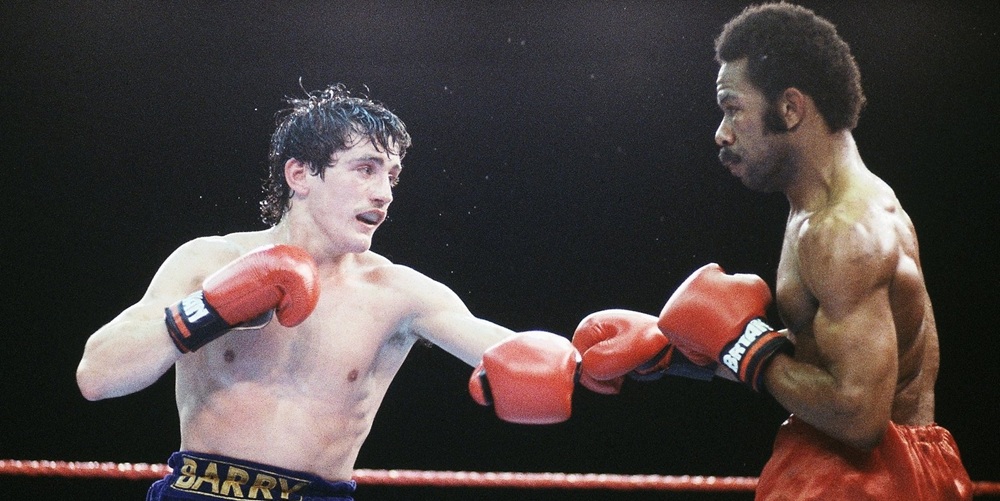
Ireland, the Emerald Isle, is a land of boundless landscapes historically marked by political and religious tensions that have undermined its peace and unity. It was precisely in a context of growing tensions that Finbar Patrick “Barry” McGuigan was born, on February 28, 1961, in Clones, in the Irish county of Monaghan, located near the border with Northern Ireland. In his own way, Barry would go on to leave a profound mark on the history of both countries and on the history of boxing.
The son of well-known singer Patrick McGuigan, Barry’s childhood was shaped by the social tensions of the Troubles in Northern Ireland. He described that period as “terrifying,” recalling how he and his brothers had to face a reality of violence, death, and explosions:
“It was a terrible time in Irish and Northern Ireland’s history, people were dying every day and the tension in certain parts of Belfast and other areas of Northern Ireland was terrifying.”
His father was a central figure in his life. Pat struggled with alcoholism, yet that did not prevent him from forming a close bond with his son. He was a source of inspiration, support, and guidance. He proudly backed Barry’s career, traveling all over Ireland to allow him to compete in amateur tournaments. Often, before his fights, he would sing “Danny Boy” for him and the crowd—a tradition that became symbolic in the history of the McGuigan family and of Ireland itself. That ballad managed to make Catholics and Protestants alike cry and sing together in the arenas of Belfast and London, when any anthem might have had the opposite effect—divisive and inflammatory. His father’s struggles also kept Barry away from alcohol and helped him focus on his life goals.
Barry began boxing at a very young age, finding in the sport an escape from the turmoil tearing his homeland apart. His rise in the boxing world was swift and successful. In 1978, at just 17 years old, he represented Ireland at the Commonwealth Games in Edmonton, Canada, winning the gold medal in the bantamweight division and drawing attention for his outstanding boxing skills. Two years later, he competed at the Moscow Olympics, reaching the round of 16, where he was defeated by Zambia’s Winifred Kabunda. It was the final chapter of his amateur career.
The following year he made his professional debut in Dublin, defeating Selvin Bell by technical knockout. It was 1981, and that same year he married Sandra Mealiff, whom he had known since childhood. Their interfaith marriage—he Catholic, she Protestant—caused a stir in a Northern Ireland torn by conflict. But Barry refused to let political or social issues dictate his life or career:
“We lived just over the border in a place called Clones. Clones would have been considered a republican town and sympathetic to the IRA so what I did back then would have been considered a fairly audacious thing to do. But I was resolute in that I was not going to be intimidated by the IRA or any other terrorist organisation for that matter. I got threats from the IRA and I had to have plain-clothes policemen shadow me on both sides of the border for about a year or more.”
On June 14, 1982, McGuigan faced Nigerian fighter Young Ali, winning by knockout in the sixth round. After the defeat, Ali fell into a coma. According to Barry, he was first taken to the wrong hospital, which was not equipped to treat him, and was then transferred to another facility where he underwent surgery for a subdural hematoma. It was all in vain. He died five months later, plunging Barry into deep depression: “I didn’t know whether I wanted to box again.”
He considered retiring, but despite the psychological burden of that tragedy, he decided to continue. In 1983, he became British featherweight champion by knocking out Vernon Penprase in the second round.
That same year, Barry faced and defeated Italy’s Valerio Nati by sixth-round knockout to claim the European title. It was a brutal fight, with a red-hot atmosphere in Belfast, where more than 7,000 fans cheered their hometown hero:
“It was my first attempt to box in the Kings Hall, which had a capacity of 7000 as opposed to the 1500 that the Ulster Hall could hold so it was a substantial risk but we got a huge turnout and I got Nati out of there in round 6. Valerio was a tough kid and he came to fight. I dropped him with a double left hook to the body and as soon as he got to his feet I was on top of him again and I dropped him a second time with another left hook to the body and he couldn’t continue and was counted out.”
Despite the loss, Nati found a large group of Irish fans waiting for him back at the hotel, ready to celebrate the courage he had shown in facing Barry. But that is another story.
Barry’s rise continued the following year, punctuated by knockouts. The only fighter who managed to take him the distance—though still losing—was Juan Laporte. Barry was a relentless pressure fighter, able to close the gap and work the body with rare ferocity. His punching power and ability to land significant shots with both hands led him, in 1985, to face the legendary Eusebio Pedroza in London, in front of 27,000 spectators, for the WBA featherweight world title—a belt Pedroza had held for seven years. This is the vivid memory Barry recalls:
“Pedroza raced out into ring centre and tried to back me up. I engaged with him right away and we set the tone of the fight. It was a battle to try and control ring centre. I knew that I would have no chance of winning if I couldn’t force Pedroza back and keep him under pressure. So for the first 6 rounds it was a real battle of wills, me trying to force Pedroza back and him trying to control ring centre. It was a relentless battle until I dropped Pedroza near the end of the 7th round. The crowd went crazy when Pedroza hit the deck but when he got to his feet he fought back with all his might. Nevertheless for me that was a pivotal moment in the fight.”
Barry went on to win clearly on points by unanimous decision after 15 rounds, which crowned him world champion.
He was first carried in triumph by the crowd in attendance, and later honored with a public parade through the streets of Belfast, which drew hundreds of thousands of supporters. It was the pinnacle of his career, culminating in his being named BBC Sports Personality of the Year—an award given for the first time to an athlete not born in the United Kingdom.
In 1986 Barry defended his title twice, against Bernard Taylor and Danilo Cabrera, before flying to Las Vegas to face American fighter Steve Cruz.
The atmosphere was utterly surreal: it was June and the fight took place outdoors, in the parking lot of Caesars Palace, under a scorching sun and infernal heat. McGuigan, exhausted by the heat and dehydration, collapsed in the final round and lost the title on points. He was rushed to hospital immediately after the fight to be rehydrated:
“It was a mistake to box outside in June in Las Vegas. My manager Barney Eastwood is dead now and it would be wrong to talk about him in negative terms because so much of what he did was really exceptionally good. However that was a mistake and I hold myself equally responsible. I simply could never have performed to my best under those conditions: it was ridiculously hot and I wilted in the last quarter of the fight. It was 120 degrees ringside. I have a very good friend of mine called Fr. Brian D’Arcy who, as well as being a very well respected priest in Ireland, also writes for a national newspaper. Fr. Brian was ringside that day and he tells a story about his pen melting as he was trying to write his column. Suffice it to say that it was the wrong environment for me to successfully defend my World Title. The argument is that it was equally tough for my opponent Steve Cruz and that is true but he was from Fort Worth Texas which had a similar temperature to Las Vegas and he was second generation Mexican so I think it’s fair to say that he was much more acclimatised to the conditions than I was BUT it was our mistake (Barney Eastwood’s and mine). Plus I won the majority of my fights with relentless pressure and powerful combination punches which worked against me on that occasion because of the conditions. Remarkably I was still in the fight right up to the last round but I was knocked down twice in the 15th round and lost the fight because of those two knockdowns. I promise you I was not hurt or buzzed by either of those knockdowns in the last round, I was simply so exhausted that I couldn’t stand upright but knew I’d lost my World Title.”
The following year his father Pat passed away. His career then entered a downward phase, also marked by his split from manager Barney Eastwood.
He returned to the ring in 1988 under promoter Frank Warren, winning three fights by knockout. But the following year, after a defeat to Jim McDonnell, he retired for good with a record of 32 wins, 28 by knockout, and 3 losses:
“I fought Jim McDonald in a final elimination bout for a crack at the World Title but I sustained a very nasty cut above my eyebrow and the referee stopped the contest. I decided there and then to retire from boxing and walk away with my faculties enacted and I never looked back.”
After his boxing career, Barry McGuigan’s life has been marked by intense involvement in media, sports promotion, and social causes.
In addition to founding Cyclone Promotions, through which he managed Carl Frampton’s career for many years, Barry served as an advisor to Daniel Day-Lewis during the making of the film The Boxer, overseeing the fight choreography. He is also a respected boxing commentator for several major international networks.
In 2019 he lost his daughter Danika to colon cancer.
Barry McGuigan’s life is truly a mosaic in which historical and political moments, tragic events, social conflicts, and symbolic gestures intertwine. At its center stands Barry’s boxing career and personal life, which have crossed through Irish history with dignity and such strength of will that he is remembered today as a symbol of resilience, success, and brotherhood.
On the occasion of his 65th birthday, we take this opportunity to extend our warmest wishes to him, thanking him for his support and for giving us the chance to know him better through his own words.