




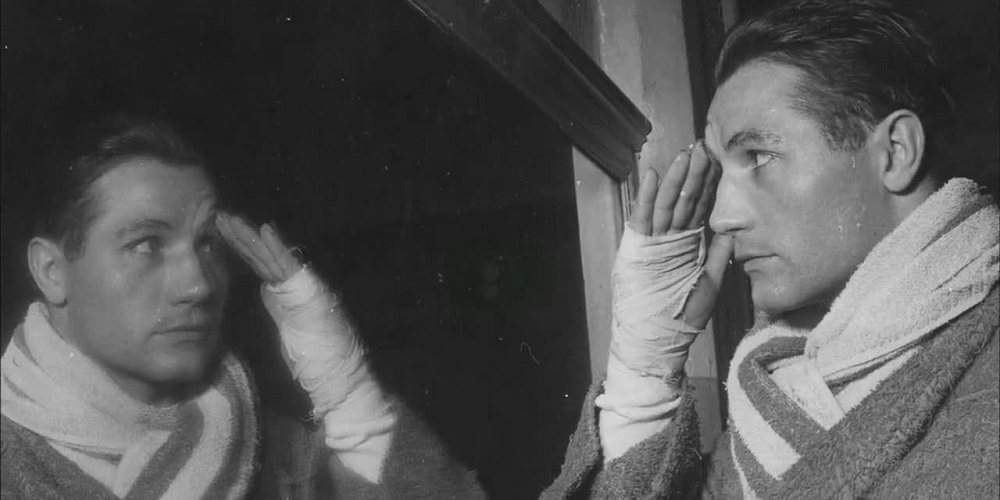
Life’s events, far more than boxing, left deep marks on the face of Tiberio Mitri, a historic champion from a bygone era. His face, etched with deep wrinkles, and his eyes, now devoid of the light that had once animated his spirit in his prime, told more about him than anything else, revealing the torment of a life squandered amid countless regrets.
A troubled story, which began on July 12, 1926, in Trieste, where Tiberio was born. The son of a dockworker with alcohol problems and a tavern keeper, as an infant he was often entrusted to a woman who took him begging and would prick him with a safety pin to make him cry and stir pity in passersby.
He grew up in the San Giacomo district, amid ethnic tensions and constant clashes between neighborhood gangs. He had a turbulent childhood; despite his shy character, he was constantly fighting in the streets with Slovenian and Croatian boys as well as with Lombards and Venetians. To scrape together a few coins, he stole brass and copper handles to resell to junk dealers.
At 10 years old, he lost his father to pneumonia caused by the grueling work down at the port.
Tiberio and his brother ended up at the ECA, the municipal welfare institution, somewhere between a boarding school and a reform school, where young people from struggling families were sent. But that place was hell for young Mitri, so he ran away and found himself back on the war-torn streets of Trieste.
He returned to his neighborhood, trying to get by with odd jobs. Someone noticed him and convinced him to join a boxing gym, since he could handle himself with his fists. But he attended without conviction or motivation.
In 1942, at just sixteen, he volunteered for the Navy, but a year later he was captured by the Germans who had invaded the city. He was interned at San Sabba, the only extermination camp in Italy, where Jews were burned and partisans tortured. To save himself and avoid deportation, Tiberio was forced, against his will, to enlist in the railway militia. As fate would have it, the militia commander was also the president of the boxing committee. That is what saved Tiberio.
Subjected first to the atrocities of the Germans and then to Tito’s troops, Trieste experienced every imaginable horror. But on June 12, 1945, Allied forces regained control of the city. From there, Tiberio Mitri’s career began: he resumed training, but with a new spirit, as if seizing a unique opportunity placed in his hands.
Tiberio was a talented middleweight, and his trainer Bruno Fabris immediately turned him professional.
Fabris was an unusual figure: poet, writer, and boxing trainer. He guided Tiberio with passion and dedication, and also taught him how to read and write. Gifted with surprising grace in his movements, Tiberio improved quickly.
At 20, he fought every ten days—and he won. He was fast, technically skilled, effective, and above all physically overwhelming, despite lacking one-punch knockout power. Soon came the European title, captured unexpectedly against Cyrille Delannoit.
Everyone fell in love with Tiberio and his dazzling boxing. Meanwhile, Trieste was being reborn in the postwar years, and life was blossoming again.
Fulvia Franco, a stunning young woman from Trieste, was crowned Miss Italy in 1948. Struck by Tiberio’s charisma and good looks, she sent him a letter with the imprint of her kiss. A relationship followed, landing them on the covers of gossip magazines.
Tiberio was a simple young man, and the contrast with Fulvia’s sophistication and cool demeanor was evident. Yet they soon married in a ceremony that became a national event.
Meanwhile, Tiberio’s career continued, with a successful defense of his European title in Paris against Jean Stock. Tiberio won and was carried in triumph by the French themselves.
Then came the world title opportunity, on the most prestigious stage of all—the Madison Square Garden—against the great Jake La Motta, who strongly wanted Tiberio as his challenger.
Fabris tried to hold him back, warning him that he was not yet ready for such a challenge. But Tiberio’s impetuousness and enthusiasm led him not to listen to his loyal trainer, who refused to follow him on what he considered too risky a gamble.
In New York, Tiberio came into contact with Frankie Carbo, the man who controlled Italian-American Mafia betting operations. The young man from Trieste was not savvy enough to resist the allure and excitement of a transatlantic star’s life, and amid the lights of Broadway and fashionable clubs, he was swept away.
Carbo, the fight’s promoter, also managed Jake La Motta’s affairs. Yet Frankie seemed to be betting on Tiberio as the rising star of world boxing, partly because of his good looks, which sharply contrasted with La Motta’s.
Thus he entrusted Mitri to Saverio Turiello, a trainer within the Carbo orbit. Despite the emotional whirlwind he was experiencing, Tiberio performed well in the bouts leading up to the big fight. Nevertheless, instead of training with dedication, he found himself living in a sort of Hollywood movie, amid ambiguous situations, arguments, and jealous scenes with Fulvia, who flew to Los Angeles seeking film roles.
The fight with La Motta arrived, and the comparison was merciless. Tiberio was flat and could do nothing against his opponent: Jake overwhelmed him with fury, aggression, and punching power. Fifteen rounds of futile and passive resistance—yet stubborn and incredibly courageous.
The physical damage was severe: Tiberio had to step away from the ring for a while, despite agreements with Carbo. He was forced to pay heavy penalties that left him broke.
He fled New York and took refuge in Rome where, with support from his wife’s family, he opened a bar. Meanwhile, he became the protagonist of photo novels.
He returned to boxing, alternating strong performances with weaker ones. He earned another shot at the European title and, in 1954, became champion again by knocking out Randolph Turpin in a single round with a magnificent left hook. But the joy was short-lived: the same year, he lost the belt to Charles Humez by TKO.
His career was now waning and his marriage in crisis, despite the birth of their son Alessandro. Tiberio and Fulvia separated.
A series of melancholy bouts in Australia closed Mitri’s career.
Upon returning, cinema and television welcomed him. Though in secondary roles, he appeared in Ben-Hur, A Farewell to Arms, and The Great War. These were the years of La Dolce Vita, and Tiberio let himself be carried away—at a cost: alcohol, drugs, numerous women, and a constant swing between euphoria, depression, and violence. He began a troubled relationship with an American heiress, Helen De Lys Meyer, culminating in a stormy marriage that produced a daughter, Tiberia.
In 1967 he was arrested on charges of domestic violence and extortion against his second wife. Tiberio had become a victim of himself. He tried to mend relations with his children. But Tiberia had long lived in America, and his relationship with Alessandro was difficult: the young man was intimidated by his father’s figure, and Tiberio could not empathize with that shy son, who perhaps reminded him of his own past.
He took refuge in Florence, where he spent his days in a trailer on the city’s outskirts. There he lived for a long time with Marinella Caiazzo, his partner for many years, who eventually left him, unable to restrain his excesses, including violent ones.
The end of that relationship pushed him further into decline, and on August 3, 1980, he was again imprisoned in Rome on charges of possession and dealing cocaine.
Once released, he settled in a small apartment in Trastevere.
In 1981 his son Alessandro died unexpectedly of a heroin overdose. In the following years, Tiberio saw Fulvia die of liver cirrhosis and his daughter Tiberia die of AIDS.
Devastated, Tiberio managed to stay on his feet thanks to the support of the Roman Sant’Egidio community, which brought him back to a boxing gym—his world—where he could mentor and advise young fighters.
“I never thought life was this long,” Tiberio once said with characteristic frankness.
In his final years, he was struck by Alzheimer’s and Parkinson’s disease. He wandered, often aimlessly, through the streets of the city, begging, unable to remember that he had a pension. He did not even remember his son’s death. On February 12, 2001, in Rome, at 6:30 in the morning, Tiberio wandered—likely confused—along the railway tracks near Porta Maggiore and was struck by a passing train. Thus, in tragic fashion, the blonde angel of the ring was extinguished, unable to find peace away from the sixteen ropes.