




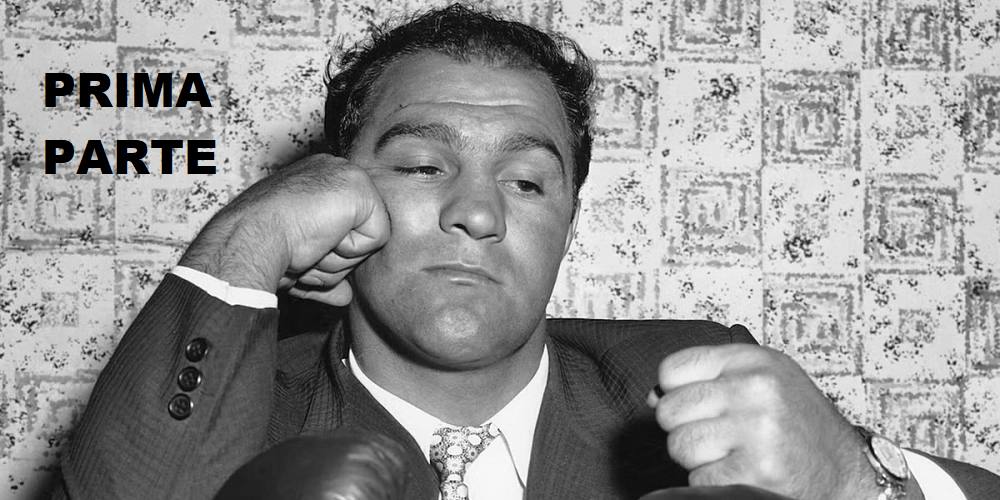
There is no doubt that former heavyweight world champion Rocky Marciano left an indelible mark on boxing history, to the point of becoming an icon of our beloved sport. His unblemished record, his highlight-reel knockouts, and his inexhaustible courage inspired subsequent generations, providing creative sparks for writers and filmmakers alike, eventually turning Rocky into a true pop-culture myth. A myth, however, on which opinions are far from unanimous: some consider him invincible and believe he would dominate in any historical era, while others see him as overrated, aided in his achievements by the absence of true all-time greats among his contemporaries.
To explore the issue in greater depth, we asked fourteen distinguished boxing experts—seven Italian and seven international—to share their views, asking them where they would place Rocky in an all-time heavyweight rankings and why. Some provided an exact position, while others preferred to give a range.
In this first part of our feature, we present the opinions of the seven Italian experts we consulted.
The opinions of the Italian experts
Alessandro Bisozzi
Writer and boxing historian, author of several books on early Italian boxers based on extremely meticulous historical research, including Il migliore (dedicated to Cleto Locatelli) and Il Campione. Storia vera di Carlo Orlandi da Milano.
His answer: between 11th and 20th place (perhaps).
Reasoning
One has to be clear—and rather ruthless—when compiling a list of the greatest boxers of all time, because several parameters must be taken into account. The most important, in my opinion, are, in order: the historical period in which the boxer competed, the quality of the opponents he faced, the titles he won, and lastly—but not least—the boxer’s intrinsic value. This last parameter also matters, because I could easily name dozens of fighters who won little or nothing in their careers but were nevertheless wonderful boxers. One name above all: Holman Williams, a Black boxer active in the United States between the 1930s and 1940s, who only won the world title reserved for Black fighters and never even captured, for instance, his state title. And yet Holman Williams not only faced the greatest fighters of his time, but was truly outstanding, winning nearly 150 bouts out of 190. A boxer who was inducted into the International Boxing Hall of Fame for his technical qualities.
So, returning to your question, keeping the four parameters I mentioned in mind, if you want my very modest opinion, Rocky Marciano does not appear in a top-10 list of the greatest heavyweights of all time. We could delve into details of Marciano’s career—he was indeed a very strong, wonderful, and atypical heavyweight in terms of height, weight, and build—but he was still a fighter with limited technical skills who faced the greats of his era when, at least for some of them, they were already in decline. Perhaps he could appear among the top 20 heavyweights ever, but I would need to study the careers of those 20 in depth to say so with certainty.
Marco Bratusch
Former editor of the Italian website Boxe Ring Web and former contributor to the prestigious U.S. site Fight News, for which he covered live events such as Oleksandr Usyk vs. Mairis Briedis.
His answer: borderline top 10–12.
Reasoning
I can’t give an exact position because I have never compiled all-time rankings for the various weight classes, let alone pound-for-pound lists. I’ve always enjoyed reading those made by different boxing historians and watching how fans would “tear each other apart” on online forums discussing the topic. Personally, I never attempted it because I’ve always found it a not-so-stimulating exercise that would also require a great deal of time and concentration—especially since I’m probably too much of a perfectionist and would end up considering two thousand parameters without ever finishing a list I’d truly be satisfied with.
That said, I can share my perspective on Marciano, which I formed by studying the dynamics of the heavyweight division in that historical period and various aspects of his career. I also own a small book about him written more than thirty years ago by my former editor Flavio Dell’Amore, who obtained the material from the United States the old-fashioned way. I don’t have a particularly high opinion of Rocky, so I certainly wouldn’t place him near the very top of an all-time heavyweight list. I suspect I’d struggle to fit him into a top 10 or even a top 12, and I’ll explain why.
Historical context matters greatly. These were the years following Joe Louis’s era, and the desire for a white heavyweight world champion was strong among the American public and, consequently, among managers as well. Al Weill (Rocky’s manager) was a very controversial figure, though that doesn’t mean Marciano was especially helped—certainly not. Still, I believe he did not win the first fight against Roland La Starza. He did win the rematch, when he was a more complete fighter, more confident in his abilities.
Ezzard Charles had been a great light heavyweight, but he had nearly a hundred fights on his record, including about ten losses, when he fought Rocky. Joe Louis and Jersey Joe Walcott were about ten years older than Marciano, belonging to a different generation, even though they were very long-lived fighters. Louis was shot when he faced Marciano. Walcott was less shot, but he too was a former light heavyweight who had even started as a middleweight, with physical dimensions that could actually play into Marciano’s strengths as a fighter—he was a great punch absorber and a powerful hitter, but with technical limitations. Rocky himself said in an interview that he was lucky to land that punch in their first fight, because Walcott was boxing him very well and was ahead on points.
All in all, what I feel comfortable saying is that era—aside from the names already on the decline that I’ve mentioned—was not particularly rich in heavyweight talent. That’s why I find it difficult to place Marciano on the same level as fighters who, in richer eras such as the 1970s or the 1930s, faced a greater number of high-level opponents.
Alfredo Bruno
Well-known sports journalist and historic byline of the Italian magazine Boxe Ring.
His answer: fourth place.
Reasoning
My ranking starts like this: 1) Joe Louis, 2) Muhammad Ali, 3) Lennox Lewis, 4) Rocky Marciano. Marciano was unbeatable in his time, even though his strongest opponents were already past their prime. In some respects, I consider him stronger than the best version of Tyson.
Enrico Crociati
One of the world’s greatest collectors of boxing footage, owner of a vast video archive that he is gradually sharing with humanity through his YouTube channel. As a spectator, he has attended more than one hundred world title fights live, witnessing firsthand greats such as Marvin Hagler, Alexis Argüello, Bruno Arcari, Víctor Galíndez, and many others.
His answer: between fourth and fifth place.
Reasoning
In my view, Rocky was a fighter without exceptional natural gifts—flat-footed, short-armed, built almost like a bulldog. Yet he made history. He had iron discipline; at a time when Italians in the U.S. mostly worked on construction sites unless they were drawn into organized crime, and when many were tempted by women, whiskey, and tobacco as soon as they made some money, he lived like a Tibetan monk. He was always humble as a fighter and, beyond being able to absorb anything, he kept coming forward with the intention of throwing one punch more than his opponent, never giving up an inch. In his mind, nothing was impossible.
It’s true that he basically beat blown-up light heavyweights, but they were still bigger than him and they were Hall of Famers. He beat Ezzard Charles, Archie Moore, Jersey Joe Walcott, even Joe Louis. And in my opinion, together with his trainer, he created a perfect boxing style for himself. He never bounced around; he attacked, threw thousands of punches… I don’t remember which fight it was, but I once saw him throw about fifty hooks in a row—something supernatural for those times. Obviously today he’d be missing twenty centimeters in height and fifteen kilos to be a heavyweight, but try to imagine a heavyweight with Marciano’s traits standing between 1.90 and 1.95 meters tall and weighing around 105 kilos… They’d have to arrest him and take him away, otherwise he’d wipe everyone out.
I believe that a fighter with few natural gifts, who essentially builds himself (because his trainer Charley Goldman mainly helped him avoid changing his nature), deserves a high ranking precisely because of these traits. He had the endurance of a mule, perseverance, consistency… And according to everyone who knew him, he never spared himself in training. One of his mental strengths was his refusal to accept defeat: when he stepped into the ring, losing was not an option—it simply didn’t exist in his plans. Moreover, he never spoke badly of any opponent; once out of the ring, he was as gentle as a lamb, which, considering the characters in boxing at that time, is a merit in my book. I’d rank him fifth, if not fourth.
Alessandro Duran
Former Italian champion, former European champion, former WBU champion, successful trainer, and respected commentator.
His answer: between third and fifth place.
Reasoning
Rocky Marciano was a truly great champion. A heavyweight who retired undefeated with 49 fights and 49 wins, 43 of them by knockout—an impressive record. He certainly belongs among the very top positions in any all-time heavyweight ranking, even though making such lists is always extremely difficult, because in my opinion everyone is a champion of their own era. Personally, I believe Muhammad Ali and Joe Louis were the greatest heavyweights ever; Rocky Marciano ranks very high as well, and whether he’s third, fourth, or fifth doesn’t really change anything. He was a fighter who demolished every opponent he faced. It’s true he beat Joe Louis, but it’s also true that Louis was at the end of his career. It would have been interesting to see what would have happened if they had fought a few years earlier.
Leonardo Pisani
High-school teacher and accredited journalist, contributor to Boxe Ring and 2Out.it, moderator and founder of the well-known Facebook boxing discussion group Pugilatomania.
His answer: outside the top ten.
Reasoning
Talking about myths, symbols, and exceptional figures is always difficult and problematic; complexity takes over and is itself dominated by emotion, passion, and—why not—imagination. Rocco Francis Marchegiano, better known as Rocky Marciano, is all of this. The young American, son of Abruzzese and Beneventan immigrants, who wanted to become a baseball pitcher, made generations of Italian Americans and Italians dream with the myth of invincibility. That magical number in the heavyweight division—49 wins, achieved before leaving the ring as undefeated world champion—became an icon, a magical number in boxing for decades. Legends must be told and preserved in memory, but I’ll make an exception for that frail-born boy who became a rock-breaker with his right hand, the “Suzy Q”: a heavyweight with the height of a middleweight and the reach of a welterweight, yet capable of leaving an indelible mark on the history of the Noble Art.
He was a classic puncher, trained and refined by that great ring craftsman Charley Goldman, who took that raw, indestructible block of human rock and turned it into a magnificent athlete—indeed, a powerful heavyweight capable of knocking out anyone placed in front of him. The secret? Who knows. Genetics certainly helped. Marciano was strong, and the harsh life of southern Italian immigrants’ children in an America that wasn’t kind to Italians forged his ability to suffer, to work to exhaustion to reach a goal, and a will and tenacity bordering on the inhuman—qualities that became his extra weapons in the ring.
Too often Marciano is dismissed as a crude fighter with limited boxing skills, but I find that judgment unfair: he wasn’t a stylist, but he knew how to throw punches—and throw them well. He wasn’t a footwork artist, but his blows came from those tree trunks he had instead of legs. Marciano was a classic puncher, but he knew how to cut off the ring and defend himself using his shoulders and upper-body movement, even leaning back to take sting off incoming shots. Moreover, he seemed invulnerable: opponents exhausted themselves hitting him, only for him to put them on the canvas.
Personally, I wouldn’t include him in a hypothetical top-10 heavyweight list, because from Liston onward the size of the ring “dinosaurs” increased enormously. For example, the Klitschko brothers are 198 cm and 201 cm tall, Tyson Fury is around 206 cm, and the same applies to weight. I prefer to analyze by historical periods, separating the division’s history before and after Liston. In earlier decades, few would have beaten Marciano: the technical and complete Louis, perhaps the faster and more aggressive Dempsey, and a young, prime Ezzard Charles could have won; the others would have found the Brockton fighter an almost impossible obstacle to overcome, because he combined near-maximum punching power with both arms and an incessant pace for every round, becoming exhausting for opponents not only physically but mentally as well.
Dario Torromeo
Renowned journalist and multi-award-winning writer, editor at Boxe Ring Web and owner of the blog Storie di Boxe, author of countless successful books on boxing history and beyond.
His answer: third place.
Reasoning
“All-time” rankings spark debates that verge on arguments. I’ve always taken them as a game. The reference parameters are too different to interpret them any other way. How can you compare a boxer from the 1920s with a modern one? Training methods, medical assistance, nutrition, scientific knowledge, opponents, and fight length are all different. Gloves and physical size are different too. The ranking I compiled some time ago started on July 4, 1919, when Jack Dempsey stopped Jess Willard in the third round to win the first world title of the National Boxing Association. Before that, world champions were recognized by the public as such, without the need for an organization to sanction the title. In that ranking, Rocky Marciano was third, behind Joe Louis and Muhammad Ali.
Marciano had elementary technique, but he possessed heavy hands. He was a demolisher rather than a one-punch knockout artist. Compact physique; at the time, you could still compete at the highest level even if you were 1.79 meters tall and weighed 84 kg. Along with John L. Sullivan, he was the shortest of the heavyweight kings, and he also had the shortest reach. Yet he fought 49 bouts and won them all, 43 inside the distance. He attacked his opponent with constant pressure from the opening bell, unloading endless combinations. Durable, a great punch absorber, he was the only heavyweight world champion in history to retire undefeated. He defeated Jersey Joe Walcott to win the title, beat Ezzard Charles, and faced the best of his era. He prevailed—even if they were past their prime—over Joe Louis and Archie Moore. He held the title for three years and learned from experience, winning every rematch more decisively. For all these reasons, I believe he deserves a place on the podium, behind two all-time greats. I said it at the beginning and I’ll repeat it at the end: this is not science, nor expertise or scientific analysis. It’s a game.