




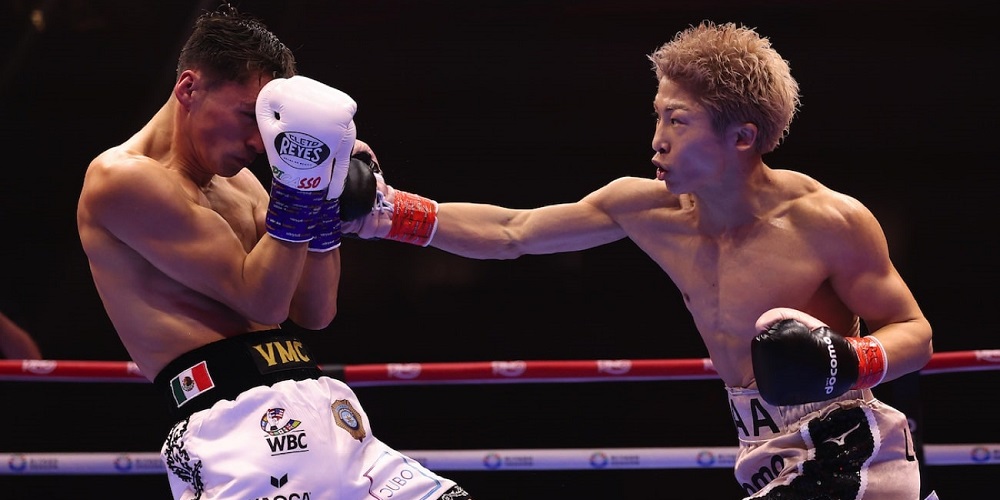
“The Ring V: Night of the Samurai” concluded just a few hours ago, a celebration of Japanese boxing, which has grown tremendously in recent years, and an opportunity to see two of the best pound-for-pound fighters in the world in action: Junto Nakatani and His Majesty Naoya Inoue.
The evening also served as a kind of preview of what could become one of the biggest events—if not the event—of 2026: the showdown between Inoue and Nakatani, a battle that promises spectacle like very few others in today’s boxing landscape.
After Nakatani, it was time for the Japanese Monster (31-0, 27 KOs) to step into the ring at the Mohammed Abdo Arena in Riyadh to face Mexico’s Alan David Picasso (32-0-1, 17 KOs), with all four super bantamweight world titles on the line.
It was a simply unique, and probably unrepeatable, opportunity for the 25-year-old Mexican: to challenge an epochal fighter, defeat him, and become undisputed champion, writing a historic chapter in boxing. Unfortunately for Picasso, Inoue gave him no chances and no hope. The Japanese phenomenon prevailed over the young challenger thanks to clearly superior technique and faster, more powerful punches, winning by unanimous decision with scorecards of 119-109, 120-108, and 117-111.
Usually, a boxer stepping into the ring against a superstar must do so believing in the feat, fueled by a mix of arrogance and self-belief necessary to attempt what others might deem impossible. But when you face someone like Naoya Inoue, the risk is that you enter the ring with little to no confidence in your own tools or in the possibility of upsetting the odds.
That was the impression Picasso gave to this writer. Not that he didn’t try at all. At times he attempted to assert himself, and toward the end he even seemed to throw his heart over the obstacle for a few fleeting moments. But that only happened because Inoue was simply managing the fight at will. Whenever necessary, the Mexican was promptly put back in his place by a sharp combination.
It is difficult to say exactly where the challenger’s limitations ended and Naoya’s extraordinary qualities began, since the Monster is accustomed to dismantling or humiliating elite-level fighters as if they were amateurs. The fact remains that Picasso could do nothing, due to the aforementioned physical, technical, and probably mental limitations. The Mexican is a very good boxer, capable of doing everything well without excelling in any one particular area, but across from him stood a fighter who excels in everything he does, whose only identified weakness so far lies in an “excessively” indomitable character and a self-confidence that occasionally leads him to underestimate his opponent.
At the opening bell, Picasso stepped forward, applying pressure and looking to fight at close range, even though his 10-centimeter height advantage over the Japanese fighter might have suggested a strategy focused more on maintaining long distance.
Inoue, for his part, moved along the ropes with a calm and confident demeanor. Barely had the second round begun when the Japanese fighter decided to make things clear, landing a devastating combination that immediately cooled Picasso’s ambitions. A further right hand to the head from Inoue, following a body combination by Picasso, drove the point home.
Inoue’s work to both head and body was textbook as always. Despite this, Picasso withstood the initial onslaught and managed to land a nice right hand and, at the end of the second round, an excellent left hook.
The Monster appeared in complete control of the ring from the outset. His combinations were always sharp and lightning-fast, and his movement in and out of range precise and timely. Picasso continued to press but already seemed tired around the third and fourth rounds. His work rate dropped, and he appeared short of concrete ideas. The only real spark came when Inoue, with confidence bordering on swagger, chose to trade with his hands down, absorbing a good left from the Mexican.
Whenever Picasso tried to lift his head, he was always “switched off” by a right hand from Naoya or by his emphatic left hook to the liver. Picasso was careful not to leave himself exposed, but still had to absorb heavy body shots that gradually eroded his stamina.
Despite the difficulties, Picasso showed great punch resistance and, above all, proved to be a solid fighter, albeit without the kind of power capable of turning around such a difficult fight.
Inoue was in absolute control throughout the contest. Around the eighth round, Picasso appeared somewhat passive. Instead of using the jab to try to discourage Naoya’s advance, he allowed himself to be pushed back by the Japanese fighter’s jab and left hook to the body.
The two fighters provided a brief surge of excitement at the end of the ninth round, engaging in a short-range exchange in which Inoue consistently targeted the liver, allowing his opponent to land a few good, albeit sporadic, shots.
Picasso’s resilience was commendable, despite the physical and technical gap. Inoue allowed himself a few too many moments with his hands down, giving the Mexican the chance to land some nice short hooks, especially with the left. But at the final bell, the verdict was clear to everyone: total dominance by Inoue, who retained all of his belts and once again reaffirmed himself as an absolute ruler of the ring. Now, for the Monster, one of the most eagerly anticipated fights of 2026 looms on the horizon: the all-Japanese showdown with rival Junto Nakatani.