




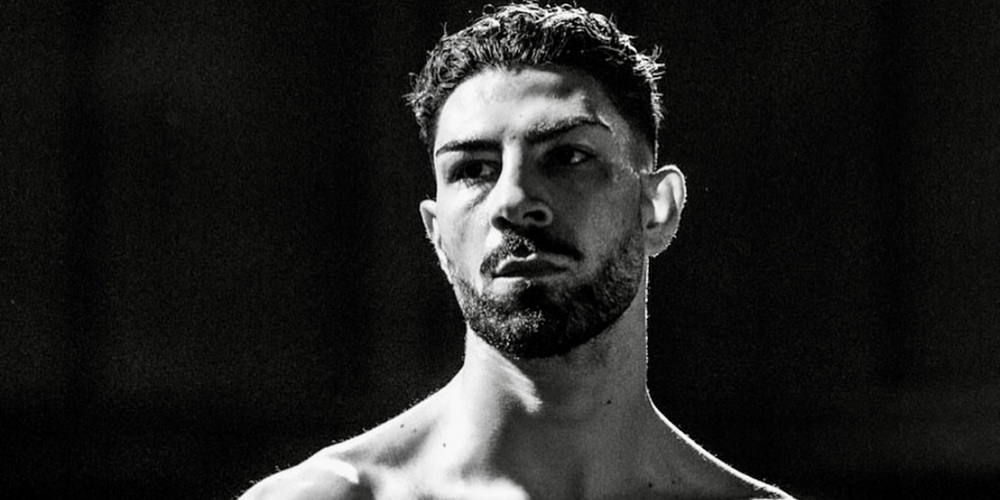
Fighting away from home in boxing means having to work twice as hard. It’s not enough to win—you have to “convince,” and sometimes even “dominate,” to avoid being left empty-handed. Giuseppe Osnato knows this all too well. The 26-year-old of Calabrian origin has made a habit of battling on the road.
In 2024, in Monza, he handed rising prospect Francesco Paparo the first defeat of his career during a The Art of Fighting event—promoted by Paparo himself. In 2025, he didn’t hesitate to travel to France, where he defeated the local favorite Mehdi Ghoualem, who was unbeaten at the time. Last Saturday in Rome, however, things didn’t go his way: the judges awarded hometown fighter Mauro Loli a baffling split decision, and it is precisely about this fight that I want to say a few words.
Those who follow us closely know that a few days ago we published an article on controversial decisions in Italian boxing, starting from the incredible defeat assigned to Ali Marcel Valdevit in Ferrara. Had I already seen the footage of Loli vs Osnato at the time, I would certainly have mentioned it and brought it up with Andrea Locatelli and Enrico Apa in the phone conversations reported in that piece. Unfortunately, I only received the footage today.
From my point of view, Osnato had won quite clearly. Out of the eight rounds fought, I gave him six, and I therefore find the judges’ scorecards (78–77, 77–78, 77–78) completely off the mark. Moreover, the total points suggest that all three judges awarded as many as three even rounds (10–10) to reach such a high tally—an approach that is highly unusual, strongly discouraged by international guidelines, and not even contemplated in the current rules of the Italian federation’s professional sector, which refer only to a “winning boxer” and a “losing boxer,” without any mention of draws.
However, this is neither the core nor the purpose of this article. The verdict in Loli vs Osnato is one of the countless hometown decisions handed out every week across the world, from the United States to Japan, from Saudi Arabia to our small local shows. It is a major flaw of our sport—one that must be fought against with determination, yet one we are unfortunately forced to deal with.
What I would like to emphasize instead are some extremely important observations about the mindset of the “away fighter.” When Giuseppe Osnato faced Paparo less than two years ago, he delivered a masterclass in what needs to be done inside the ropes when fighting away from home.
That night, the Calabrian boxer—using a colloquial expression—“owned the ring.” He gave his opponent no breathing room, attacked relentlessly, and at every moment conveyed the sense that he was fully in control, the sole master of the fight. In such a match, even the least experienced spectator can tell who is winning, and it becomes far less likely for the judges to deliver a “reversed” verdict.
Unfortunately for him, last Saturday Giuseppe did not adopt the same approach. In the ring at Villa York, the fighter trained by Gianluca Mulas chose to “manage” rather than “dominate.” He selected and measured his punches, conceded the center of the ring to his opponent, hesitated and waited too long, and in some rounds settled for doing just enough to edge them.
Let’s be clear: to a neutral and knowledgeable observer, what Osnato did should have been enough. Mauro Loli, while putting on a determined and respectable performance and playing the aggressor, produced little of substance and was clearly outlanded in clean and effective punches.
However, the Calabrian boxer’s performance was not overwhelming or spectacular—the kind that leaves everyone in awe and removes any doubt about the rightful winner. And so, while in an ideal world Giuseppe Osnato should be the winner of the Italian lightweight title semifinal, in the real one—far less fair and perfect—he is recorded as the loser.
I believe this setback, though undeserved, can serve as an important lesson for the Calabrian fighter and prove very useful for his future. Giuseppe is only 26 years old, he has already shown he has the courage to accept tough fights, and he has displayed very interesting boxing qualities. Now, alongside improving through experience and gym work, he must understand that nothing can be taken for granted.
I am convinced that the next time Osnato steps into a hostile environment, we will once again see the bold, fearless and exuberant fighter we have already admired on several occasions. That is the right version to win on the road—the one that protects you from the tricks and injustices of a sport as wonderful as it is cruel.