




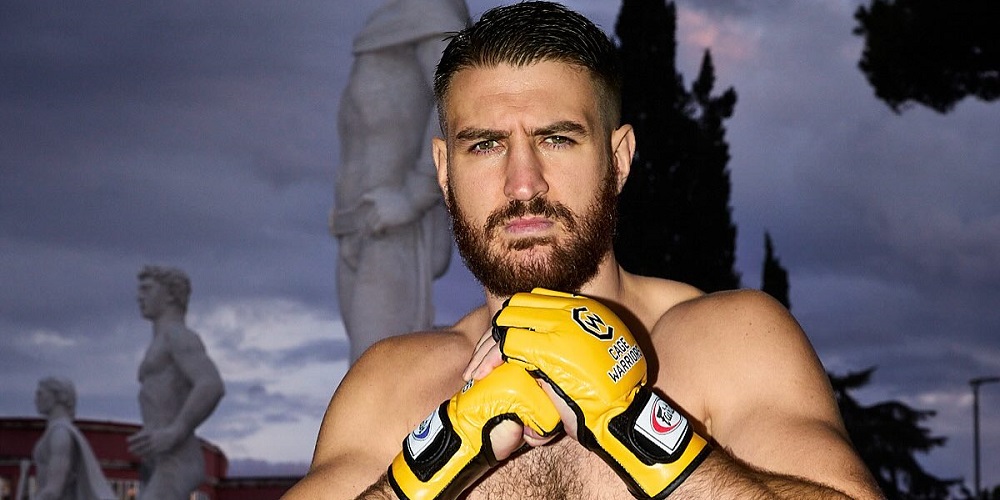
PARTIAL CORRECTION: I wrote and published this article after watching the fight video at full speed, forming the impression that, during his initial offensive burst, Gabriele Casella was struck and stunned by a clean punch to the face. A subsequent review of the footage in slow motion, analyzed frame by frame, now leads me to strongly suspect that Oulare, albeit unintentionally, made contact with his opponent’s face with the area of the forearm near the elbow. I believe that most of the points expressed in this piece remain valid: I still think that Casella’s proclamations were excessively exaggerated and inappropriate in light of what he has shown so far in the boxing world; that the choice of Oulare as his debut opponent was both erroneous and presumptuous; and that Gabriele’s gung-ho approach after the opening bell was reckless and ill-advised, a symptom of poor awareness. However, I also believe that the episode of the alleged elbow, combined with the certainly illegal final blow thrown while Casella was getting up from the knockdown, should call for greater caution in evaluating both the performance and the true boxing value of the defeated fighter. I therefore replace the word “embarrassment” with the word “debacle” in the article’s title and apologize to Gabriele Casella and to our readers for having used excessively blunt tones while underestimating the objectively controversial dynamics of the brief fight.
He calls himself “Il Magnifico.” For years he has prophesied his triumphant rise in the professional boxing rankings, presenting himself as a sort of savior of the homeland. He chooses a dangerous and awkward opponent for his pro debut, and even challenges—before fighting—another rival who is even stronger and more highly rated. Then he steps into the ring and gets knocked out in just over thirty seconds. The strange parabola of Gabriele Casella is viewed by many with mockery and irony; we prefer to take it seriously in order to reflect on a broader issue that involves many other athletes marked by an inflated ego.
If you lack the context, if you don’t know who we are talking about and what dynamics preceded this ambitious Roman athlete’s unhappy entrance into the world of professional boxing, you can get an idea by reading our preview article published a few days ago: CLICK HERE.
Let’s make an essential premise right away: getting knocked out is not a disgrace. In boxing, as in any other sport, you win and you lose. The decisive punch can land at any moment, a few seconds after the opening bell or just before the final one, and whoever takes it still deserves respect for having climbed the steps to the ring, accepting the risk to their own health.
If we allowed ourselves to use the word “embarrassment” in the title, it is not to mock a man who saw his long-nurtured hopes shatter in half a minute. We did so instead to underline the stark, almost grotesque contrast between the talk, the media hype and the rhetoric that preceded this fight and what actually happened in the ring.
Someone might object that Casella simply followed a clever marketing strategy, creating a fictional character to generate curiosity, sell tickets and promote the TAF event that took place at the PalaTiziano in Rome on Saturday night. Our answer to this objection is that there are solid reasons to believe that “Il Magnifico” truly thought he was a top-class fighter.
If that were not the case, Casella would never have chosen Oulare as his first opponent. Morike is a tough, physically imposing boxer, endowed with pace and fighting aggression. He had already proven his danger by convincingly beating a solid fighter like Roberto Lizzi. He has sparred many times, without fear, with Angelo Morejon, the best heavyweight in the country. No boxer who was not convinced he was predestined would have selected such an opponent for his professional debut.
To this already bewildering choice we must add the tactical strategy with which the Roman boxer approached the fight, a strategy we do not hesitate to define as “suicidal.” No feeling-out phase, no attempt to control the distance, no respect for the power and experience of the man in front of him. Ready, go: Casella charged forward like a novice Mike Tyson, paying a very heavy price for it.
From those few seconds of ferocious action all of this man’s unpreparedness emerges, stepping into the ring with improbable running shoes, unready for what awaited him, for what could happen to him, and for what it would have been wise to do in order not to waste the sacrifices made in training.
How can such a discrepancy be explained between what Gabriele thought of himself and what mercilessly emerged between the ropes? Certainly, the man’s enormous ego played a leading role in leading him into a trap, but the responsibilities go beyond that. One can bet that over the years Casella surrounded himself with a large number of flatterers, ready to reinforce his biases, to make him feel “Magnificent” with their compliments and to further convince him that he could lift the world with a finger.
It is typical of those with excessive self-esteem to push out of their lives those who offer realistic advice, those who dare to criticize, and those who are not always willing to agree, seeking instead the company of classic “yes men.” The protagonist of this story is certainly not the only one to have followed this path: on the contrary, even right now in Italian boxing there are people making exactly the same mistakes.
The result is before everyone’s eyes, but we wish to emphasize that Casella’s collapse was not written in the stars and that it could have been avoided or even turned into success if the Roman athlete had approached boxing with a less presumptuous attitude. “Il Magnifico,” in fact, possessed some interesting qualities that should have been developed in a different way.
The final of the 2019 Italian Elite Championships against Davide Brito, though won in anything but an exciting fashion, represented a remarkable result for such a raw boxer. It should have been interpreted as a starting point, as an incentive to improve by fighting dozens and dozens of demanding bouts before feeling ready for the big leap. Someone instead convinced him that it was an endpoint, definitive proof of his predestined nature, and that six years later Morike Oulare would be little more than a minor obstacle.
What will become now of these yes men, these fake friends, these fans blinded by their own bias? Some of them will vanish whistling into nothingness, pretending they never climbed onto the Magnifico bandwagon. Others will insist on their harmful role, telling Casella that the only reason for his defeat was the illegal blow struck by Oulare while he was on the canvas, as if the preceding phases had not already shown his inadequacy with crystal clarity.
We do not know whether Gabriele will continue to listen to those who have so far deceived him by detaching him from reality. What we do know is that the only truly “magnificent” thing about this whole affair is the lesson we can all draw from it. In boxing, presumption, arrogance and unjustified bravado only harm those who use them, and having at your side someone who honestly and sincerely points out your limits can be your lifeline.