




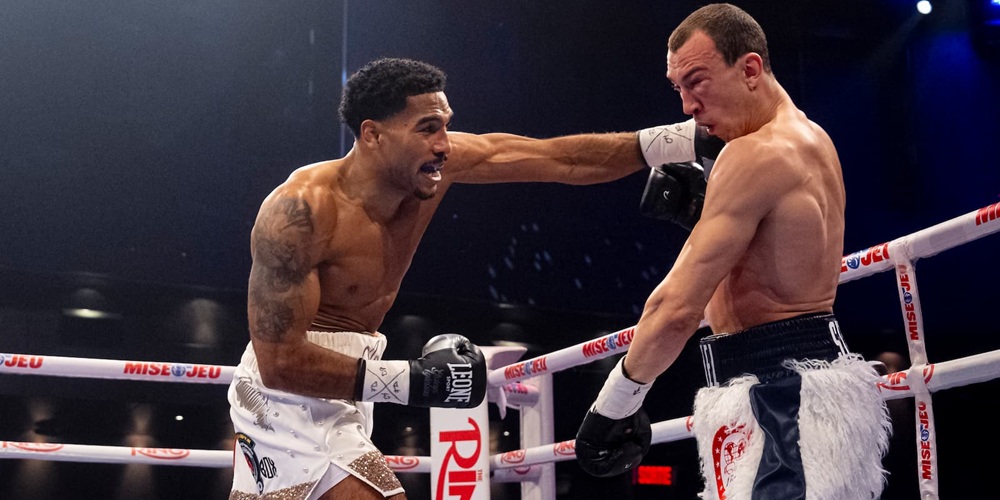
Cuban fighter Osleys Iglesias has done it: after being avoided by many well-known names on the international scene, “El Tornado” became world champion by forcing Russian co-challenger Pavel Silyagin to retire after eight rounds, thus claiming the IBF super middleweight title. The bout, held in Montreal and promoted by Camille Estephan, turned out to be rather dull and was largely decided by the huge gap in punching power between the two fighters.
Silyagin entered the fight as a clear underdog. His modest knockout ratio, combined with the fact that he had drawn with a fighter destroyed by Iglesias in a single round, made the Russian look like a sacrificial victim in the eyes of observers and analysts.
The boxer from Novosibirsk approached the fight in a way that reflected his awareness of the danger: from the opening bell, Silyagin moved constantly on his feet, relying almost exclusively on his left jab and trying to stay out of trouble, while Iglesias, as usual, loaded up his shots with great intent in search of a knockout blow.
In this early phase, the Cuban stood out mainly for the far greater impact of his punches. Despite landing rather sporadically, “El Tornado” quickly managed to inflict visible damage on his opponent’s face, whereas Silyagin, with his elusive and mobile style, appeared completely ineffective in terms of tangible offense.
After the first three rounds, the tactical pattern of the fight changed slightly. Realizing he was falling behind on the scorecards, the Russian showed a bit more courage and tried to take the initiative more often, without achieving significant results. At the same time, Iglesias, frustrated by his opponent’s elusiveness and the difficulty of pinning him down, became more of a counterpuncher, hoping to draw mistakes and punish him.
Despite the shift in roles, both fighters continued to produce very little, to the point that the meaningful punches landed in each round could be counted on one hand. Silyagin lacked the explosiveness needed to change the momentum and the physical toughness to stay in the pocket for long. Iglesias, on the other hand, lacked the timing and precision required to pull the trigger at the right moment and find the target consistently.
The result was a prolonged sense of monotony, with rounds unfolding in almost identical fashion and mostly going in favor of “El Tornado,” who only needed to land two or three clean shots to outshine his opponent’s ineffective boxing.
As the minutes passed, the condition of Silyagin’s face worsened progressively, despite the limited exchanges. In the eighth round, his left eye appeared close to shutting due to swelling. At the end of the round, his corner decided to stop the fight to protect the fighter’s health.
Although we have often seen boxers continue with faces in much worse condition, the decision by the Russian’s team seemed understandable given how the fight was unfolding—firmly in Iglesias’ control, with no real chance of a turnaround.
Iglesias’ performance can be viewed from two different perspectives. On one hand, the low work rate and the considerable difficulty in hitting a moving target raised some concerns. On the other, his ability to inflict such significant damage despite landing rarely is a clear sign of his explosive power—a quality that could prove decisive for him in the future.
Overall, the impression is that the Cuban still has a long way to go before he can aim to become the number one in the division. At present, Iglesias shows some elite-level qualities but still appears incomplete: very much a work in progress, in need of experience and different stylistic tests to reach his peak.
Last night’s fight against Silyagin will certainly help in that regard: the winner had to solve a tricky puzzle, faced an awkward and unconventional—albeit not very dangerous—opponent, and will be able to learn from his mistakes to refine his style and make the necessary adjustments in training.