




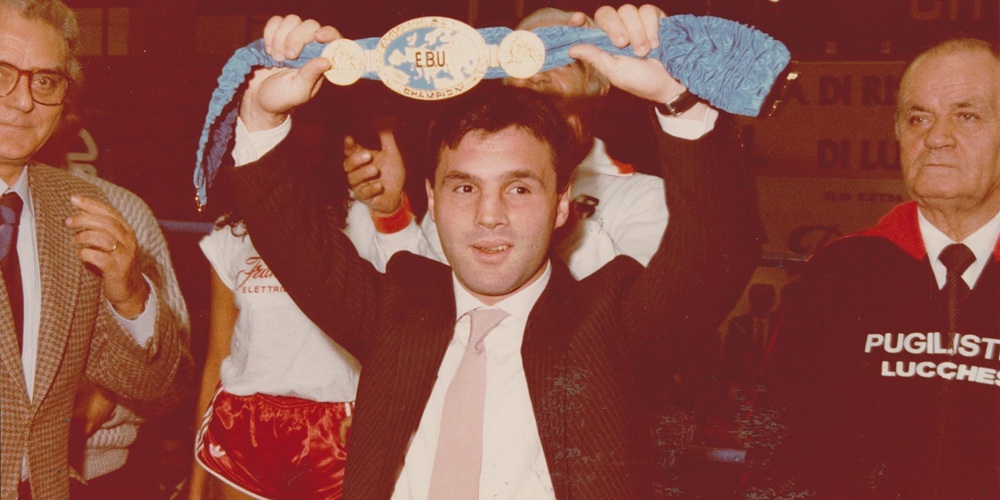
It is the 1970s, in a neighborhood of the city of Naples. A mechanical workshop closes its doors for the weekend and its interior, from a workplace, turns into something else. The owner, Pasquale Anastasio, is a boxing enthusiast: he invites all the boys from the neighborhood into his domain, hands them his only pair of gloves—rough and worn by time—and lets them face each other, one pair at a time, under boxing rules. Scenes that would be unthinkable today, which would scandalize almost anyone and would likely prompt residents to call the police. But those were different times, and those boys returned home full of adrenaline, despite a few bruises and bumps. Among them was Pasquale’s nephew, a boy destined to leave his mark on the history of Italian boxing: the future European bantamweight champion Ciro De Leva.
A southpaw, stocky, and fond of close-range battles: Ciro was a fighter from another era, one of those who gave everything and more in the ring and who, punch after punch, knew how to break down their opponents’ resistance with aggression, competitiveness, and unmatched grit. Today De Leva turns 67 and we are pleased to present the interview he kindly granted us, retracing the most important moments of his sporting career.
Let’s start from the beginning: how did your relationship with boxing begin and what pushed you to enter a gym for the first time?
When I was a kid, my uncle, Pasquale Anastasio, had a mechanical workshop in Naples, near the railway. He loved boxing and on Saturdays and Sundays he gathered all the boys from my neighborhood and nearby areas in the workshop and made them fight boxing matches. There were only two gloves, so one was for you and one for your opponent. In theory we were supposed to punch with just one hand, but every now and then a few shots slipped out with the other hand too—the one without the glove. On top of that, the gloves were nothing like modern ones; we’re talking about more than 50 years ago. The surface was made of plastic and the punches hurt a lot. That’s where my passion for boxing was born. Later I joined a gym, met my coach Geppino Silvestri, and started my boxing career by having my first fight in 1975.
Your amateur career was quite solid. Twice you came close to winning the Italian title, but on both occasions you were defeated by the fighter who could be described as your “nemesis”: Franco Cherchi, who later beat you as a professional as well. What aspect of his boxing gave you the most trouble?
He was very fast! He would punch and move away immediately, and when I tried to respond I could never find him. I didn’t know how to pin him down. But I beat him once, in an international tournament in Rome. Maybe having an international judging panel helped me [laughs, editor’s note].
Moving on to your professional career, what do you remember about winning the Italian title against Giovanni Camputaro?
I knew Camputaro well because some time earlier I had been called to his gym to spar with him and help him prepare for his title fights. That allowed me to become familiar with his characteristics, so once we were in the ring I knew what to expect. I beat him even though he was more experienced than me: at the time he had already fought almost thirty professional bouts, while I had only about ten. But that happened to me quite often during my career: I accepted many difficult fights against opponents who were more experienced than me.
Later, after losing, regaining and defending the Italian title, in 1984 the big opportunity came to fight for the European title. What are your memories of that prestigious victory in Salerno against the British fighter John Feeney?
Actually, I wasn’t supposed to fight that match. The European champion was Valter Giorgetti, but he was judged unfit to defend the belt because he suffered a knockout in a non-title bout in the Principality of Monaco against the American Jeff Whaley. My coach called me fifteen days before the fight and said: “Ciro, there’s the European title fight with Feeney, because Giorgetti can’t face him—they didn’t grant him medical clearance.” My only doubts were about the weight, which has always been my toughest opponent: at that moment I was over the limit and I wasn’t sure I would be able to shed the extra kilos in time. But my coach convinced me to try, so in two weeks I prepared for the fight. Feeney was a strong opponent, a southpaw fighting in a conventional stance. I still remember that after taking a couple of uppercuts to the body I went back to my corner intending to quit, but my coach pushed me back into the ring and, round after round, I managed to come back and win the fight.
Your reign as European champion was very long, with seven consecutive title defenses, all against solid and demanding opponents. Is there a fight from that phase of your career that left a particularly strong impression on you?
The one against the British fighter Ray Gilbody, fought in Cosenza. That night I saw death in the face. It was an extremely tough fight, also because in that period my performance was beginning to decline a bit. My body had been worn down by too many close-range battles: in a year and a half I had fought eight bouts with the European title at stake. I also had to endure constant sacrifices to make the weight limit: from 60 kilos I had to drop to 53.5 kilos… I would go days without eating or drinking and at night I would jump out of bed because of hunger. I realized I had lost something in terms of physical performance during my last title defense, the one against the Spaniard Vicente Fernandez. In 1983 I had knocked him out in three rounds, while in 1986 I had to sweat to beat him.
After the victory over Fernandez came the world title opportunity, in Turin, against the Venezuelan Bernardo Piñango, the reigning bantamweight world champion. Unfortunately that night you were unable to achieve the historic feat of winning the belt. What do you think went wrong?
Well, first of all, as I said before, the eight consecutive fights for the European title had worn me down. On top of that, Piñango was a real champion—he was very good. He had won the title on the road against the American of Mexican descent Gaby Canizales and in the past he had also won the silver medal at the Olympics. So he had a very respectable résumé. I won’t hide the fact that a couple of times in the early rounds, after I hit him, I saw his eyes roll and thought I might win inside the distance, but then I wasn’t able to land the decisive punch. I struggled to hit him because he was taller, had very long arms and was very technical. It’s no coincidence that he later also became world champion in the super bantamweight division. I made it to the tenth round, then I took a strong punch to the eye and instinctively turned away. I had no intention of giving up—it was just an instinctive movement—but the referee, knowing that there were still five rounds to go, stopped the fight to protect me.
After that defeat you had only one more fight, a year later. Then you decided to hang up the gloves…
Yes, because I felt my bell ring. My coach used to tell me all the time: “When you hear the bell, you have to stop.” I retired while still the reigning European champion, even though I could have earned another good purse by making another defense of the title. But I never fought for the money: I fought because I loved fighting and winning. I would have paid myself to be able to fight. But I had realized that physically I was no longer the same fighter, so I preferred to call it a day. They had squeezed too much out of me.
In the footage of your fight against Pinango, Patrizio Oliva can be seen in your locker room encouraging and supporting you. What was your relationship with Patrizio like and how did it evolve over time?
When we were fighters we were always together. He would host me at his house, I would host him at mine… We went to the national team together, we were like two brothers. Then, once our careers ended, each of us went his own way.
After finishing your career as a boxer, did you remain in the world of boxing?
Yes, I opened a gym and coached for a while, but then I closed everything because I no longer saw in young fighters the same spirit of sacrifice that we had in our time. They came to the gym just so they could go around saying they had done boxing. However, I did manage to train a few good-level fighters: two or three Italian champions came out of my gym, as well as a European champion, Francesco Speranza. He was a very talented kid, a southpaw with a tremendous left uppercut. He fought very good opponents, even abroad, and he would fold them in half, leaving them stretched out on the canvas.
And then what happened with him?
What happened is that when he got involved with the national team they ruined him. There they made him spar with everyone, including guys who were heavier than him. One opponent would come down and another even heavier one would step in, and since everyone wanted to show off in order to earn a place on the team, those weren’t sparring sessions—they were real fights. In that respect I was lucky because in my time both my coach and the national team trainer managed the fighters carefully. They knew when to increase and when to reduce the intensity in order to preserve them. Later on, instead, they stopped being careful: they knew they had plenty of replacements, so they didn’t worry about burning out a young fighter. In the long run Francesco started to perform less well than before, also because he was a middleweight and punches at that weight really hurt. But when he was at his best he was truly great.
What does Ciro De Leva do today?
First I worked as a taxi driver, then I applied to the municipality for an N.C.C. license, and now I’m working with Uber.
Thank you for your availability, happy birthday again and best of luck for the future!
Thank you!