




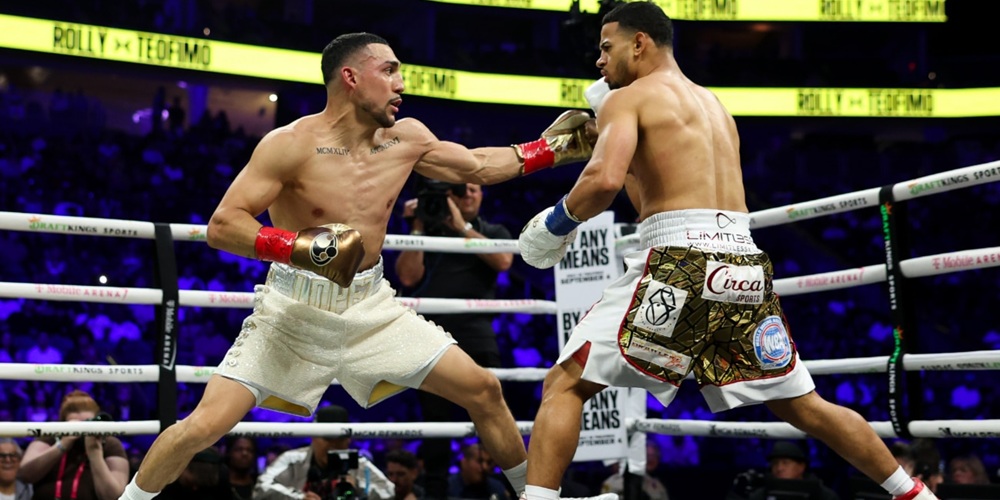
Teofimo Lopez (23-2-0, 13 KOs) officially entered boxing history as a three-weight world champion, but his victory over Rolando “Rolly” Romero (17-3-0, 13 KOs) last night at the T-Mobile Arena in Las Vegas was not without controversy. Despite Lopez’s near-constant dominance over the course of twelve rounds, the judges returned a majority decision that raised more than a few eyebrows: 114-114, 115-113 and 116-112 in Lopez’s favor. Glenn Feldman’s scorecard, which saw the fight as a draw, is likely to remain a topic of discussion for some time, given how poorly it reflected the course of a fight in which the 29-year-old Brooklyn native controlled the action with his jab, body work and constant pressure, which at the very least made him the more active fighter in the ring, unlike Romero.
Before the fight, the media had put the spotlight on the long-standing friendship between the two protagonists, who had previously trained together. Some controversy arose over the excessively cautious approach adopted by both fighters in the ring, which reminded some observers more of an intense sparring session than a world-title fight.
Lopez, historically not particularly inclined to play the aggressor, surprised everyone by taking the center of the ring from the opening bell and immediately putting a defensive-minded Romero under pressure as he struggled to find the right rhythm.
The first three rounds were clearly controlled by Lopez: an insistent jab, combinations to the body and more authoritative ring generalship, with Rolly far too passive. The former champion seemed to be waiting overly cautiously for Lopez to make a mistake so he could land a significant punch.
That approach hurt him on the judges’ scorecards, but above all it proved foolish because he actually had the weapons to hurt Lopez.
The script changed briefly around the fourth and fifth rounds. Romero finally found his best weapon, the left hook, and landed it with surgical precision.
He repeated the shot in the fifth round, opening a clearly visible cut above Lopez’s right eye that began bleeding heavily. The fight suddenly came alive and Romero seemed to see red, like a bull, awakening from his torpor and coming within inches of turning everything around. A sharp right hand from Romero visibly shook Lopez, who was then subjected to a fierce assault from Rolly and ended up on the canvas, although he had been pushed down by his opponent. It was not ruled a knockdown, but Lopez came perilously close to going down for good. Credit to Teofimo for maintaining his composure and containing Romero, who charged forward chaotically and without much accuracy.
The T-Mobile Arena erupted in support of hometown favorite Romero, with the feeling that the fight had finally opened up.
Nothing of the sort. Lopez came out for the sixth round as if nothing had happened, picking up exactly where he had left off. No signs of weakness, no change in strategy, no hesitation. The jab went back to doing the work, occasionally supplemented by body shots. That seemed to be enough.
Romero, meanwhile, reverted to his most frustrating version: passive, reluctant, unwilling to take risks and, above all, unable to follow the advice of his corner, which was imploring him to increase his punch output.
Paradoxically, Romero was the more dangerous of the two whenever he actually engaged. But Lopez dominated the jab count by a 21-7 margin and maintained a consistent advantage in overall work rate.
A left hook late in the seventh round shook Lopez once again. Yet the Mexican-American never capitalized. He continued to give up the center of the ring, allowing his opponent to dictate the pace at will and build an advantage simply by getting a few punches off.
Romero simply did not do enough, despite having the tools to make himself dangerous. There is no counterargument to that.
The final third of the fight was a Lopez monologue, interrupted only by sporadic flashes from Romero that made his reluctance even more baffling. The final verdict crowned Lopez as the new WBA welterweight champion.
In his post-fight interviews, Lopez highlighted his return to the ring with these words: “This is what I have to tell you: if you lose and come back, you never really lost, because you’re a winner. I’m a true example of what it means to win. It’s not about losing, it’s about never giving up.”
The 29-year-old hinted at a desire to take some time off, particularly with a second child on the way, but the WBA is expected to soon order a mandatory defense against regular champion Jack Catterall.
For Romero, this marks the third defeat of his career and confirms a limitation that is not even technical: his inability to respond when Plan A does not work, but above all his failure to throw his heart over the line, as if he were always fighting with the handbrake on. His reign as welterweight world champion, which lasted just one fight, has come to an end with the bitter feeling that he allowed the title to slip away without putting up the resistance that was required.