




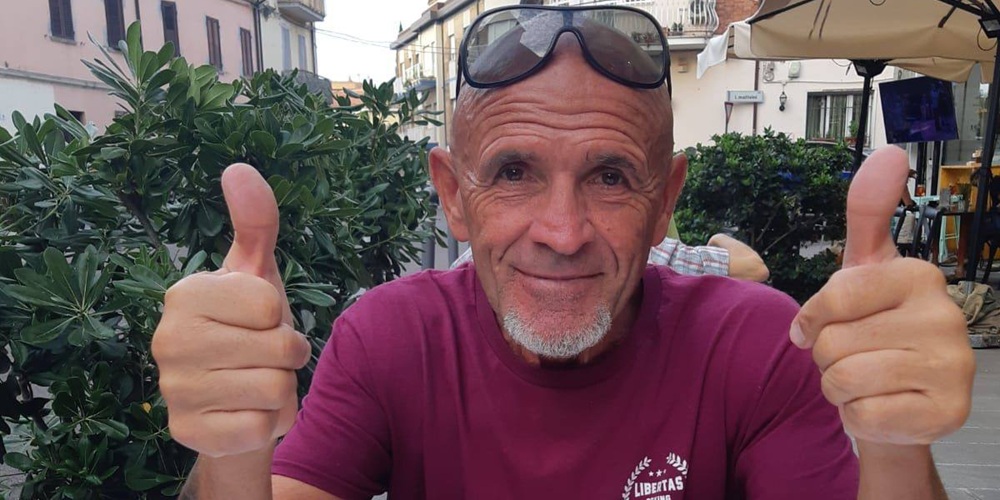
Winning is undoubtedly the primary goal of every boxer. But only those who win while delivering excitement manage to create unforgettable memories that, even many years later, still send shivers down the spines of boxing fans. Among our world champions, the Romagna-born Loris Stecca was one of those who earned the fans’ visceral love, making them leap to their feet during his fights and giving them moments of pure suspense thanks to a combative style and indomitable courage.
Extremely promising and successful since his amateur career, which ended with 57 wins out of 60 bouts, Loris found his ultimate consecration in the professional ranks. His talent—and in particular his superb offensive arsenal, enriched by a remarkable variety of punches and solutions—allowed him to reach, one after another, all the major milestones a boxer can aspire to, from the Italian and European featherweight titles to the world title at super bantamweight.
His world title triumph, achieved in front of a delirious crowd at the “Palasport di San Siro”, in Milan, was the exclamation point of Stecca’s sporting story and still stands today as one of the most thrilling fights ever contested by an Italian fighter. The surrender of Dominican Leonardo Cruz, who turned his back under the blows of a relentless Loris after twelve rounds fought at a furious pace, marked the peak of our champion’s trajectory—one that would soon be followed by harsh setbacks, both in and out of the ring.
From the dramatic defeats against Puerto Rican Victor Callejas, to the serious accident that ended his boxing career, and the tragic mistakes that Loris himself acknowledges and for which he has paid the consequences, the champion from Santarcangelo di Romagna has gone through troubled and difficult times. Today, at 66 years of age, he feels close to finally achieving peace of mind.
We spoke about all this with Loris Stecca himself, retracing the epic battles that saw him as a protagonist in the ring.
Your first successes in your professional career were linked to the Italian title. Your fights with Marco Gallo, Pasquale Mazza, and Salvatore Melluzzo allowed an increasingly large audience to discover your qualities. Which of these bouts for the Italian title are you most attached to?
I feel attached to Pasquale Mazza for reasons of friendship, but among those three fights, perhaps the one with Melluzzo was the fiercest, also because he was the highest-rated opponent. We were in the same stable and there was also a rivalry due to the fact that I was the rising star while he was the established champion at the time. I never underestimated anyone, but I knew and believed I could beat him. It was a demanding fight because he was a good boxer; his fans struggled to accept the defeat, but I had broken his brow ridges by hitting him hard several times. As tough as it was, he could never have beaten me that night, because nothing could have stopped me at that moment.
Winning the European title against Welshman Steve Sims turned out, paradoxically, to be less complicated than your first defense against your fellow Romagnolo Valerio Nati. How important was that beautiful derby for both of your careers?
There was great respect between me and Nati, but we were, so to speak, “two roosters in one henhouse”: we were two champions, both from Romagna, and there was a healthy sporting rivalry between us. When they proposed that fight to me, I said, “Of course! Gladly!” because I knew that to reach my goals I had to beat Nati—I couldn’t refuse. On the other hand, for him too that fight, which was beautiful and very hard-fought, was a springboard, and even though he lost, because those two or three points awarded to me by the judges were absolutely fair, his stock rose. In fact, when I later vacated the European title, he was the one called to fight for it. In a way, I was more useful to him than he was to me.
In the wonderful WBA world title fight you fought and won against Leonardo Cruz, we saw a different Loris Stecca compared to your European-level bouts: less bouncy on your feet, more determined in taking the center of the ring. Was that a transformation you prepared in the gym?
No, no boxer decides in advance what kind of fight to have. Once you’ve been trained a certain way, you go on instinct. Sure, in the gym you can say “I have to box from outside” and things like that, but in the ring it’s a different story. None of my fights was ever prepared to go exactly the way it did: each one unfolded “in its own way,” and that’s why they were all different. I didn’t have a single style—I did what came naturally. For example, against Steve Sims I fought in a way I had never done before: I had always been an aggressor, coming forward and hammering away, but with him I fought going backward, slipping and countering. I let instinct guide me—that’s what champions do.
The images of that epic night for Italian boxing are now unforgettable. Cruz turning his back, exhausted by your punches, Rino Tommasi getting carried away in commentary, you being lifted in triumph by your team: within a few moments, Italian boxing experienced incredible euphoria—but what did that extraordinary victory mean to you?
The fight with Cruz was the pinnacle of my career, not only because it was for the world title, but also because the opponent was a good one—an experienced man who had already fought in world title bouts. But throughout my career I always fought everyone, both in Italy and abroad. Nowadays I can’t help but laugh when I hear that fighters who have only won an intercontinental title are celebrated as if they were world champions, while I—who was the first Italian to win a world title at super bantamweight and the youngest Italian ever to win a world title—am often not even mentioned in rankings, maybe because I’ve always spoken my mind.
Just three months after your triumph over Cruz, a contractual clause forced you to defend your title against Victor Callejas in Puerto Rico, and that’s where you suffered your first professional defeat. What led you to ask for a rematch against the dangerous Caribbean puncher for the WBA title instead of pursuing a belt from another organization?
There would be a very long story behind my title defense in Puerto Rico against Callejas, which has been discussed online, but I don’t want to make excuses: Callejas is the only man who ever beat me, and he was a great champion. Some time after that first defeat, Branchini, in front of Elio Ghelfi—who was my trainer—told me: “Loris, I have two world title opportunities: the rematch with Callejas or the WBC title fight against Juan ‘Kid’ Meza.” Since I wanted to win the WBC belt as well, I wanted to face Meza—I would have torn him apart. I’m not saying it would have been easy, but I would have beaten him. However, Ghelfi, with whom I always had a great relationship, even in private life, told me: “I would go for the rematch with Callejas, because if we lose again, it will mean he’s our bogeyman and then we’ll take a different path.” That’s how the decision to have the rematch with the Puerto Rican came about, also because I was convinced I was better than him.
After so many years, do you have any regrets about that famous rematch in Rimini? Or do you think Callejas was simply the wrong opponent for your characteristics?
I would like it to be properly explained what happened here in Rimini when I had the rematch. The left hook that made me wobble in the first round fractured my jaw. On top of that, Callejas hit me with an elbow that split my eyebrow, but I kept going despite everything. At the end of the third round, after I had him staggering against the ropes, he didn’t want to continue—but right at that moment, the lights went out. Very few people have talked about this. The power outage gave him a chance to rest for a few minutes, but he had already quit! It was his manager, Pepito Cordero, who pushed him back into the ring, pulling him by the trunks and shouting “Hijo de puta!” All of this was admitted by Callejas when he came to visit me in Rimini twenty years later, and we had a big dinner together with Canale 5 present at the Molo 22 restaurant. Then, when he hit me in the sixth round, he shattered everything, and there was nothing more I could do.
After hanging up your gloves, your life was quite troubled, as you yourself recounted in your autobiography “No mas – La mia vita,” published in collaboration with Fabio De Santis. After so many ups and downs and the mistakes you have acknowledged, can we say that Loris Stecca, now 66, has finally found his peace of mind?
I’m still looking for it, but I’m almost there [laughs]. I’ve understood that we live in an unfair society, but I’m learning to take life more kindly. As I’ve always said, I made mistakes in the past, but many others made mistakes as well.
In that case, we sincerely wish you to find peace of mind as soon as possible and extend our warmest birthday wishes.
Thank you very much, and I send you a big hug!