




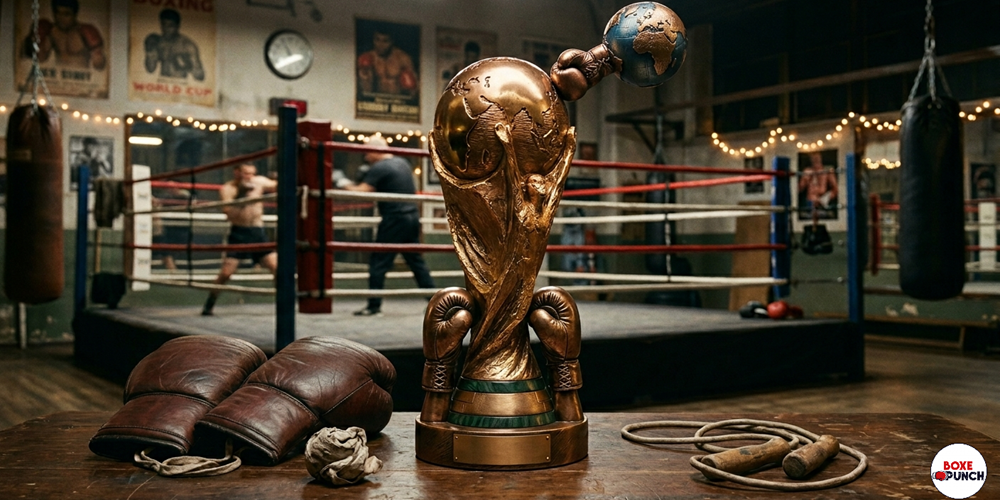
Criticism, complaints, and grievances about everything that doesn’t work in the world of international boxing have become so frequent and widespread that they are hardly news anymore. We ourselves have often pointed the finger at the harmful behaviors, counterproductive decisions, absurd rules, and unreasonable practices that undermine our beloved sport. However, if we truly hope for improvement, the pars destruens must necessarily be accompanied by a pars construens. Today, I want to propose a concrete idea that, in my opinion, could benefit boxing if properly implemented—an idea I have chosen to call “The Year of the World Championships.”
The “problem” of four belts
Let me be absolutely clear with our readers: unlike many boxing fans, I am not nostalgic for the era of the “single title.” I believe that even many years ago, having only one world title per weight class already created significant issues—and today, with the drastic reduction in fight frequency necessary to protect fighters’ health and physical integrity, those issues would be even more pronounced.
In previous articles, I have already recalled some “famous cases” that highlight the distortions caused by a single title—from Ezzard Charles, the greatest light heavyweight of all time, forced to move up in weight after waiting in vain for a title shot, to Jake LaMotta, who was persuaded by organized crime to throw a fight in order not to have his path to the middleweight title blocked.
That said, it is undeniable that the fragmentation of the title into four belts of equal value—not to mention the countless minor organizations—also has unpleasant consequences, the most significant of which is undoubtedly the disincentive to organize major fights between top champions.
Since several high-level fighters within the same weight class can simultaneously call themselves “world champions,” the idea of staging unification bouts may appear risky and unattractive, especially when those fighters are managed by rival promoters, wary of losing their golden goose. So how do we get out of this situation?
From a silly question to a possible solution
A very common tendency among poorly informed boxing fans, always looking for simple and immediate solutions at no cost, is to make inappropriate comparisons with other sports. “If in football there is only one world champion team, why can’t there be just one champion in boxing?” is the kind of question experts have been asked for years.
In truth, these are foolish questions, because they mix apples and oranges, ignoring the deep intrinsic differences between various sports. The question I just mentioned is, in terms of rationality, equivalent to asking: “Why can’t we walk on the sun, given that we’ve been to the moon?”
And yet, precisely by reflecting on that nonsensical question, the idea at the core of this article came to me. Of course, football is a team sport, not an individual one. Of course, in football it is possible to gather the best national teams in the world in one place and have them face each other over a relatively short period, whereas in professional boxing a single fight requires two months of preparation and one month of recovery…
However, there is one aspect of that very different sport that made me think. If football fans are willing to wait four years to find out which country has the best team in the world, settling in the meantime for less prestigious competitions, why not offer boxing fans the same kind of satisfaction, on the same time scale?
The Year of the World Championships: mandatory unifications every four years
Nowadays, a world champion typically makes two, at most three title defenses over the course of a calendar year. So why not establish a system whereby, every four years, those two fights are not simple title defenses, but instead the semifinal and final of a tournament designed to crown the “true champion”?
The structure of the tournament would be extremely simple: the WBC champion would face the WBA champion, while the IBF champion would face the WBO champion (matchups proposed purely as an example). The two winners would then meet in the second half of the year to determine the unified champion.
Any fighter who refuses to face the designated opponent would be immediately stripped of his title and replaced in the tournament by the highest-ranked contender from his organization. In case of failure to reach an agreement on purses and a resulting purse bid, the split could be determined through a mathematical algorithm that takes into account the earnings of the two fighters in their most recent bouts.
In this way, all champions—from heavyweights down to minimumweights—would be incentivized to step up. Refusing to do so would mean losing not only the belt earned through great sacrifice, but also the reputation of an indomitable warrior, which would crumble under accusations of cowardice from fans.
What happens after the tournament? The “Dragon Balls” hypothesis
Naturally, many technical details would still need to be defined (for instance, what to do if a fighter already holds more than one world title in a given division), but I am confident that the presidents of the four major boxing organizations could easily sort everything out—provided they are willing to engage in open and honest discussions.
The most interesting question concerns what happens after the conclusion of the tournament, at the end of the so-called “Year of the World Championships.” One option would be to let the winner keep all four belts and defend them one after another against the mandatory challengers. However, given the already mentioned issue of low fight frequency, this scenario risks severely limiting the paths to glory, ultimately harming boxing’s popularity in certain parts of the world.
A valid alternative would be to give the four belts the same behavior as the “Dragon Balls” from the famous Japanese manga Dragon Ball, which, after granting the wish of whoever gathered them, would scatter across the globe. Similarly, after allowing the new unified champion to choose which belt to keep, the other three could be “released” and contested among the top six fighters in the rankings. In this way, after fulfilling the fans’ desire to know who the best fighter in the world is, the belts would once again provide prestigious opportunities across the continents.
Would WBA, WBC, IBF, and WBO agree?
What would the leaders of the four major international organizations think if they came across this article? Of course, I cannot know for sure, but I firmly believe that working together on projects like this is in their best interest.
It is no secret that a certain level of discontent has been growing among boxing fans toward these organizations, partly due to many highly questionable decisions made over the past decades, and partly because the very existence of multiple sanctioning bodies inevitably leads to title fragmentation. If this dissatisfaction were to persist or even worsen, someone might take advantage of it to dismantle the entire system.
Dana White is already trying, backed by the substantial funds of his wealthy investors and his well-known political connections. Personally, as I explained in a recent opinion piece, I believe his initiative is destined to fail—but in the future, the attack could come from more astute and less compromised figures, with greater chances of success.
It is understandable that those who lead the WBC, WBA, IBF, and WBO might be inclined to believe that the prestige of their organizations is destined to last forever. However, that would be a serious mistake.
Recently, past, present, and future WBA titles disappeared from the website of the most comprehensive boxing database in the world, BoxRec—a scenario that almost everyone would have considered impossible before it actually happened. This is clear proof that prestige and authority are not guaranteed indefinitely, and that repeated mistakes can erode them little by little, with the risk of losing them entirely in the future.
A quixotic initiative
I have no illusion that my words will be heard or embraced by those who have the power to change the rules of the game. I know that, in all likelihood, mine will remain a cry in the wilderness, with the same practical impact as Don Quixote charging at windmills.
On the other hand, Don Quixote perfectly embodies the spirit with which Boxe Punch was created on the very first day of this journey, just under two years ago. And it is with that same spirit that I will bring this article to the attention of the four presidents—Gilberto Mendoza Jr., Mauricio Sulaiman, Daryl J. Peoples, and Gustavo Olivieri—closing it with the final lines of a famous song by the great Italian songwriter Francesco Guccini:
Il Potere è l’immondizia della storia degli umani
e anche se siamo soltanto due romantici rottami,
sputeremo il cuore in faccia all’ingiustizia giorno e notte:
siamo i “Grandi della Mancha”,
Sancho Panza… e Don Chisciotte!