




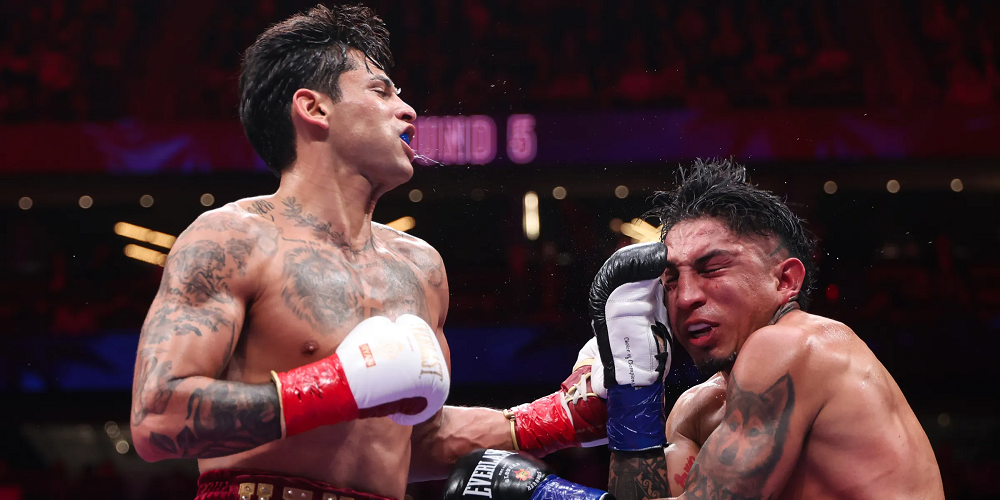
“King Ry” is back and, for the first time in his career, has truly earned a throne worthy of his nickname. Ryan Garcia dominated former WBC welterweight world champion Mario Barrios from start to finish, taking the prestigious belt from him. The Californian’s clear superiority was rewarded with a fully deserved unanimous decision. These were the official scorecards read at the end of the main event of “The Ring: High Stakes”: 119–108, 120–107, 118–109.
When a fighter is psychologically fragile and prone to inconsistent performances depending on his level of confidence and determination, the worst thing an opponent can do is give him a boost of confidence seconds after the opening bell.
Unfortunately for him, Barrios did exactly that. Even though it’s well known that fighters who rely on hand speed are especially dangerous and lethal in the early rounds, the champion immediately planted himself in front of the challenger, almost inviting him to throw, and was blasted by two powerful right hands to the head, the second of which put him on the canvas.
If suffering an early knockdown against Rolando Romero had dampened Garcia’s enthusiasm and sent him into a spiral of insecurity, this time being the one to land the first big shot galvanized him, giving him total confidence and composure.
The enormous speed gap between the two fighters quickly emerged as a key factor. In the second round, Barrios’ game plan appeared to be pressing forward behind a high guard to force Garcia to move constantly and tire himself out. That strategy quickly fell apart, however, as the challenger’s counterpunching made the champion’s advance far too costly.
Particularly damaging—and somewhat surprising—was Barrios’ inability to read Garcia’s right hand. At elite level, that punch usually doesn’t yield great results for the Californian, since unlike his left hook, it can look somewhat mechanical and predictable. This time, though, it landed repeatedly, and two quick right hands at the start of the fifth round badly shook the champion, paving the way for three minutes of sheer punishment.
Visibly demoralized and unable to find solutions, Barrios became extremely passive in the middle rounds, staying at center ring and focusing mainly on covering up. In doing so, he avoided major trouble but produced almost nothing offensively, to the point that at times Garcia’s performance looked more like a heavy bag workout than a competitive fight.
The champion showed faint signs of life only at the end of the eighth round. The ninth and tenth were in fact the most competitive rounds of the fight, although in this writer’s view both were still won by the challenger.
Garcia appeared slightly fatigued—breathing through his mouth, throwing fewer punches, and showing less precision than in earlier rounds. Barrios capitalized only partially: he landed a few solid body uppercuts and a good right hand in the tenth, but his success was too sporadic to reverse the momentum.
Relying on his constantly pumping left jab was enough for King Ry to regain full control in the eleventh. Barrios failed to produce a meaningful final push in the twelfth and last round, and his performance ranks among the poorest ever delivered by a world champion in the welterweight division.
There were huge celebrations in the challenger’s corner after the final bell: Garcia, his father Henry, and the rest of the team were beaming, aware they had produced a near-perfect performance. The reading of the scorecards was a mere formality. As often happens in one-sided fights, the loser was awarded a few consolation points, but in truth King Ry deserved three scores of 120–107.
During the post-fight interview, Garcia dedicated the victory to his father, who trained him during his amateur days and has returned to his corner after a carousel of trainers. The name “Henry” was also displayed on the waistband of his trunks, further highlighting the renewed father-son bond, once shaken but now stronger than ever.
Interestingly, the winner—who said he injured his right hand during the middle rounds—named Shakur Stevenson as the opponent he would like to face next. Stevenson is coming off a sensational win over Teofimo Lopez and now sits third in The Ring’s pound-for-pound rankings, but he has just moved up to the super lightweight division, the fourth weight class of his career, which began at featherweight.
Not surprisingly, Stevenson responded to King Ry’s challenge by stating he would accept only at a 144-pound catchweight (midway between the super lightweight and welterweight limits) and if anti-doping tests were handled by VADA. We will see whether those conditions are met and whether the fight materializes.