




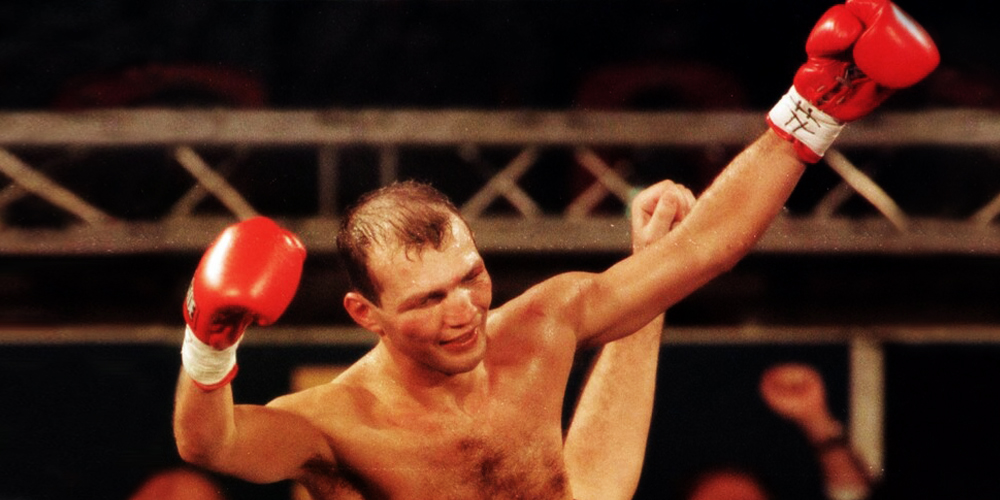
Our journey of rediscovering Italian boxers who achieved major victories on the international stage continues with a chapter dedicated to Alessandro Duran, a talented welterweight from Ferrara who, during the 1980s and 1990s, fought on Italian and European rings, building an enviable résumé and fulfilling his dreams. The son of the great Argentine boxer Juan Carlos Duran, who settled in Italy and became a three-time European champion at middleweight and super welterweight, Alessandro followed in his father’s footsteps, turning professional at just 18 years old.
His sporting path was marked by countless battles for the Italian title, which he won, defended, and regained several times before taking flight toward even more prestigious goals. From the thrilling domestic clashes, to winning the WBU belt, to fulfilling the dream of becoming European champion like his father, and finally to his relationship with the fans: our chat with Alessandro Duran touched on all the key aspects of a winning and extraordinarily long-lasting career.
Over the course of your career you fought an impressive 17 bouts for the Italian title. Is there one in particular that stayed with you more than the others? And how much did those many fights against your countrymen help you improve and be ready for the next steps?
I believe the Italian title represents the first cornerstone in building an important career. That’s why I keep fighting to make people understand that this title—sometimes looked down upon by promoters and managers more than by boxers themselves—is of fundamental importance. For a young fighter, becoming Italian champion is a huge satisfaction and an important experience; then you need at least three or four defenses, because that way, when you go on to fight for an international title, you can be mentally and physically ready for the challenge. I fought 17 times for the Italian title, which is a significant number, especially in a period when if you lost you stayed in limbo for a year and a half or two before getting another chance. The most delicate one was certainly the title I won in 1991 against Marco Cipollino, a few months after my father’s death, because on that occasion I had to understand whether I had the character to carry on without what had always been a fundamental guide for me. That night I won decisively and proved that I could achieve something important.
After establishing your superiority at home, you found international consecration by winning the WBU belt against South African hard man Gary Murray, a rough fighter who didn’t shy away from dirty tactics. Did it give you more satisfaction to take the title from him in San Remo by disqualification, or to outpoint him in your Ferrara four months later?
The greatest satisfaction naturally comes from winning an important title, even though at that time the WBU was not recognized in Italy. It was only recognized after my rematch with Peter Malinga; even back then there was a war between sanctioning bodies and organizations, but as I always say—still today—it’s not the sanctioning body but who gets into the ring that gives importance to a fight. Many times I read that even some journalists, when listing world champions, don’t take the WBU title into account, but I know that I faced real fighters. When I fought him, Gary Murray was ranked right behind the big names: after De La Hoya and Trinidad came him. In San Remo I deservedly won by disqualification, and then in the rematch in Ferrara I confirmed my superiority. He was a hugely followed athlete: he drew 18 million TV viewers in South Africa, and in fact their national television broadcast both fights live. At that time boxing in Italy was already in deep crisis, and every event sparked controversy over agreeing dates with RAI; my good fortune was that I delivered strong ratings, which gave me significant bargaining power.
The belt was taken from you by the ferocious South African puncher Peter Malinga, but the circumstances of that knockout immediately appeared quite controversial…
The ending of that fight was a scandal. We were in Palma di Montechiaro, Sicily, in the square where the film The Leopard was shot; there were eight thousand people present, and at one point I found myself on the canvas and saw the crowd coming down the steps to get closer to the ring and protest against the referee. I realized something strange had happened, but I wasn’t clear-headed enough to understand what it was, so much so that when I went to Mario Mattioli’s microphone for RAI I said, “That’s fine, in sport you win and you lose, I’ll start again from the European title.” Then they showed me the slow-motion footage and I understood what had happened: the referee called a stop, held me by blocking my arms, and at that moment Malinga threw a hook that went past the referee and hit me on the jaw. I was groggy; I didn’t go down only because I was hanging on the ropes. When I heard “Box!” I went to center ring, he landed a right that slightly clipped me on the back of the head and I went down: that’s where the fight ended. That night I understood I was facing an extremely dangerous opponent from the very first round; when I went back to the corner I said, “Who did you bring me?” because he really had iron bars instead of hands—when he hit my guard I felt the shock through my arms. But I’m sure he could never have beaten me in a fair way, and I proved it in the rematch.
The rematch, fought in Ferrara, was perhaps one of the finest bouts of your career. How difficult was it to keep such a relentless opponent at bay for twelve long rounds without any lapse in concentration?
It was a difficult fight, as all the fights of my career were; sometimes the difficult becomes easy and the easy becomes difficult, because a lot depends on the condition you bring into the ring. Unfortunately, this is a sport where everything is decided in one night, and not all nights are the same. To be perfect on fight night you also need a bit of luck—you prepare for months and months, and at that level if you perform at 95% instead of 100%, you risk paying dearly. Before the rematch in Ferrara everyone had written me off, but those were exactly the fights that fired me up: when I started as a clear underdog, my strength multiplied. After the weigh-in the day before, I went for a walk downtown with my uncle, an international referee, and at one point he stopped and asked me, “Alessandro, can I tell you something without you taking offense?” I replied, “Go ahead.” He looked at me and said, “Tomorrow don’t play the hero—if things get ugly, raise an arm.” At that point I told him where to go and said he hadn’t understood a thing, because the next day I would become world champion again—and that’s exactly what I did. Even though Malinga’s punches were heavy and hard, that day I was too strong mentally; it was a bet against everything and everyone, and I was willing to do anything to win.
Watching your most important fights, one notices your ability to finish strongly, increasing the pace in the later rounds, when boxers are usually more tired and less sharp. Was that the result of specific athletic preparation, or simply a natural trait of yours?
Preparation certainly played a role—the hard work I had behind me mattered a lot. The greatest compliment I received during my career, even from opposing managers as well as from those who worked with me as sponsors, was that I was the most serious athlete they had ever known. And I consider myself less serious than my father was. As a child I saw the huge sacrifices he made and the seriousness with which he approached this sport he loved beyond measure. Genetics also play a part: you have talent and certain physical traits to start with, but you have to work on them. If we analyze my career, we realize my real breakthrough came when I was 31. I turned professional at 18, and in the early years I too suffered psychologically from the fear of not being able to endure fatigue, and that held me back. The psychological turning point came when my father passed away: at that point it was live or die, go on or end my career. His words came back to help me, because he always told me, “You are a champion—you have to believe in yourself.” When I became convinced of that and started believing in myself, I exploded and had the career I had.
Your professionalism is also evident in another significant fact: in nearly twenty years of career you always stayed in the same weight class, welterweight. Did it require huge sacrifices to make the 147-pound limit for so long?
Up to 35 years old I never had problems; then my metabolism changed and I had to be more careful, but I never went to the extremes I saw some colleagues go to. Fluids were essential for me—my sacrifice was limited to the day before the weigh-in: I wouldn’t eat pasta and instead of the usual four or five liters of water I’d drink one. As soon as the weigh-in was over, I immediately rehydrated: I carried two 1.5-liter bottles of Gatorade and drank them back-to-back within a few minutes. “Weight cutting” is a big misconception; I’m convinced that to get into the ring with proper physical safeguards you need to reach the day before the weigh-in without depriving yourself of anything. I was always on weight, fluctuating between 66.5 and 67 kilos; in fact, a week before the fight with Malinga I weighed 65.5 kilos. Sometimes at the table, when I clenched the fork, I’d get cramps in my hands—I know very well the sacrifices this sport demands, but mentally I was so strong that I overcame everything. At times I even fought with a fractured hand; in those moments, psychological condition became decisive.
After the two defeats against Michele Piccirillo, you chose not to stop and went on to win a title that was still missing from your résumé—the European championship. What pushed you in that direction instead of chasing world glory against one of the reigning champions of those years?
The European title was the one I had always dreamed of, because it was the title that had made my family great. The European middleweight title my father won was, at the time, something extraordinary—people recognized him and stopped him on the street. On the day of the rematch in Bari with Piccirillo, even before the fight, while I was resting in my hotel room at five in the afternoon, Salvatore Cherchi—who was my manager at the time—called me and said, “You know, they called from Germany; there’s a chance to fight for the WBO world title against Akhmed Kotiev in twenty days.” I laughed and told him, “Salvatore, let’s wait—I’ve got a pretty tough commitment tonight, then we’ll see how to move.” The fight with Michele was extremely tough, spectacular, truly beautiful; maybe it’s a bit presumptuous to say, but I believe that if a fight like that had been staged by two Americans, it would have been shown and replayed many times. We were in Bari in a packed arena, and the bout drew 2.1 million viewers on Rai Tre, yet in my opinion it was underestimated. That’s when I understood my career was far from over. When I returned to the locker room swollen, exhausted, but very satisfied with my performance, Cherchi asked me, “So, what do you want to do? Do you want to fight for the world title?” I replied, “No, Salvatore—give me the great gift of bringing the European champion to Italy and give me the chance to try to win the only title I haven’t won.” Cherchi’s masterpiece was finalizing the deal with Nesterenko. They came probably thinking it would be an easy fight, but that night I put on another great performance and won on points.
These and other successes of your career took place in your Ferrara. How important was the push from your fellow citizens in reaching so many milestones, and what was your relationship with the Ferrara crowd like overall?
I have to say that for the fight with Nesterenko I was deeply disappointed by the low attendance. To meet the financial needs of the promotion, I agreed to fight for a fixed purse plus a percentage based on ticket sales, as I had done on other occasions. That time, however, I had initially said no, because I sensed an atmosphere that wasn’t very enthusiastic—but in the end I accepted. That fight was a flop in terms of attendance: 600 paying spectators—an outrage! And I said it very clearly: “This is a wound I’ll carry inside me for the rest of my life.” It felt like a betrayal. Afterwards there was a reconciliation with the crowd, culminating in the extraordinary night of eight thousand people in the square against Escriche, which was my personal apotheosis. Bringing eight thousand people into the square was an extraordinary achievement whose magnitude I only fully understood later, at the end of my career, as the years went by. Ferrara is a strange city, made up of very polite people—cold on the surface, but capable of warming up when needed. At the Palasport I always drew big crowds who supported me with great enthusiasm; the poor attendance for Nesterenko was probably influenced by the two losses to Piccirillo. Perhaps many didn’t come for fear of witnessing the end of my career—which, instead, entered its third phase that very day. I went on for another three years as European champion, winning and losing, but always getting immediate rematches; I believe I proved myself to be an internationally competitive boxer.