




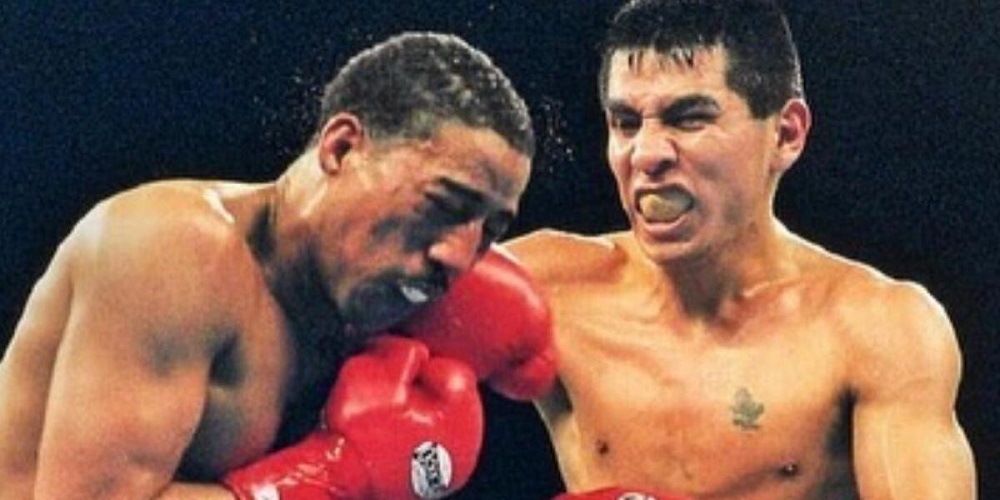
There are special fights that mark a boxer’s leap in quality, taking him from the status of “potential champion” to that of a defining figure of his era. For the charismatic Mexican destroyer Marco Antonio Barrera, that coming-of-age moment was the unforgettable battle with American Kennedy McKinney, staged on February 3, 1996, at the Great Western Forum in Inglewood. The main event of the very first edition of HBO’s Boxing After Dark series, the bout was breathtaking in its beauty and sealed the definitive coronation of the “Baby Faced Assassin.” We celebrate the 30th anniversary of that magnificent defense of the WBO super bantamweight title by retracing its key moments.
The rising star, the veteran, and an explosive buildup
Considering that Marco Antonio Barrera was approaching his 40th professional bout while McKinney had fought just 30 times, it may seem odd that the former arrived branded as the rising star and the latter as a fighter nearing the end of his career.
One must take into account, however, that the Mexican—who turned pro at just 15—was only 22 on fight night, while the 30-year-old McKinney had logged an extraordinarily long amateur career, with nearly 230 bouts in the vest.
A gold medalist at the Seoul Olympics, the American had captured the IBF world title as a professional with a dramatic knockout of South Africa’s Welcome Ncita while trailing on the scorecards and seemingly at the mercy of his opponent, earning a reputation as an indomitable warrior. After five successful title defenses and a surprising loss to the little-known Vuyani Bungu, McKinney was looking to reclaim the spotlight against a man many were already hailing as the heir to Julio Cesar Chavez.
Fireworks went off at the press conference: angered by the way his rival was yelling at him, Barrera punched him square in the face before the two were separated. The appetizer had been served—and the main course would not disappoint.
An unforgettable clash of thrills, spectacle, and twists
We don’t know how much the pre-fight scuffles fueled the young Barrera’s fiery temperament, but his approach to the bout was clearly that of a man with a chip on his shoulder. From the opening bell the champion swarmed his opponent, loading up on his punches with total commitment and mixing shots upstairs and downstairs, undeterred by the thought of facing the best fighter he had ever encountered.
McKinney, for his part, drew confidence from being a clear step up from Barrera’s previous opponents. “Who has beaten Barrera? Who has knocked him out?” he asked the press rhetorically, suggesting that his talent would bring the Mexican idol back down to earth. And truth be told, those fearsome punches—enough to wipe out many of the fighters the Baby Faced Assassin had already conquered in record time—were not sufficient to settle matters quickly. After weathering the storm, McKinney began to slow the fight with his jab and control the tempo.
The generous nature of both fighters, however, could not remain dormant for long. From the sixth round on, the bout gradually turned into a full-scale war between two men on a mission, throwing hundreds of punches per round in a desperate bid to assert dominance.
Just when the relentless exchanges seemed to have sapped Barrera’s energy, the Mexican found the right spark to surprise his rival and floor him. It was the eighth round, and moments later McKinney was forced to endure the indignity of a second count. With the three-knockdown rule in effect, dramatic moments followed, but the American somehow made it to the bell on his feet. Another knockdown in the next round looked like the beginning of the end, yet the challenger had the proverbial nine lives of a cat: he got up, gritted his teeth, and kept fighting with indomitable courage.
HBO’s commentators could hardly believe it when Kennedy McKinney—already down three times and seemingly on the brink of defeat—suddenly began to take over in the tenth round. A visibly tired Barrera, shaken by a sharp right hand to the head, started backing up—something truly uncharacteristic for him—allowing the revived challenger to seize the center of the ring and attempt a desperate comeback. The challenger’s “resurrection” even produced a count, when Barrera’s glove brushed the canvas in the penultimate round after yet another right hand landed. Still, despite McKinney’s spirited efforts to turn the tide, it was clear to everyone heading into the final round that only a knockout could dethrone the champion.
Both corners knew it too: McKinney’s urged one last all-out effort, Barrera’s advised caution—but was, naturally, ignored. Eager to finish in style and heedless of the scorecards, the Baby Faced Assassin delivered a mythical twelfth round, flooring his opponent three times—one of which was culpably missed by the referee—and was carried out in triumph.
The indefatigable McKinney would produce one final miracle a year and a half later, scoring an incredible knockout of Junior Jones in his trademark fashion—finding the winning blow in the midst of a seemingly hopeless situation. An ace up his sleeve that, against the young Barrera, he simply couldn’t draw.