




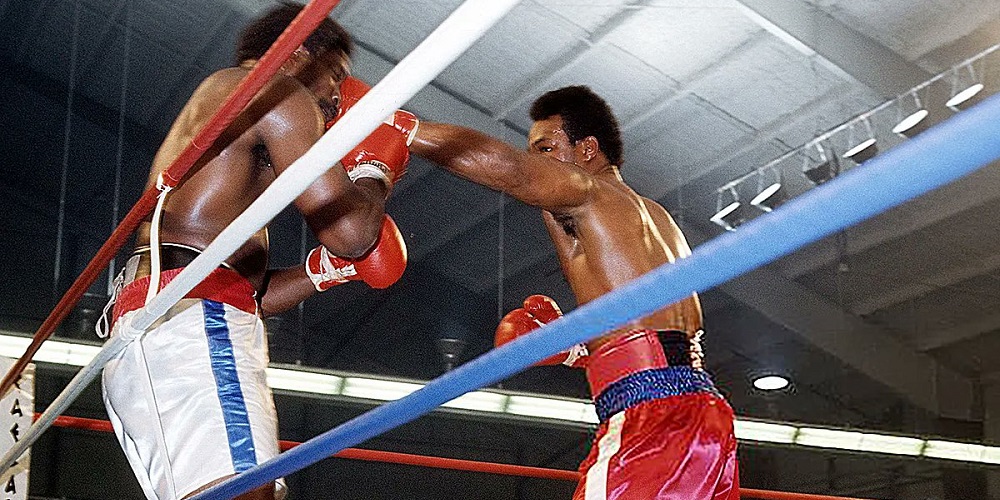
On January 24, 1976, exactly 50 years ago, the Caesars Palace in Las Vegas became the stage for a bout that went down in history for its brutality—so much so that it was named Fight of the Year and remains, to this day, the only fight to have two rounds share the title of Round of the Year (the fourth and fifth). The protagonists were George Foreman and Ron Lyle, who produced a clash of such intensity that any description feels inadequate. Therefore, I ask the reader who chooses to venture into this brief account for indulgence: the best suggestion is to enjoy the spectacle by watching one of the most spectacular boxing contests of all time.
Foreman, the former world champion dethroned 15 months earlier by Muhammad Ali in the legendary “Rumble in the Jungle,” was returning to the ring for the first time since that searing defeat. He had had to battle depression, frustration over a loss he had never even contemplated in his mind, and the shock of discovering that family members had bet against him—and had hidden from him the truth about his biological father (“But the hardest blow was delivered by my sister Gloria: ‘Didn’t you ever notice you’re different from us? You don’t look like us because your biological father is someone else. His name is Leroy Morehood, he’s a war veteran’”). George managed to meet him shortly before he died.
He spent part of those months in Paris, in a state of utter recklessness, indulging in the purchase of cars, villas, exotic animals and numerous sexual escapades—without finding any relief, consumed instead by anger and resentment. He decided to return to the ring; after all, it was the only thing he truly knew how to do.
Standing across from him was Ron Lyle. A man to whom life had offered nothing but hardship, which he repaid in the ring with punches. The third of nineteen siblings, he grew up among gangs, received a second-degree murder conviction (despite being considered innocent by various sources), and survived a nearly fatal stabbing in prison, which required 36 blood transfusions. Ron began training in isolation and later learned to box thanks to the support of Cliff Mattax, the prison’s athletic director, who recognized his potential. From there came a steadily rising trajectory that carried him to the biggest rings in the world, culminating in a 1975 challenge against Ali for the heavyweight world title. Before suffering the TKO loss in the eleventh round, Lyle was ahead on the judges’ scorecards. Despite the disappointment, he returned to the ring later that year to face the fearsome puncher Earnie Shavers, defeating him by sixth-round TKO. Then came Foreman.
The fight was short but as intense as few others. Five rounds of a ferocity rarely seen, as the two men—by nature and by their extraordinary punching power—had more than one trait in common. From the very stare-down, it was clear they were about to unleash something savage.
In the very first round, a right hook from Lyle rocked Foreman, forcing him to clinch to recover. Encouraged by the strong opening round, Lyle pressed forward, but Big George landed an odd left somewhere between an uppercut and a hook. The power of the blow stunned Ron, who retreated to the ropes, where Foreman battered him with punches. Despite more than a minute and a half under fire and numerous blows absorbed, Lyle managed to survive. Surprisingly, however, the round ended a full minute early due to a mistake by timekeeper John Worth, who mistakenly followed the ABC network’s broadcast timer instead of the official one.
Having regained his energy, Lyle resumed trading heavy shots with Foreman in the third round, showing no reverence whatsoever. In a mid-to-close-range exchange favorable to George, Lyle managed to land three clean right hands to the face in quick succession, taking advantage of a Foreman completely unconcerned with defense.
At the start of the fourth round, Lyle caught Foreman with a beautiful straight right. The impact left George stunned, and he absorbed a long series of hooks punctuated by an uppercut. On the final left hook, George crashed to the canvas. He got back up, visibly shaken, found the strength to clinch and catch his breath, then suddenly unleashed his leverage, hammering Lyle with two massive hooks, followed by three more left hooks, and finishing with a right hook to the temple that sent Lyle to the canvas. Ron managed to rise but was immediately attacked by Foreman, who struck him with all his might. Lyle seemed on the verge of collapse after a series of Foreman left hooks, but he seized a moment of hesitation and fired back with a left hook—twice. George was in trouble again. Ron pressed forward once more, legs barely holding him up, and landed a right hook, a right uppercut, and a left hook to the jaw.
The momentum had shifted. Lyle hit Foreman with an uppercut, George replied with a left, but Lyle answered with a right that sent Foreman to the canvas yet again. George found the strength to get up, just in time to stagger to his corner, saved by the sound of the bell.
Thus came the fifth round, and George advanced menacingly despite what had happened moments earlier. Lyle remained aggressive, but Foreman appeared at least lucid and ready to respond. A left hook from Lyle once again caught Foreman, who staggered around the ring trying to clinch. Once again, he survived—helped in part by his opponent’s fatigue, which prevented Lyle from capitalizing. He absorbed another left hook that could have dropped a bull, yet somehow stayed on his feet. Lyle leaned on the ropes, utterly exhausted. Foreman struck him with three consecutive jabs, then Lyle found one last burst, firing a right uppercut followed by a left hook and then a right, blows that seemed decisive. Instead, Foreman astonishingly remained standing and summoned the strength for a long two-handed barrage, driving Lyle back to the ropes—helpless, drained of all energy, at the mercy of his opponent. The volume of punches was overwhelming, and Lyle collapsed slowly, inch by inch, toward the canvas, unable to rise.
Half a century has now passed, and both protagonists are gone. Ron Lyle died in 2011 at the age of 70 from a gastric abscess that led to septicemia. George Foreman passed away last year, but the cause of death was not publicly disclosed and, despite speculation, remains unconfirmed to this day.
It is probably fair to say that Lyle was not an outstanding boxer, burdened by too many technical limitations, and that the Foreman of that night was still searching for himself after Kinshasa. But beyond context and circumstances, in the memory of boxing fans, their clash remains an indelible snapshot of courage, power, and will—a perfect photograph of a no-compromise, calculation-free brand of boxing, and for that reason still loved without reservation today.