




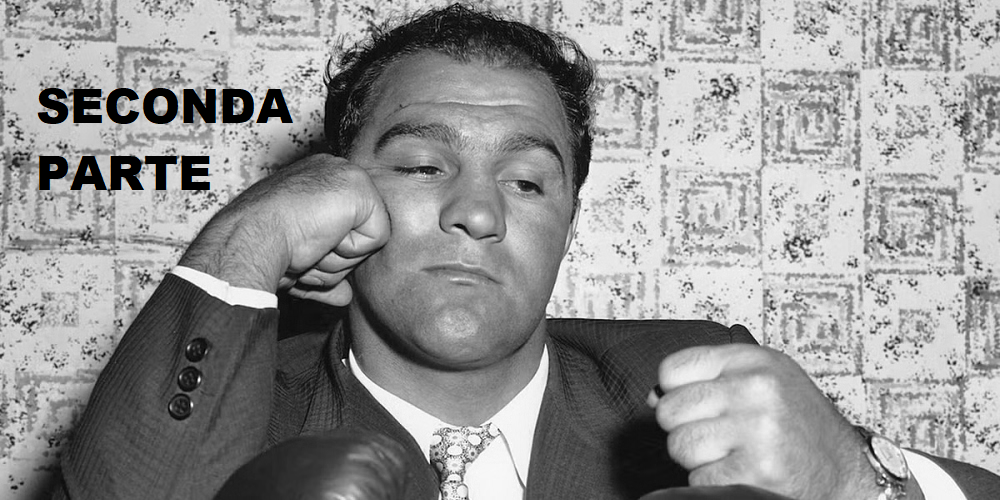
There is no doubt that former heavyweight world champion Rocky Marciano left an indelible mark on boxing history, to the point of becoming an icon of our beloved sport. His unblemished record, his highlight-reel knockouts, and his inexhaustible courage inspired subsequent generations, providing creative sparks for writers and filmmakers alike, eventually turning Rocky into a true pop-culture myth. A myth, however, on which opinions are far from unanimous: some consider him invincible and believe he would dominate in any historical era, while others see him as overrated, aided in his achievements by the absence of true all-time greats among his contemporaries.
To explore the issue in greater depth, we asked fourteen distinguished boxing experts—seven Italian and seven international—to share their views, asking them where they would place Rocky in an all-time heavyweight rankings and why. Some provided an exact position, while others preferred to give a range.
In this second part of our feature, we present the opinions of the seven international experts we consulted.
The opinions of the International experts
Adam Abramowitz
American journalist, owner of the insightful blog Saturday Night Boxing, contributor to The Ring magazine, and member of the Boxing Writers Association of America (BWAA) and the Transnational Boxing Rankings Board (TBRB).
His answer: between ninth and eleventh place.
Reasoning
I would put Marciano somewhere between 9 to 11. Here is who I have over him: Ali, Louis, Holmes, Lewis, Foreman, Holyfield, Tyson, Frazier. I think Marciano could go next. I also am putting a caveat of not being a historian. It’s possible I’m underrating Jack Johnson and perhaps a few others that didn’t have the same opportunities in the early days of professional boxing.
Oliver Fennell
British journalist, editor of the prestigious UK boxing magazine Boxing News.
His answer: in the lower part of the top 10.
Reasoning
Marciano’s record is somewhat inflated by the “perfect” record, which stood for so long and essentially mythologised him, especially by casual fans who considered an entire career spent undefeated as evidence of a man who COULDN’T be defeated.
We’ll never know, of course, but Marciano did struggle against a few fighters outside the all-time great discussion, at least at heavyweight, and his reign, which “only” ran to six defences, came against a combination of underdogs, natural light-heavies, ageing fighters, or a combination of the above.
Rocky recognised his own vulnerabilities when he was floored by a fortysomething Archie Moore and considered it was better to retire then than tempt fate further. This followed difficult nights against Jersey Joe Walcott and Ezzard Charles, were both also on the wrong side of their primes.
But in Marciano’s credit, he still won those fights, demonstrating adaptability and a fierce desire to win, as well as the unrelenting aggression that earned him such a fierce reputation even before he won the title. Emphatically winning rematches with Walcott and Charles also showed huge capacity for improvement, and gave evidence of the toll he exacted from opponents. As well as Walcott and Charles had done against him once, they simply couldn’t do it again when they realised even their best had not been enough to beat The Rock.
On paper, Marciano places near the bottom of an all-time heavyweight top 10 – but that’s not to say he wouldn’t beat a few of those placed above him.
Lee Groves
American journalist and boxing historian, member of Compubox, executive producer of the boxing podcast In This Corner, and International Boxing Hall of Fame voter.
His answer: between sixth and tenth place.
Reasoning
Rocky is an interesting case study for historians for several reasons. On the positive side, he has that immortal 49-0 record that has remained a touchstone even after Floyd Mayweather ended his career 50-0 and even after other fighters have surpassed that mark but didn’t end their careers undefeated. He was also a compelling personality outside the ring and there are many reasons to admire him: His blood-and-guts fighting style, his extraordinary dedication, discipline and tenacity, and the dramatic way he won his fights (his come-from-behind one-punch KO of Walcott and his last-ditch stoppage of Charles in their rematch) among them. For these reasons, he can’t be left off any lists for all-time great heavyweight champions.
However, there is the negative side. First, he would not fare well in fantasy match-ups past a certain point because he would face enormous deficits in terms of height, reach and weight. In today’s world, he’d be a cruiserweight, and a tremendous one at that. His tendency to suffer cuts around the eyes would hamper him as well, especially against the likes of Lennox Lewis, Muhammad Ali and the prime version of Joe Louis, who was one of the most precise hitters in history. There were times when he was easily hit, and he was floored by both Walcott (first fight) and Archie Moore. There is also the fact that he didn’t face an all-time great in their physical prime during his reign. Walcott, Charles and Moore are all-time greats, but they were aged at the time they fought Rocky, yet they were still able to push him. How would he fare against the 1966 or 1967 version of Ali, or the 1980-82 version of Holmes, among others? Given all his disadvantages, one has to wonder.
We at CompuBox have compiled retro numbers on Marciano (we have eight of his fights in the database). His combined numbers paint an interesting picture: His output was 48.7 punches per round, slightly above the 44.1 heavyweight average. As one might expect from someone with his short height and reach, power shots made up 87.1% of his total output, far above the 54% division average, so he was an extraordinarily aggressive fighter. He also was slightly above average in terms of accuracy (37% overall, 21% jabs, 40% power compared to the norms of 32%, 24% and 40% respectively) and body shots made up 38.3% of his total output, well above the 28.8% CompuBox average. However, the most surprising number given his reputation are his defensive numbers, which, over the long haul, ware better than expected (25% overall, 11% jabs, 33% power). His upper body movement allowed him to roll under his opponents’ punches and he blocked them well.
As for my final assessment, Rocky probably occupies a spot somewhere in the lower half of the top 10 among heavyweight champions. Yes, he had flaws and they were obvious, but one shouldn’t ignore the final results: A perfect record, highlight-reel knockouts, a well-earned aura of invincibility and the admiration and love he earned from fans. One can’t ask any more of a great fighter than that.
As far as the aged opponents, that’s not Rocky’s fault. All any fighter can do is to fight whomever is placed in front of him. Rocky not only did his job, he did it perfectly. But in terms of ranking all-time greatness, one has to take into his account the opposition he faced as well as the context surrounding those opponents, and it is here that Rocky gets hurt historically.
Steve Hunt
British journalist and author, owner of the blog Steve Hunt Boxing and the podcasts The Boxing Movie Podcast and The Desert Island Fights, and author of the book Heavyweight Title Fights of the 1980s.
His answer: between sixth and tenth place.
Reasoning
There is a clearly a fundamental problem with a historical ranking list of heavyweights that does not apply to the other weight divisions. For example, every middleweight in history has had to weigh in at 160lbs. With heavyweights that is obviously not the case, leading to a huge weight disparity.
That gives you two choices. Either you take the fighters exactly as they are, matching the 185lbs Marciano against the likes of the 245lb Lennox Lewis, or you create an almost P4P list within the one division, imagining the weight differential to not exist.
In the second list, with the weight advantage that most of his rivals would hold over him removed, he would clearly rank significantly higher. If the fights against his rivals from another time were held over 15 rounds, I would also count this as a plus for the Rock. His main assets were his punch power, his endless stamina and he was impossible to discourage.
Working on the basis that we are matching these fighters as they are I have only five heavyweights who I would favour strongly to beat Rocky. They would be these: Holmes, Ali, Liston, Foreman and Lewis. Even then, I can see Holmes and Ali being vulnerable to Rocky in the later rounds if it went that far.
Opponents where I find it hard to pick a winner would be these: Holyfield, Tyson, Frazier, Usyk.
For me he is a top ten heavyweight, whatever criteria you use. Some people will include in that, things like historical impact, where clearly Rocky would score very high. The beauty of Rocky is the fact that no one ever beat him in a professional boxing match. Unfortunately, that is also one of the reasons why it is so hard to assess his place among the greats! Hope that helps, but I find it very difficult to rate fighters from different eras, particularly the heavyweights!
Michael Montero
American journalist of Italian descent, contributor and correspondent for The Ring magazine, International Boxing Hall of Fame voter, and host of the boxing podcast The Neutral Corner.
His answer: within the top 10.
Reasoning
Rocky Marciano’s place among the all-time great heavyweights has become a subject of great contention in recent years. In America, it’s almost become chic among younger fans to disparage his great legacy and simply call him overrated. In more radical circles, Marciano is often marginalized to having been nothing more than an “unskilled, mafia-protected brawler”.
Nothing could be further from the truth.
The reality is that Marciano, born Rocco Francis Marchegiano, had exceptional stamina, durability and punching power, especially as an undersized heavyweight. “The Brockton Blockbuster” also possessed underrated natural athleticism, a relentless will to win, and was a pioneer of the swarming, pressure style of fighting that had mostly been utilized by smaller fighters until that time.
The fact that Marciano came into boxing much later in life that most accomplished professionals, with a very brief amateur career of only 12 bouts, only makes his ring accomplishments even more impressive. Imagine what could have been if he had grown up boxing as a youth?
Nonetheless, in today’s era, Marciano would simply be too small to compete in the modern heavyweight division. The World War II veteran stood at just 5’10” tall and routinely walked into the ring around 185-pounds, and that was back when boxers weighed-in the same day of their fights. To put things into perspective, current lightweight prospect Abdullah Mason (20-0, 17 KOs) stands only an inch shorter than Marciano, with a six inch longer reach.
So, while he may not have fared well in mythical head-to-head matchups against the massive, “super-heavyweights” of the modern era, you can only judge a fighter by what they did against the best of their time. In the end, Marciano went 6-0 (5 KOs) against hall-of-famers Joe Louis, Jersey Joe Walcott, Ezzard Charles and Archie Moore.
In my humble opinion, Rocky Marciano is undoubtedly one of the top ten greatest heavyweight boxers of all time.
Phil Rogers
British freelance journalist, author of several articles published in Boxing News, and owner of the blog https://progers.journoportfolio.com.
His answer: within the top 10.
Reasoning
Marciano is someone I’d place in the top 10 heavyweights of all time. An undefeated, vicious puncher with victories over names such as Jersey Joe Walcott, Ezzard Charles, Archie Moore & Joe Louis.
Some pick holes in these wins, citing their age and decline, and for that I suppose you’d have to deduct points. The era was not the strongest for the division, and this wasn’t helped by the likes of Floyd Patterson avoiding him. But Marciano never ducked anyone. Six title defences, five of which were against the number one contender (the other against the number two, who’d just won an elimination bout against the number one) puts him in rare company.
And if we’re adding bonus points in these arbitrary lists for intangibles, for heart, for relentless spirit, for superhuman conditioning, he’d earn more than most.
Purely for the fun factor, that 88% KO ratio and three Ring Magazine “Fight Of The Year” wins from 52-54 deserve to have him placed amongst the blue ribbon division’s finest.
Cliff Rold
American journalist, for many years a mainstay of the well-known website Boxing Scene, owner of the blog The Corner Stool, and a member of the Boxing Writers Association of America (BWAA), the Transnational Boxing Rankings Board (TBRB), and the International Boxing Research Organization (IBRO).
His answer: eighth place.
Reasoning
Marciano was unbeaten but wasn’t unbeatable. No man who ever entered the ring could ever really claim that. Still, never losing will always give him a special place in the Heavyweight pantheon and he didn’t really miss anyone who mattered. It can be pointed out that Marciano’s best wins came against older fighters…but most of those were damn good old men. Not all. Louis was ancient. Savold was in his last fight and entered off a knockout loss to that ancient Louis. For others, age was not so big a factor. Walcott’s performance in the first Marciano fight certainly doesn’t scream old and Charles gave everything he had left in both of their outings. Marciano beat what Charles had left out of him. Nino Valdez is often cited as the best contender Marciano didn’t fight but Marciano did face a Moore who bested Valdez twice on points. In fact, Moore entered their bout with a 21-fight winning streak which included wins over Harold Johnson and Joey Maxim at Light Heavyweight, and a knockout of Heavyweight hopeful Bert Whitehurst, later twice to last the distance with Sonny Liston.
While he can look crude, Marciano was more skilled than given credit for, able to make himself smaller than he already was while winning both early and late. His rematch record is perfect as regards stopping his man earlier the second time around. In part a reflection of changed and changing times, Marciano was only the third white Heavyweight champion, from Sullivan to him, to defend against a black challenger and the only one to do it more than once (aided by success in the first try of course). His struggles with the boxing ability of Charles and Walcott make it easy to envision Marciano struggling with the best larger Heavyweights who followed him, particularly when factoring their size was complimented with athleticism and skill. The timing of his rise played a part in his success…but that’s the case for most Heavyweights. He’d have won more than his share in any era. Marciano was an inaugural member of the IBHOF in 1990.