




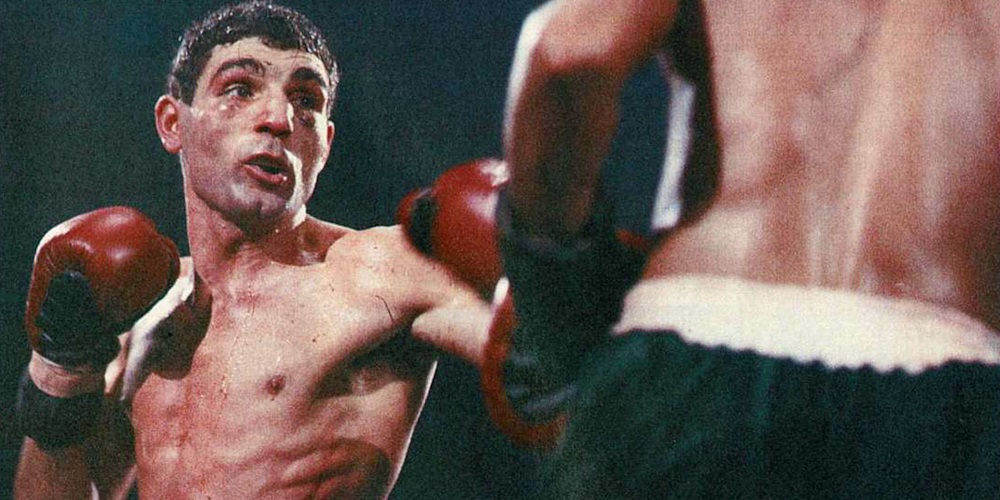
Hit without getting hit: this is the pure and simple essence of the “Sweet Science”, and very few have interpreted it as literally as the great Patrizio Oliva, an indispensable name for our series on great Italian boxing. In defiance of brawl-loving fans, who believe every fighter should go to war head-on, the Neapolitan champion earned his victories through intelligence, technique, and timing—along with unmatched determination. It was precisely by discussing his unmistakable style that we began our pleasant conversation with Patrizio, before focusing on the most significant moments of his thrilling sporting journey.
What do you say to those who criticize your boxing style, judging it to be too cautious and not aggressive enough?
Everyone knows the Patrizio Oliva who touches and moves away—my technique and my intelligence in hitting without getting hit. But when a battle was forced upon me, I never backed down, because I knew how to do that as well. If I didn’t, it wasn’t because I was afraid, but because there was no reason to: if I could win without being hit, should I really take risks just to please someone? There are people who speak badly about my boxing because in this country you have to criticize no matter what. To them I say: name me a boxer who, like me, has won everything there was to win, who stayed at the top of the world for twenty years, who from his very first amateur bout all the way to the second defense of his professional world title was never knocked down and never even given a count by the referee. We’re talking about almost 150 fights between amateur and professional boxing! If I managed to do that, it’s because I had extraordinary ring intelligence, I knew how to defend myself well, and I could anticipate what my opponent was going to do.
Perhaps your greatest victory—greater even than Olympic gold and the prestigious belts you won as a professional—was emerging, through boxing and sheer willpower, from a difficult environment. Have you ever reflected on what direction your life might have taken without that rundown gym that you called “the most beautiful place in the world”?
Yes, my destiny was already written. If that gym hadn’t existed—the one I went to with my brother Mario—the highest aspiration I could have had would have been to become a factory worker. When I walked into that gym, I immediately understood that I had found my path and that I could change my destiny. That’s why, even though the gym was a real dump—to the point that we had to urinate on the floor to keep the rats away—I say it was the most beautiful place in the world for me. It proves that you don’t need beautiful, ultra-equipped gyms to achieve results; what really pushes us to reach them is our will and our inner strength. The famous scene from the movie Rocky IV, where Ivan Drago trains with high-tech equipment while Rocky climbs mountains, is a metaphor that perfectly symbolizes this concept. I never got tired of walking those 15 kilometers to go train: I already had the dream of becoming Olympic champion and world champion in front of my eyes. And the incredible thing is that I dreamed of doing it at super lightweight—I even guessed the weight class! At the time I weighed 30 kilos; as an adult I could have weighed 53 or 70, but I liked the super lightweights because I liked Bruno Arcari. Destiny later had it that Arcari would become my trainer during my professional career.
Winning Olympic gold and the Val Barker Trophy in the Soviet Union, beating the local hero in the final, was truly a “movie-like” feat. Can you describe the feelings surrounding that historic triumph and the attitude of the Moscow crowd toward you on that occasion?
It really was a movie-like feat for two reasons. The first is that I was facing a man who, a year earlier, had robbed me of the European title in Cologne, when I had clearly beaten him but the judges awarded him the win amid protests from the crowd. The second reason is that I faced him in the final: I could have run into him in the very first bout, but destiny wanted to give me a fairytale revenge and placed us on opposite sides of the draw. I knew that it wouldn’t simply be the better boxer who won—we were both champions—so the difference would be made by motivation, and mine was enormous because I wanted to dedicate the victory to the memory of my brother Ciro, as I had promised him on his deathbed. I won by a narrow margin: the first round was mine, the second was his, but in the third round I showed everyone that I wanted to win more than he did. The Moscow crowd applauded me.
Your professional path to achieving the world title dream was simply impeccable: four defenses of the Italian title, eight defenses of the European title, and a flawless run of 43 consecutive victories that would later become 48. Is there one fight from this triumphant run that you remember with particular affection? And why?
I remember with great affection the defense of the Italian title against Antonio Antino. Antino was a friend of my brother; he had competed in the championships with him. The night before the fight in Ischia, we found ourselves talking and joking about how hungry we were and how little we had eaten in those days to make weight. He said to me, “Just imagine having to fight for the Italian title against my idol!” These are small anecdotes that show there is no malice between a boxer and his opponent.
The victory over Argentina’s Ubaldo Sacco, which allowed you to lift the WBA world title belt in the Principality of Monaco, was a display of refined technique. But how important was your ability to endure suffering that night?
That was actually what made the real difference! When Ubaldo Sacco defeated Gene Hatcher, who was a warrior, many people said, “My God, Oliva has to fight this guy? He’s going to get massacred!” People fail to understand that not all fighters are the same. I am not Hatcher, I am Patrizio Oliva, and I box my own way. That night, from the first to the fifteenth round, Sacco never gave me a moment’s rest: I would hit him, slip away, and find him right back in front of me. He forced the fight, because for every step he took, he made me take four. The same thing happened to Ali when he fought Foreman: he immediately realized he couldn’t beat him by dancing around, because it would have been impossible to escape him for 15 rounds, so he went to the ropes and let him burn off his rage. I didn’t go to the ropes because I had different characteristics, but I understood that I had to plant my feet and make Sacco feel my punches.
Your defeat against the ferocious puncher Juan Martín Coggi deeply saddened Italian fans. The Argentine later proved to be a great fighter, but looking back on that night, do you have any regrets, or do you believe it was simply time for the baton to be passed from one champion to another?
That defeat never really hurt me, because I already knew it was coming—I had factored it in. What happened with the weight proves it: normally, a month before a fight I was already on weight, but when I fought Coggi, two days before the bout I was still three kilos over! I no longer had the desire to fight, and Rocco Agostino had already noticed it—he scolded me every evening because I trained with the face of a man sentenced to death, and I told him, “Rocco, I just can’t do it anymore.” I was mentally exhausted; they had squeezed me dry. There were fighters who did one world title fight a year, while in a year and a half they made me fight four world championships and two non-title bouts. On top of that, I was a very serious professional: I went into training camp two months in advance and trained hard. So after the defense against the Mexican Rodolfo González, I told Rocco Agostino that it had been the last fight of my career and that I would call a press conference to announce my retirement. Shortly afterward, he called me and said, “Patrizio, are you still serious about it? Because I may have arranged the fight of the year for you…” He revealed that he had reached an agreement for me to defend the world title in America against Héctor “Macho” Camacho for one million dollars—which at the time was worth about 1.7 billion lire. My biggest purse up to that point had been three hundred million, so it would have been the payday of a lifetime; I told myself it was worth one last effort.
Rocco left for the United States to finalize the deal, but Camacho’s team, after watching my footage, decided to have him fight first against a boxer similar to me, to see whether that kind of matchup would appeal to American audiences. And, to be fair, that fight did happen: Camacho faced Howard Davis Jr., an Olympic champion from Montreal with an elusive style. I had already started training when I received this news, and of course I became demoralized. We then reached an agreement with Harold Brazier, the world number eight, for a voluntary defense, but three weeks before the fight Brazier also pulled out! At that point they told me they had found this Argentine boxer, nothing special, who had just become national champion. Mentally, that was the moment I completely checked out: I didn’t train well, I didn’t live like an athlete, and two days before the fight I was overweight. I trained under the sun to lose the last kilos and arrived at the bout so exhausted that I fell asleep in the locker room—my brother Mario slapped me to wake me up! And when I got back up from the canvas after losing, I thought, “Finally, it’s over. I can retire.” That’s why I already knew in advance that whoever I faced could beat me. Fate then had it that Coggi turned out to be a “new Monzón,” but to knock me out he had to hit me with five consecutive punches—he was a fighter who usually knocked everyone out with a single shot. I didn’t see the hook of the first knockdown coming, but in my career I had avoided millions of wide punches like that; that night, mentally, I just wasn’t there.
Your life after hanging up the gloves has been a true whirlwind of experiences: referee, judge, supervisor, trainer, even stage actor with your show “Patrizio vs Oliva,” and much more. What pushed you to constantly seek new challenges and new adventures?
I am a very multifaceted person who has never resisted change in life. Opportunities come along, and I seize them. Someone who does the same job for many years eventually nullifies himself mentally. Many people are forced to do so because it is their only means of making a living. I was fortunate enough to be able to change activities and always do new things, and that—by giving me constant new stimuli—has helped me stay young as the years have gone by.