




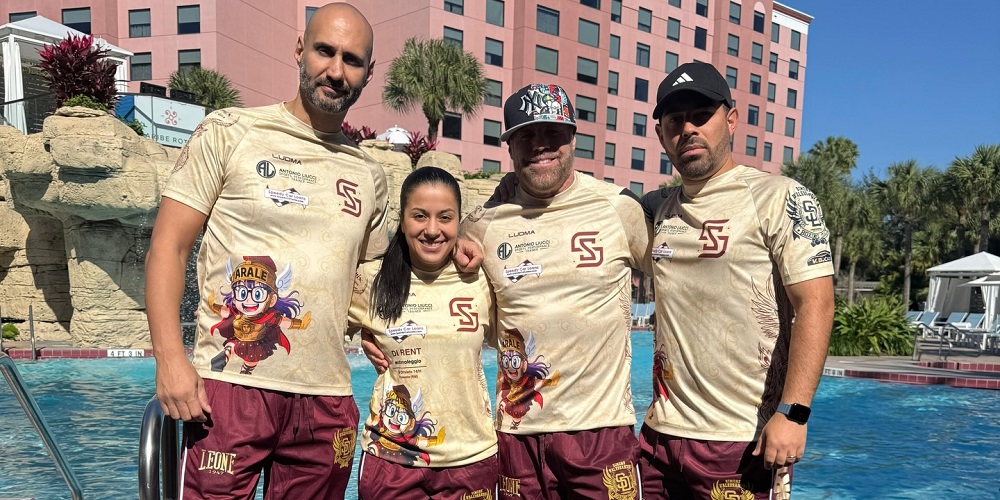
Simone D’Alessandri is a man of sport. As such, he is accustomed to frank, direct, and fair confrontation—the kind that athletic competition instills day after day, challenge after challenge. We therefore hope that he will not view this article as a personal attack, but rather as an opportunity for debate among people who genuinely care about the well-being of Italian boxing. The subject at hand is the interesting video message recorded in Orlando by the Italian coach in the aftermath of his fighter Stephanie Silva’s bout. A message that, in some respects, I found entirely shareable, yet at the same time one that prompts me to express a few differing opinions.
The Missed Weight: An Appropriate and Convincing Explanation
The first part of D’Alessandri’s remarks is flawless and even necessary. In recent days, far too many people have unfairly accused Silva of unprofessionalism for missing the super-flyweight limit and thus losing her chance to compete for the WBA belt. Simone reconstructed the sequence of events, providing an explanation that we find convincing and that highlights our athlete’s innocence and her sheer bad luck.
Not only did the food poisoning deny her the opportunity to chase her world-title dream—which would not have materialized even in the event of a victory—but it also weakened her physically just days before a very demanding fight.
The Epic Narrative of the Fight
D’Alessandri then focused on the bout itself, delivering a description steeped in epic tones, to the point of drawing a comparison with Rocky Balboa, who in the famous film Rocky IV traveled to the Soviet Union to face the local idol Ivan Drago and ultimately won over an initially hostile crowd.
In this case as well—setting aside one specific sentence I will address in the next paragraph—I consider the Italian coach’s account to be truthful. The initial boos that turned into applause, the local crowd’s protest during the reading of the scorecards, Gilberto Mendoza’s “apologies” for the verdict, and the photo granted to Stephanie with the world title belt are, in my view, events that truly occurred and about which I have no reason to doubt.
I would add, however, a couple of entirely personal observations. The first is that I myself, despite having a very slight edge for Jasmine Artiga at the end of the fight, would have booed upon hearing the glaring margins awarded to the American fighter by two of the judges. The second is that Mr. Mendoza, by virtue of the role he holds and the often mellifluous personality he has displayed, seeks to maintain excellent relationships with everyone; it would therefore not surprise me at all if, behind the scenes and in conversations with Artiga’s team, he had expressed very different opinions. That said, I readily admit this is mere speculation.
Do American Newspapers Really Say the Champion Is Silva?
“Today all the newspapers here in America say that the champion is Stephanie Silva” are the exact words used by D’Alessandri during his recap. I am sure Simone said this in good faith, persuaded by those around him at the time that the consensus on Stephanie’s superiority was unanimous. However, an analysis of articles dedicated to the fight by the most authoritative U.S. boxing websites paints a different picture.
Boxing Scene, the most widely read boxing website in the world, entrusted coverage of the event to Jake Donovan, one of its leading writers (link to the article). Here is what he wrote about the Artiga vs. Silva fight:
The first several rounds saw Artiga, the first-ever Tampa-born and bred boxer to win a major title (Antonio Tarver was born in Orlando), consistently work behind her right jab out of the southpaw stance. She clearly struggled as the fight wore on to keep the heavier Silva at bay. The 39-year-old Artiga never lost sight of the task at hand, though, and stuck to her superior fundamentals to get the job done in the end.
The Ring Magazine, the most historically prestigious American boxing magazine, also covered the event (link to the article). Here are a few lines from their report:
Artiga (15-0-1, 7 KOs) landed the sharper shots against Silva (10-2), who was ineligible to win the title after missing weight by more than four pounds. Silva had her moments as well when she was able to push Artiga back and land in exchanges with the champion. Ultimately, the cleaner work of Artiga gave her the edge.
With More Patriotism, Would We Be Kings of the World?
The part of D’Alessandri’s speech that struck me the most—and that most compelled me to write this article—was the concluding one. The coach urged those listening to unite, to “cheer,” asserting that if we Italians had even 50% of the patriotism typical of Americans, we would be “the kings of the world.”
In and of itself, this appeal contains nothing wrong or objectionable. The idea of supporting one another, of avoiding gratuitous denigration of our compatriots, of wishing them success when they compete abroad is genuine and commendable. I fear, however, that this message could be interpreted by part of the Italian boxing world in a profoundly distorted way.
Anyone who has written about boxing in this country knows full well the script to follow in order to avoid being regularly inundated with polemics and crude attacks:
If an Italian boxer wins, you must write that he was extraordinary.
If he loses narrowly, you must write that he was robbed.
If he loses clearly, you must write that he nearly pulled off the feat.
If he gets battered, you must write that he offered heroic resistance.
I have never followed this script, and indeed, looking back over the twenty years I have spent covering boxing, I could write a book of anecdotes about the endless “headaches” caused by my modus operandi.
But the real problem is not me—I have thick skin. The real problem concerns those promoters, trainers, boxers, and fans who believe that true friends are the ones who always call you a phenomenon, who shower you with praise and pats on the back, who refrain from pointing out a flaw or a shortcoming for fear of upsetting you. The problem is theirs, because while compliments feel good, it is constructive criticism that helps us grow, pushing us not to rest on our laurels and to do better and better.
I will not start naming names by dredging up the past. On the contrary, I do want to name one person—the praiseworthy exception that proves the rule: the Tuscan boxer Simone Rao. Five months ago, following his extremely close split-decision loss to Francesco Grandelli, we published an article in which we wrote, among other things, that the judges had rewarded the rightful winner.
Rao did not merely refrain from attacking us: he reposted our piece on his profile, thanked us for the report, and calmed his fans who were contesting the verdict. That, in my opinion, is the point. With a few fewer so-called patriots and a few more Simone Raos, we would have far better chances of becoming the “kings of the world” in boxing.