




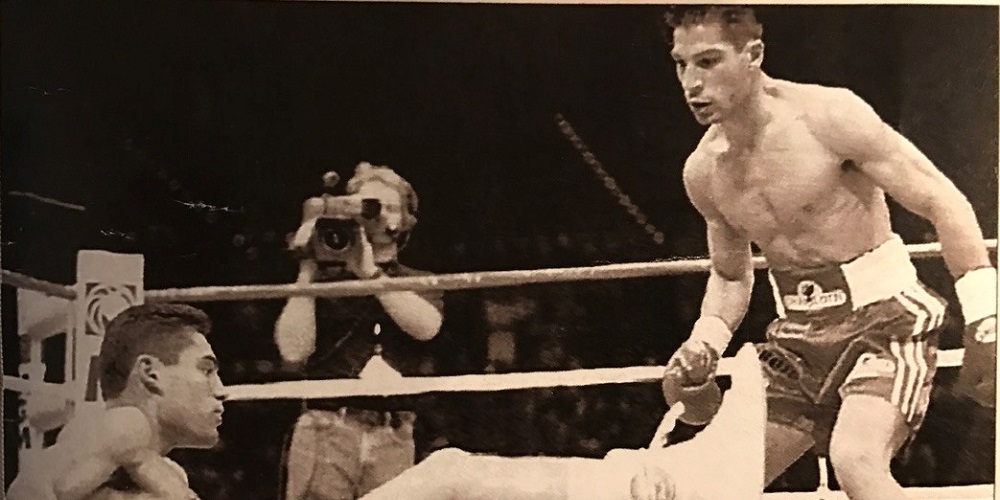
A lethal punch, inexhaustible grit, courage pushed to the limits of recklessness: Giorgio Campanella was a genuine gem in the Italian boxing scene. Exceptionally precocious in displaying his talent, he competed at the Seoul Olympics at just 18 years old, went on to become a three-time world title challenger as a professional, and achieved the feat of knocking down the great Oscar De La Hoya in a dramatic first round in Las Vegas. On his 56th birthday, we present the conversation Giorgio kindly agreed to have with us, retracing the key moments of his intense and thrilling career.
What do you remember about your first steps in boxing, and in particular the Olympic Games in South Korea?
I joined the national team at 14; at 16 I won in Messina the Italian championships knocking out in the final the reigning champion, who was 22 at the time. I am the youngest boxer to have taken part in the Olympics in 103 years of Italian Boxing Federation history: it was the edition won by the late Giovanni Parisi. I won my first match by knockout, and in the second I knocked down Andreas Zulow with a left hook—he later went on to win the gold medal. After Seoul, since military service was still compulsory, I joined the police force for a year and won the Italian championships again. Then I decided to chase my big goal and turned professional. When I first stepped into a gym in Crotone at 10 years old, I didn’t even know what the Olympics or the national team were; I was already dreaming of fighting for the “real” world title in America. So for me, turning pro was a natural step.
After twenty consecutive victories and after winning and defending the Italian title, the opportunity of a lifetime came: you were named mandatory challenger for Oscar De La Hoya’s WBO world title. How did you react to that call from destiny?
In 1994, besides being Italian champion, I was the official challenger for both the European title and the WBO world title. My manager, Salvatore Cherchi, offered me three options: fight for the European title, face De La Hoya, or wait for him to move up to lightweight and then fight another boxer for the world title. I’ve always boxed to reach the highest levels, so I didn’t hesitate for a minute in choosing De La Hoya, even though I had seen him fight and knew he was a great boxer. In my opinion, he was one of the all-time greats, and I don’t say that because I fought him—you just have to look at his record to see how many legends he faced.
Your fight against the formidable De La Hoya will probably remain in your memory forever. He tried to attack you immediately, and you put him down with a tremendous left hook before suffering his comeback. What do you feel when you think back to that night?
There are things people don’t know, also because I’ve always been quite reserved. I decided to go to Las Vegas two weeks before the fight to adjust to the time zone. In my last training session at my gym before leaving, I dropped my sparring partner with a straight right to the forehead and in doing so fractured my right hand. So when I arrived in Las Vegas, I wasn’t in the best psychological state. But with Franchino Cherchi, who was my coach, we worked for fifteen days on a specific move: slipping his right hand and throwing my left hook. A few seconds after the start of the fight, on the second right hand De La Hoya tried to throw, I did exactly what we had prepared and knocked him down. Standing in the neutral corner, my whole life flashed before my eyes. I thought about my beginnings in Crotone, the move to Tavullia—where before Valentino Rossi they used to cheer for me—about all the goals I had pursued and achieved up to that day. I remember as if it were today that when I saw De La Hoya get back up, I thought, “It’s not my moment.” I watched the video of that fight for the first time a few months later, because after the loss I went through a tough period: my left hook barely grazed him! If it had landed two or three centimeters higher, he would have stayed on the canvas for forty-five minutes and I would have made history. That’s how it went—so be it.
After that famous battle, you had two more shots at the WBO world title, first in the Netherlands against Regilio Tuur and then in Germany, as a lightweight, against Artur Grigorian. What stands out in your memory about those two unfortunate trips?
During my preparation for the world title fight with Regilio Tuur, I started feeling pain in my knee: it was inflammation of the synovial plica. The doctor prescribed cortisone, but I couldn’t take it because of anti-doping controls. If I had fought for that world title in Italy, in better physical condition, I wouldn’t have had any problems. Instead, I went to the Netherlands after a 50% preparation and fought twelve rounds with my head held high, while my opponent, at close range, was headbutting me and splitting me open like a mussel. He was the hometown fighter and nobody saw anything. From that moment on, my morale struggled to recover: I kept asking myself why injuries had struck me at the crucial moments of my career. The world title fight with Grigorian was canceled a few days before the scheduled date because the German dislocated his shoulder in training. When the opportunity to go to Germany came again, I had mentally checked out: I trained on my own, without sparring, and after ten honorable rounds I had nothing left. At that point I thought, “Why take two more rounds of punishment that could hurt me more than the ten I’ve already done?” Shortly after, I decided to quit—I just didn’t feel it anymore.
Looking back at your career with a clear mind, is there anything you wouldn’t do again? Do you have any regrets about certain choices?
One thing I wouldn’t do again is campaign at super featherweight. I was draining myself too much and couldn’t punch the way I did as an amateur, when at international tournaments some opponents would pull out rather than face me because they feared my power. I fought for world titles against real fighters; many guys I used to drop in sparring later won some titles, but nobody remembers which belt it was or who they fought. People remember my fight with De La Hoya and my battles. After our fight, Artur Grigorian told me privately that I should have moved to Germany to train with him under the management of the famous promoter Klaus-Peter Kohl. But I already had two children and didn’t want to move to Hamburg. I have no regrets: I take life as it comes.
How has your life developed after retirement? What do you do now, and what are your plans for the future?
Before earning my boxing trainer’s license—which is the job I do today—I waited nine years because I still felt like a fighter, and as long as you feel like a fighter you can’t train others. Then I got my license and started my coaching career. Today I live in Tenerife, where I’ve opened a beautiful gym. I spend a lot of time with my wife, with whom I will celebrate 36 years of marriage in a few months. I have a 34-year-old son and another who is about to turn 28. Compared to others in my line of work, I believe I have the advantage of experience gained between the Olympics and the professional ranks: when I look one of my boxers in the face, I know what he’s feeling because I’ve lived it myself—and that allows me to give him so much.