




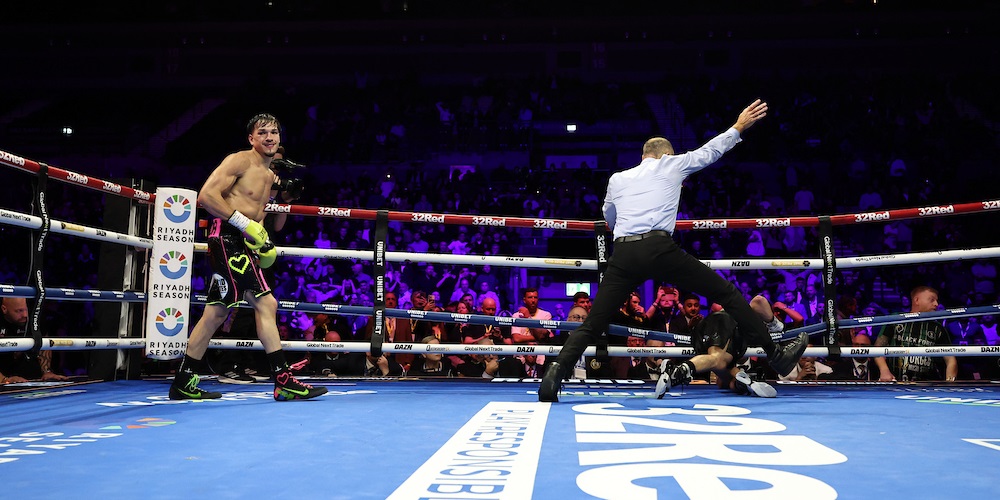
A battle was expected, and a battle it was inside Liverpool’s Echo Arena. WBA featherweight world champion Nick Ball and challenger Brandon Figueroa held nothing back, producing an intense and thrilling fight worthy of a world title—and perhaps even a Fight of the Year contender. Twelve rounds fought at a blistering pace, capped by a dramatic twist in the final round: Brandon Figueroa dropped Nick Ball first with a devastating left hook and then, moments later, floored him again under a barrage of punches, scoring a knockout and crowning himself WBA featherweight world champion.
The pre-fight expectations were fully met, with both fighters trading furiously, a constant back-and-forth of textbook combinations. Their aggressive, uncompromising styles made for a grueling and punishing contest. It was a difficult fight to describe, packed with nonstop exchanges, momentum swings, and alternating phases in which each man took turns asserting himself.
Twenty-nine-year-old Brandon Figueroa (27-2-1, 20 KOs), from Weslaco, Texas, is a highly experienced fighter, having shared the ring with the likes of Stephen Fulton (losing twice on points), Luis Nery (defeated by KO), and Mark Magsayo (beaten on points). Exceptionally aggressive and armed with a strong punch (73.08% KO ratio), Figueroa is a pressure fighter with great stamina, a relentless pace, and long combinations, particularly effective when targeting the body. He throws an incredible volume of punches, which inevitably leaves him open, making him vulnerable to counterpunchers and fighters with sharp timing.
Liverpool’s 28-year-old Nick Ball (23-1-1, 13 KOs), on the other hand, is less constant in his output, relying more on short, fast combinations at close range. With notably short reach, he makes excellent use of upper-body movement and is highly skilled at slipping inside to unleash hooks and uppercuts.
Figueroa, enjoying a significant reach advantage over his opponent (standing around 5’9” compared to Ball’s 5’2”), began the fight working from mid-range, but soon reverted to his usual approach—relentlessly marching forward.
Ball started fast, landing a beautiful left uppercut just seconds after the opening bell, followed by an equally sharp right uppercut. At close quarters, Figueroa initially struggled due to the Englishman’s hand speed. He tried to contain him with straight punches, but it took a few rounds to find the correct distance.
Figueroa is an atypical fighter: although he can use straight punches effectively, his attacking mindset eventually draws him into close-range exchanges. As the rounds progressed, the American began to increase the tempo, generating ever-greater punch volume. Ball was very effective for long stretches at timing his opponent, blocking and countering or slipping shots and firing back.
Against Ball’s excellent uppercuts and left hook, Figueroa responded with an impressive work rate, mixing straight punches to the head with hooks to the body. The two exchanged fiercely for much of the fight: Ball’s attacks were cleaner and more eye-catching, while Figueroa’s were more constant and relentless.
Despite his clear reach disadvantage, Ball showcased a solid jab—used sparingly due to the size difference—and his trademark eye-catching uppercuts. Figueroa’s work with straight punches, however, proved just as effective, if less flashy. Ball soon found himself bleeding from the nose under the sustained long-range punishment.
Ball’s left hook remained sharp throughout, but his lack of power became evident against such a durable opponent. Figueroa never backed up, continuing to bombard the champion with punches to both body and head, switching stances several times in an effort to neutralize Ball’s left hand.
As the rounds wore on, Figueroa’s body work, straight punches, and constant pressure began to take their toll on Ball’s endurance. The Englishman absorbed punishment well for most of the fight, but fatigue gradually set in, along with a loss of sharpness. Figueroa’s relentless pace was punishing, and Ball’s output became more sporadic—alternating between occasional sharp combinations and flashy single shots that lacked effectiveness. He appeared weakened by the challenger’s pressure and increasingly unable to contain it, his punches losing precision and power as the American pressed forward.
Ball produced one final surge in the eleventh round, starting strongly with the jab and left uppercut before unleashing a fine series of combinations that drew loud applause from the home crowd. Figueroa appeared briefly fatigued but never gave ground, staying right on top of Ball, who nevertheless handled himself well and gave the impression he still had enough left for a dramatic final round.
Instead, the shock arrived. At the bell for the twelfth and final round, Figueroa launched himself at Ball with ferocity, perhaps fearing a controversial hometown decision. After driving him to the ropes, he landed a crushing left hook in close quarters that sent the Englishman to the canvas.
Ball struggled to rise and was clearly hurt. Figueroa immediately swarmed him, unleashing a relentless barrage. Helpless, though still trying to cover up, Ball collapsed under the onslaught of hooks, allowing Figueroa to seal a twelfth-round knockout and capture the WBA featherweight world title.
This marked the first defeat of Nick Ball’s career. Little can be held against the small but courageous Englishman: he fought well, displayed beautiful punches and textbook combinations, and was ultimately undone only by a lack of power. It was a superb performance by Figueroa—solid, extraordinarily durable, and armed with a refined arsenal to both head and body—as the Texan reclaimed the WBA featherweight world championship following his loss to Fulton.