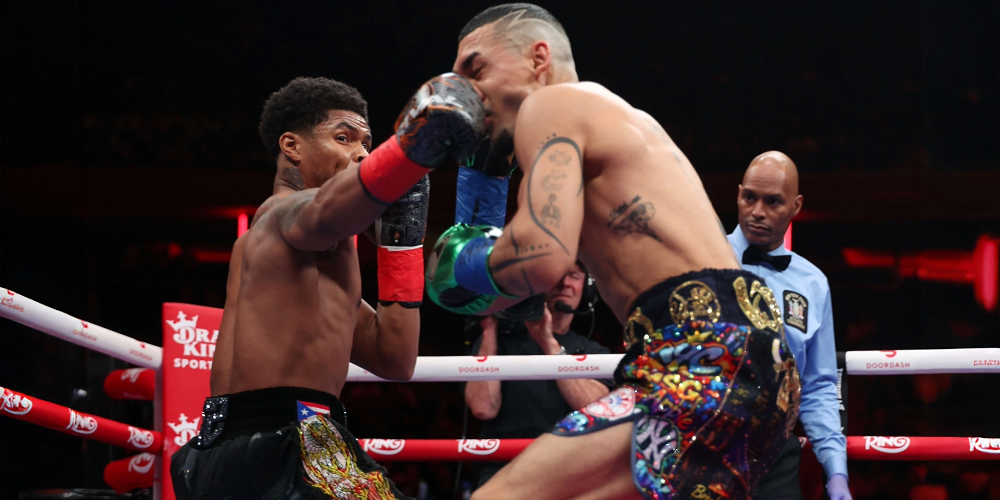
Shakur Stevenson makes it four. After becoming world champion at featherweight, super featherweight and lightweight, the American has now captured a world title at super lightweight as well, taking the WBO belt from Teofimo Lopez. He did so by literally giving his opponent a boxing lesson, controlling the fight from start to finish, as clearly reflected by the wide scorecards turned in by the judges, who all scored it 119–109 for the challenger. The main event of “The Ring VI”, staged at Madison Square Garden in New York, therefore held no surprises.
It took just one round to highlight the substantial difference in timing between the two fighters, an aspect that would prove crucial over the course of the entire bout. Lopez began the fight winging wide hooks and missing badly, while Stevenson had little trouble catching him on the inside with fast, precise straight punches thrown at exactly the right moment.
The reigning champion quickly realized that charging forward would expose him to severe punishment, so he attempted to adopt the role that suits him best—that of the counterpuncher—inviting Stevenson to come forward in the hope of landing meaningful shots on the counter.
The challenger, however, did not take the bait. He remained composed and calm, advancing in small steps, clearing a path with his right jab and firing his left hand only when he was certain there was no danger. In doing so, he began to build a significant lead on the scorecards, making his superiority unmistakable in the fourth round, when he felt sufficiently in control to successfully unleash the left uppercut to the body as well.
Lopez’s difficulty in finding the right adjustments became particularly evident at the start of the fifth round. The fighter of Honduran roots first rushed forward recklessly, eating a one-two flush to the face; then he switched stance, only to be punished again, immediately abandoning that option as well.
Watching the fight felt like witnessing a scientific debate between a university professor and a self-taught student. Particularly impressive was the sequence with which Stevenson opened the sixth round: five consecutive jabs to the face landed without Lopez managing to interrupt his monologue.
In the middle rounds, to be fair, there were a few more balanced frames. “The Takeover” occasionally found the target with his right hand to the body, and Shakur at times lowered the pace, settling into a calm, low-risk management of the fight.
The eighth round, however, was the only one in the entire contest that Lopez won clearly, thanks to a significantly higher work rate than his opponent. Otherwise, even in rounds where little of note happened and neither fighter established undeniable dominance, Stevenson’s greater composure and technical cleanliness stood out clearly, contrasted with Teofimo’s pure improvisation, which was often ineffective.
The challenger’s jab—a true elite-level weapon—was the main protagonist of the closing rounds. A seemingly simple punch, yet extraordinarily effective, it prevented the champion from getting started, constantly disrupting his timing, keeping him at bay and further breaking up his already fragmented attacks.
Lopez therefore failed to mount any meaningful late push even in the championship rounds, despite it being clear to everyone that his slim hopes of victory rested on a potential knockout, given the unbridgeable gap that had opened on the scorecards.
There is nothing to dispute about the judges’ work. With a bit of imagination and compassion, they might perhaps have awarded the loser one or two extra points, but in truth, aside from the eighth, it is impossible to identify a single round that Lopez won beyond doubt.
During the post-fight interviews, a bizarre scene unfolded, as British boxer Conor Benn—called out and provoked by Stevenson after the final bell—climbed into the ring and exchanged heated words with the winner. On this point, the author believes the incident cannot be better summed up than by the words chosen by American journalist Ryan Songalia on X:
“This is weird. Shakur Stevenson just beat Teofimo Lopez like nothing, and then he calls out Conor Benn. That’s like beating the Yankees, and then calling out the Colorado Rockies.”
If you enjoy our content and want to help us grow, give a like to our Facebook page: boxepunch