




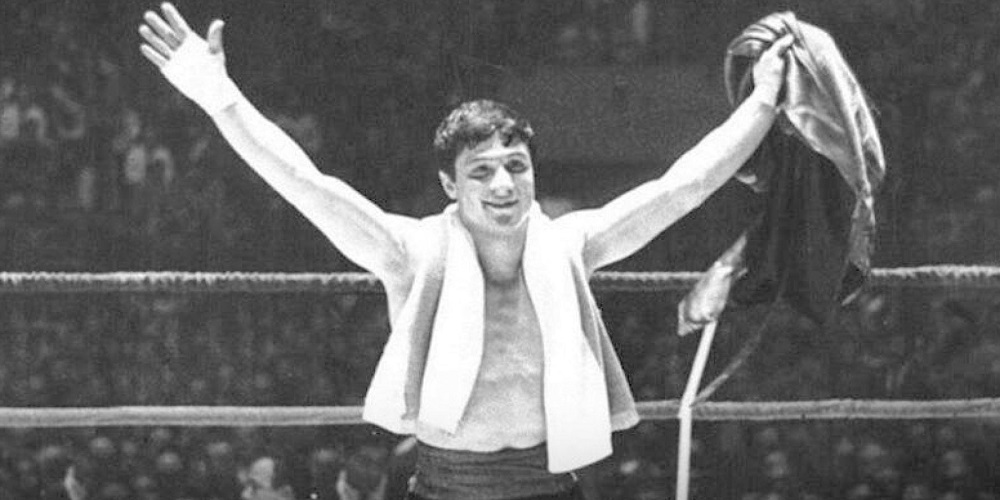
If there is one thing that stands out about Bruno Arcari, an extraordinary world champion of Italian boxing, it is the frankness of his words—free of rhetoric, artificial embellishment, or arrogance. Bruno always had his feet firmly on the ground, with a blunt, honest way of speaking, without frills. He was simply a phenomenal boxer, one of the greatest in our history—by many considered the greatest alongside Duilio Loi and Nino Benvenuti—yet he always let others celebrate him. Bruno focused on training properly, with head and heart, with rigor and sweat, because that was his nature and that was how he had been taught: “I have always seen boxing as a job to be done to the best of my ability, without distractions, always remembering what my first coach taught me: you may feel like the king of the world, but it only takes a tenth of a second to find yourself sitting on the canvas.”
He was—and remained throughout his life—reserved, shy, little inclined toward social life. So much so that time almost led him back into anonymity, despite everything he gave to the boxing history of our country.
Born in Atina, in Ciociaria, on January 1, 1942, but Genoese by adoption, Bruno moved with his family to the Ligurian capital during his first year of life, fleeing a land ravaged by war.
As a boy he started playing soccer. He was not particularly gifted technically, but he certainly had temperament: “I was fourteen and played left wing, but I was always arguing with everyone.” He was advised to take up boxing and, intrigued, decided to enter the Mameli Pejo gym in Genoa, where he was mocked by trainers Alfonso Speranza and Armando Causa because his legs were too big. They told him to come back the next day, to test his determination. Bruno returned the following day, unfazed by the treatment he had received—and from that moment on, he never left.
He immediately showed talent and the temperament of a true boxer: “In the gym there were several guys who were good, and one day I told the coach: I’ll beat all of these guys.” It was not arrogance, but absolute confidence in his abilities.
He grew enthusiastic, and the noble art became far more than a simple passion for him: “I was just a kid, maybe fifteen at most, and I worked as an errand boy in a fruit and vegetable shop in Nervi. I had some friends who were crazy about boxing: when Duilio Loi fought—and he often did in Milan—they’d take out the station wagon and go. ‘Bruno, are you coming?’ I often went along too: since I was the smallest, they’d squeeze me in the back, in the trunk. I dreamed of being Loi.”
He turned amateur and in 1962 won the Italian super lightweight title, confirming it again the following year. He then won the pre-Olympic tournament and went to the 1964 Tokyo Olympics as the leading athlete of the entire Italian boxing movement. In his opening bout, however, he was forced to retire—despite being comfortably in control—due to a head clash with Kenyan Alex Oundo.
His professional debut in 1964 was equally bitter. Once again a head clash stopped him, this time inflicted by Franco Colella, who granted no rematch and would later even print on his business card “Franco Colella, winner over Arcari,” as Giuliano Orlando later recalled.
Ten straight victories followed, propelling him toward a shot at the Italian title against Massimo Consolati. And once again, halting his rise in a bout he was leading, came a cut to the brow caused by a right hook from Consolati. Arcari went through a moment of discouragement, but his longtime manager Rocco Agostino and Rino Tommasi—among the first to believe in him—convinced him not to give up.
From that point on, no one would stop Arcari anymore: too much talent, too much belief, too much intelligence. Bruno learned to protect his eyebrows—his true weak spot—by improving his guard and refining his movement. Among the first to pay the price was Consolati himself, who granted Arcari a rematch and saw the Italian super lightweight title taken away from him after a disqualification for repeated fouls.
After defending the title three times, the bout against European champion Johann Orsolics of Austria arrived.
At Vienna’s Stadthalle, in a fiery and surreal atmosphere—with 15,000 Austrians shaking the arena and cheering their local idol—Arcari produced the first of his masterpieces. He conceded the opening rounds of study, then took control, silencing the crowd and winning by TKO, with Orsolics stopped by the referee due to the injuries sustained.
He defended the European title four times, always winning inside the distance.
Then, on January 31, 1970, finally came the chance to fight for the WBC world title, against Filipino Pedro Adigue, a boxer with an almost ferocious temperament, capable of any foul in the ring. It was a bout pushed to the limit in terms of brutality and violence. In the third round, a terrifying right hook to the jaw buckled Bruno’s legs, yet he held on. It was like an electric shock for Arcari, who began to fight back. The final three rounds remain legendary to this day: Arcari took command, even as Adigue refused to give an inch, until a left hook from the Italian staggered the Filipino. At the sound of the bell, the unanimous verdict: Arcari is world champion!
A natural southpaw with a solid technical arsenal, Arcari was quick on his feet and constantly on the move. He could hurt with both hands, but preferred the technical battle. Even so, he never backed down, not even in the most brutal of wars.
Bruno finally became famous. In Italy he reached unbelievable popularity, despite being the very archetype of the anti-diva, far from the spotlight and high society: “They called me from everywhere, but I only thought about work, about preparing well. As world champion, the best purses went to me: the longer I stayed on top, the more I earned. End of story.” This is Arcari, in all his blunt honesty.
In March 1971, in Rome, Bruno had to defend his world title against the challenge of João Henrique, a Brazilian boxer of crystal-clear talent. It was an evenly fought match that Bruno won on points. The verdict, however, was generous—as Arcari himself acknowledged.
About a year later, in June 1972, the two faced each other again. The fight was such an event that it captured the attention of 200 million television viewers worldwide. In Italy it achieved an 87% audience share, shattering the previous record set by Italy–Germany 4–3. Henrique was confident of victory, which only further motivated Arcari. In the ring they produced a spectacular contest, but it was Arcari who accomplished yet another feat. In the final rounds, he struck with such ferocity that he broke João’s jaw. Henrique resisted bravely, but was eventually floored after Arcari caught him with a body shot. He got back up, but had nothing left, and Bruno was carried in triumph once again.
On September 2, 1974, after defending it nine times, he voluntarily relinquished the world title, just as he had done with the Italian and European titles. He could no longer make the weight and continued his career at welterweight. Many believed it might be possible to organize an incredible showdown with José Nápoles, but the Cuban champion demanded exorbitant sums; the suspicion that he never really wanted to face Arcari would remain forever unanswered.
Arcari’s welterweight career was short and certainly less significant, but it produced one final spark when a young and fast-rising boxer crossed his path: the Italo-Australian Rocky Mattioli. It was Arcari’s swan song. He controlled the first part of the fight thanks to superior speed and technique, then resisted valiantly against the vigorous assault of Mattioli—younger and heavier—in the second half. The verdict was a draw.
Two years later, in 1978, Bruno Arcari retired to private life, bringing the curtain down on an incredible career as an absolute dominator. Today he lives in Deiva Marina, on the eastern Ligurian Riviera, leading a secluded life far from the spotlight and from that world to which he gave unforgettable pages. Sadly, he suffers from a degenerative illness, for which he receives the lifetime allowance provided by the Giulio Onesti law, reserved for distinguished former Italian athletes in conditions of particular need; a long-awaited contribution that was finally granted four years ago, at the conclusion of the evaluation process carried out by the special Commission established within the Department for Sport of the Presidency of the Council of Ministers.